
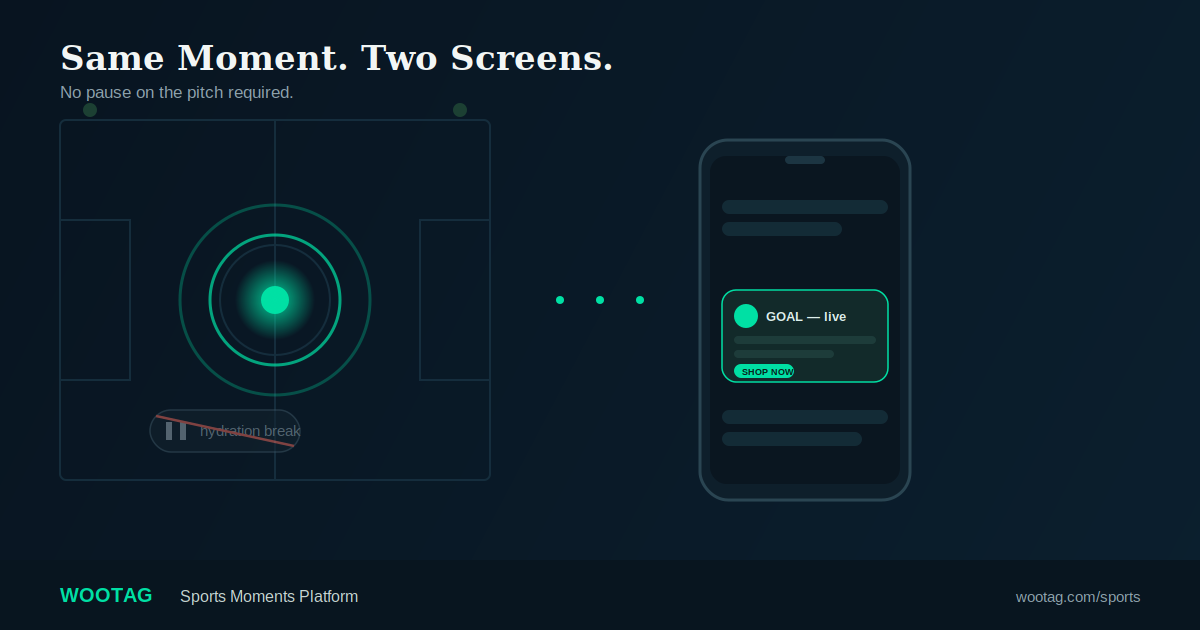

On June 16, a three-minute hydration break flashed up on the big screen at Gillette Stadium during Norway vs Iraq at the 2026 FIFA World Cup. The temperature was a mild 23°C. The crowd booed anyway. It wasn’t the heat they were reacting to — it was the sense that the pause on the pitch was really a pause built for advertisers, with a BBC estimate putting the US ad value of those breaks at more than US$250 million in the American market alone.
That moment — reported in a recent Straits Times primer on sport commercialisation — is a useful place to start, because it captures the exact tension that brands, rights holders and fans are all wrestling with right now: how do you monetise sport without altering the sport itself?
We think there’s a better answer than hydration breaks, 12-day tennis tournaments, or dynamic ticket pricing. It’s to stop trying to insert commerce into the moment, and instead build a parallel experience around it — which is exactly what Wootag’s Sports Moments Platform is designed to do.
The commercialisation trap
The numbers behind sport’s commercial boom are genuinely staggering. Global sports market revenue was valued at US$417 billion in 2025 and is projected to reach US$602 billion by 2030, according to Kearney. Global sports media rights alone are set to exceed US$67 billion in 2026, and in 2024 the NBA signed an 11-year, US$76 billion media deal spanning Disney, NBC and Amazon Prime Video that also covers the WNBA.
None of that is a problem on its own. As Philip Phua of the National Institute of Education put it in the same Straits Times piece, commercialisation “itself is not inherently harmful; it has financed many of sport’s successes.” The issue the article surfaces isn’t that money is flowing into sport — it’s where the money is trying to sit. Too often, it’s trying to sit inside the 90 minutes, the three sets, the final lap — and that’s where things start to strain:
- The product gets stretched. The 2026 World Cup expanded from 32 to 48 teams, pushing match count from 64 to 104 — and FIFA president Gianni Infantino has already floated 64 teams for 2030. WTA players are contractually obliged to compete in all four Grand Slams plus 10 WTA 1000 and six WTA 500 events, with fines for skipping them. World No. 1 Aryna Sabalenka called the resulting calendar “insane.”
- The price of watching goes up. Group-stage World Cup tickets were priced at up to US$575 in 2026, more than double 2022’s top group-stage price of US$220 — and FIFA’s dynamic pricing model pushed first-round resale tickets past US$1,000.
- The game itself gets edited. Mandatory hydration breaks, expanded formats, and shifting kick-off times are all, in part, downstream of media and sponsorship economics rather than the needs of the sport.
Every one of these levers raises real revenue. They also chip away at the thing that made the audience show up in the first place — the uninterrupted, unscripted drama of live competition. It’s a trade-off that shows up again in the article’s discussion of the failed European Super League proposal and growing concern about “sportswashing” — both examples of commercial or political interests reshaping the sport rather than sitting alongside it.
Fans have already built the parallel screen — brands just haven’t met them there
Here’s the part of the picture the commercialisation debate tends to underweight: fans have already solved this problem for themselves, on their own terms.
Industry research from Teads and Censuswide finds that roughly 60% of sports fans use a second screen while watching a match, moving between the TV, social feeds and shopping — and are more likely to recall and purchase from a brand that shows up across those screens. Deloitte’s Sport Fan Insights survey puts the figure even higher among Gen Z and Millennial fans, with 77% multitasking during games while actively seeking data, interaction and control rather than passive viewing.
In other words, the audience already has a second, ungated channel running in parallel with the live broadcast — one that doesn’t require FIFA to add a hydration break, the WTA to add a tournament, or a broadcaster to raise ticket prices. It just requires someone to meet the moment on that second screen, the instant it happens.
That’s the gap Wootag’s Moments Platform is built to close. Rather than editing the live event to create a commercial window, Wootag’s Listen → Contextualize → Adapt → Activate framework listens to the real signals of the game itself — a wicket, a goal, a match point, a final-lap overtake — and fires a brand experience on the channels fans are already holding in their hands, within milliseconds of the moment happening on the pitch, court or track.
- Listen: Wootag ingests live data feeds across cricket, football, tennis, Formula 1, the NBA and the NFL, watching for the specific triggers that matter in each sport — wickets and centuries, goals and penalties, match points, overtakes.
- Contextualize: each signal is mapped to brand-safe creative and offers tuned to the emotional register of that instant — celebration, tension, relief — without ever touching the broadcast feed itself.
- Adapt: the same moment is reshaped automatically for whatever format it needs to land in — a social clip, a CTV overlay, a shoppable tile, a display banner.
- Activate: the experience fires across social, OTT/CTV, display and retail screens in real time, so the brand moment and the game moment happen together, not instead of each other.
None of that requires the referee to blow a whistle for anyone but the players.
Same emotional peak, two very different ways to monetise it
| Moment in the game | Commercialisation approach seen in the article | Wootag’s parallel-track approach |
|---|---|---|
| Peak physical demand (heat, fatigue) | Mandatory in-play hydration break, built partly for ad inventory | Signal-triggered creative on second-screen channels — no pause in play |
| Growing tournament/fixture list | More matches, longer events, more mandatory appearances | More moments monetised per existing match — no extra matches required |
| Rising ticket and subscription costs | Dynamic pricing, premium DTC bundles | Reach engaged fans on channels they already use for free — social, feeds, apps |
| Fan attention during the match | Competing for eyeballs against Netflix, TikTok, other broadcasters | Meeting fans exactly where they’re already second-screening, in the moment |
The pattern across the article’s examples is that commercial upside has mostly been captured by touching the live product — the match, the calendar, the price tag. Wootag’s case studies point to a different lever entirely. In one campaign, UltraTech Cement activated real-time shoppable overlays tied to IPL boundaries, wickets and powerplay milestones, delivering a reported 3.2x engagement lift, a 42% increase in brand recall, and 12M+ real-time impressions — without a single second of play being altered.
Why this matters beyond the numbers
The Straits Times piece raises a subtler worry too: that heavy commercialisation risks making sporting culture “hollow” — where the spectacle around the game crowds out the game, and international brand noise drowns out local clubs, local athletes, local fans. Phua’s proposed fix in a Singapore context — using a marquee event as an “attention funnel” that converts interest into support for the smaller, local team sharing the pitch — is instructive for brands too. The goal isn’t to extract more attention from the sport; it’s to add value alongside it without diminishing what made people tune in.
That’s also why transparency matters in how we talk about this. The engagement figures cited from Wootag’s own case studies (UltraTech’s 3.2x lift, 42% recall increase, 12M+ impressions) come from client campaign results on Wootag’s platform, distinct from the third-party industry research cited above (Kearney, Deloitte, Teads/Censuswide, BBC). We think brands deserve to know which numbers come from audited external research and which come from platform performance data — both matter, but they answer different questions.
The takeaway
Commercialisation isn’t the enemy of sport — the article makes that case well, and we agree with it. The problem is a monetisation model that too often has only one lever available: change the game to make room for the money. Wootag’s Sports Moments Platform is built on the premise that there’s a second lever — one that meets fans on the screen they’re already holding, at the exact instant the moment they came to watch actually happens, without a single hydration break required.
If you’re a brand, rights holder or sponsor trying to grow revenue without becoming part of the next “has commercialisation gone too far” headline, it’s worth seeing what that looks like in practice. Explore Wootag’s Sports Moments Platform →
Sources: The Straits Times, “Has commercialisation done more harm than good for sport?” (July 20, 2026); Kearney; Deloitte Sport Fan Insights; Teads/Censuswide research via Broadcast; BBC; Wootag internal campaign data.
