

A conversation with a marketeer this monsoon season surfaced a problem that’s uncomfortably familiar to anyone who has planned a seasonal campaign in India: the season itself never shows up on schedule.
Her brand had built a monsoon activation months in advance — creative signed off, media booked, offers mapped to “the rains.” But when the monsoon actually arrived, it didn’t arrive the way the campaign brief assumed it would. The showers were intermittent — a heavy burst one afternoon in Bandra, nothing for four days, then a downpour in Andheri while Colaba stayed dry. Rather than fire a campaign built for a monsoon that wasn’t behaving like the brief, the team held onto the activation. Budget sat unspent. A live moment came and went, unclaimed.
This isn’t a one-off story. It’s the shape of monsoon marketing across India right now.
The monsoon stopped being a season. It became a signal.
The data backs up what felt, anecdotally, like an unusually erratic few years of weather. India’s climate is producing sharper, less predictable swings — rain-related disasters have now overtaken lightning as the country’s deadliest weather hazard, a sign that volatility itself, not just heat, is the story. On the ground, this has real commercial consequences: this year, India’s meteorological authority downgraded its southwest monsoon forecast to roughly 90% of the long-period average, putting the odds of below-normal or deficient rainfall at over 80%. Brands planning around “monsoon as usual” are planning around a season that increasingly refuses to be usual.
The industry’s own response has been telling. Outdoor and digital media planners now openly describe a shift toward monsoon planning that’s more data-led, format-sensitive, trigger-based, and safety-first — because the old model, a fixed campaign calendar with a fixed monsoon start date, keeps getting overtaken by the weather itself.
The marketeer we spoke to didn’t need convincing of this. She’d lived it. What she needed was a way to stop treating the monsoon as a date on a media plan and start treating it as a live signal her brand could respond to the moment it fired.
That’s exactly the gap Wootag’s Moments Platform is built to close.
Wootag doesn’t ask a brand to predict the monsoon. It asks the monsoon to tell the brand when to act. The platform ingests live weather feeds down to the postal code and treats every shift in the sky as a trigger, not a guess. On the Weather Moments page, monsoon onset is listed as a first-class signal alongside heatwaves, cold snaps and cyclone alerts — each one built to activate the moment it’s detected, not the week a media planner assumed it would.
Here’s what that would have meant for the campaign our marketeer held back:
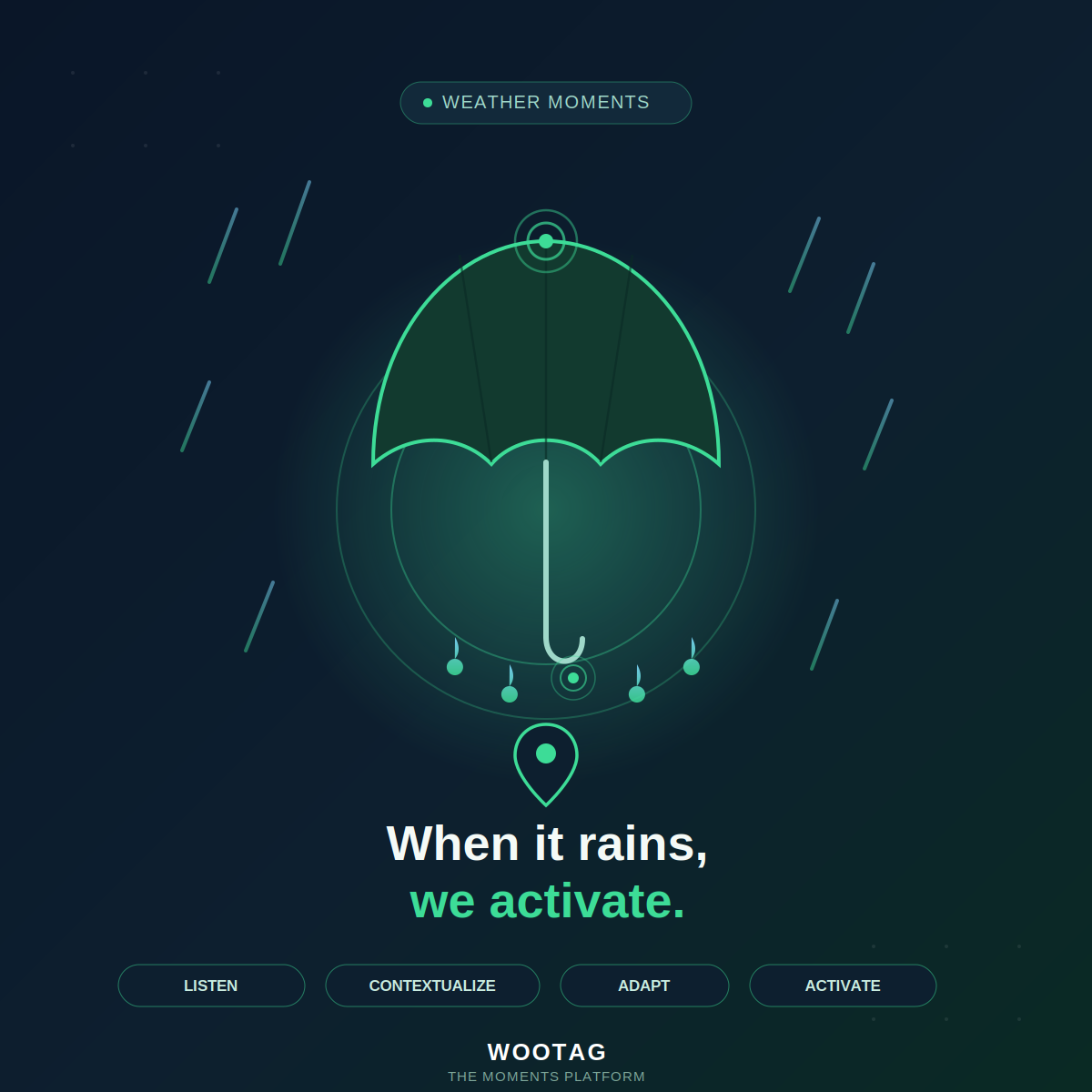
Listen → Contextualize → Adapt → Activate
01 · Listen Instead of a single monsoon-onset date baked into a media plan, Wootag’s Moments Platform continuously ingests hyperlocal weather feeds — the same “first drops land” signal that triggers monsoon onset creative — for every pin code her brand operates in. Bandra getting rain and Colaba staying dry isn’t a planning headache anymore; it’s two separate, correctly-timed triggers.
02 · Contextualize The moment rain is detected in a given geography, Wootag’s engine maps that signal to the right creative and offer — umbrella and footwear messaging, a food-delivery nudge, a “stay dry, stay in” entertainment prompt — tailored to what that specific downpour, in that specific neighbourhood, actually means for the audience there.
03 · Adapt The same monsoon moment gets reshaped automatically for wherever the audience is — a social-feed creative for someone scrolling Instagram mid-shower, a CTV spot for someone who’s stayed in to watch something, a shoppable overlay for someone browsing on a rainy commute.
04 · Activate Creative fires within moments of the signal — not a week after the brief assumed the monsoon “should” have started, and not held back because the rain didn’t behave the way the campaign calendar expected.
The intermittent monsoon that made this marketeer sit on her activation is precisely the scenario this framework is designed for. Instead of one campaign timed to one assumed monsoon date, it’s dozens of micro-activations, each timed to the rain that’s actually falling, wherever it’s actually falling.
Why “automated” matters more than “real-time”
It’s tempting to focus on the speed — creative firing within seconds of a signal. But the more important word in this story is automated. The marketeer’s team didn’t fail because they lacked good creative or media budget. They failed because someone had to make a judgment call — is this a real onset or a false start? do we launch now or wait? — and that judgment call, made under uncertainty, defaulted to caution. The campaign sat in a drawer.
Removing that judgment call is the actual value. When the trigger condition is defined once — rainfall crossing a threshold in a given geography — the system doesn’t need a human to decide, in the moment, whether this shower “counts.” It just fires. The marketing team’s job shifts from predicting the monsoon to defining what a monsoon moment should trigger, once, well in advance. It’s a small distinction with a large practical effect: it turns a weather forecast from something a brand hedges against into something a brand doesn’t need to think about in real time at all.
This mirrors what’s happening across the wider industry. Brands are increasingly plugging weather APIs directly into ad platforms, running social ads only when humidity and rainfall cross a set threshold in a given city, rather than scheduling a campaign against a calendar date. The direction of travel is the same one Wootag’s platform is built around: fewer guesses, more triggers.
Utility and empathy, not opportunism
It’s worth naming something the marketeer raised herself: a rain-triggered ad can tip into feeling opportunistic if it’s not handled carefully. Nobody wants their commute-flooding, waist-deep-water moment turned into a cynical sales pitch. The better monsoon activations lean into utility and empathy instead — an umbrella offer that actually helps someone who got caught out, a food-delivery nudge for someone who doesn’t want to go back outside, rather than a brand simply capitalising on discomfort. That’s a creative and tonal choice a brand makes deliberately — Wootag’s platform handles the timing and targeting, but the empathy in the message is still the brand’s job to get right.
A quick comparison: planned vs. moment-triggered monsoon activation
| Traditional monsoon campaign | Moments-triggered activation | |
|---|---|---|
| Trigger | Fixed calendar date, assumed onset | Live rainfall signal, per pin code |
| Response to intermittent rain | Held back or run off-timing | Fires only where and when rain actually lands |
| Decision-making | Manual judgment call under uncertainty | Automated, defined once in advance |
| Geographic precision | City- or region-wide | Hyperlocal, down to the postal code |
| Creative | Single “Hello Monsoon” asset | Adapted per channel — social, CTV, shoppable, feed |
| Risk of wasted spend | High — budget can sit unused | Low — spend follows the signal |
The caveat, honestly stated
To be transparent: the specific campaign described here — Bandra vs. Colaba rainfall, the held-back activation — reflects a real conversation, but the brand and creative details have been generalised rather than attributed. This piece illustrates how Wootag’s monsoon-onset trigger would apply to that kind of scenario; it isn’t a confirmed case study of a named client campaign. If you’re evaluating this for your own monsoon plan, the Weather Moments page is the place to see the actual trigger categories and activation types Wootag supports today.
The rain doesn’t wait for a media plan
The uncomfortable truth in this marketeer’s story is that the campaign wasn’t wrong — the assumption that monsoon behaves on a schedule was. Every year, more data suggests that assumption is getting shakier, not sturdier. Brands that keep planning around “when the monsoon starts” will keep sitting on activations while the rain does something else. Brands that plan around “when it actually rains, wherever it actually rains” don’t have to make that call at all.
That’s the shift from a marketing calendar to a moments platform — from guessing the season to listening for it.
