
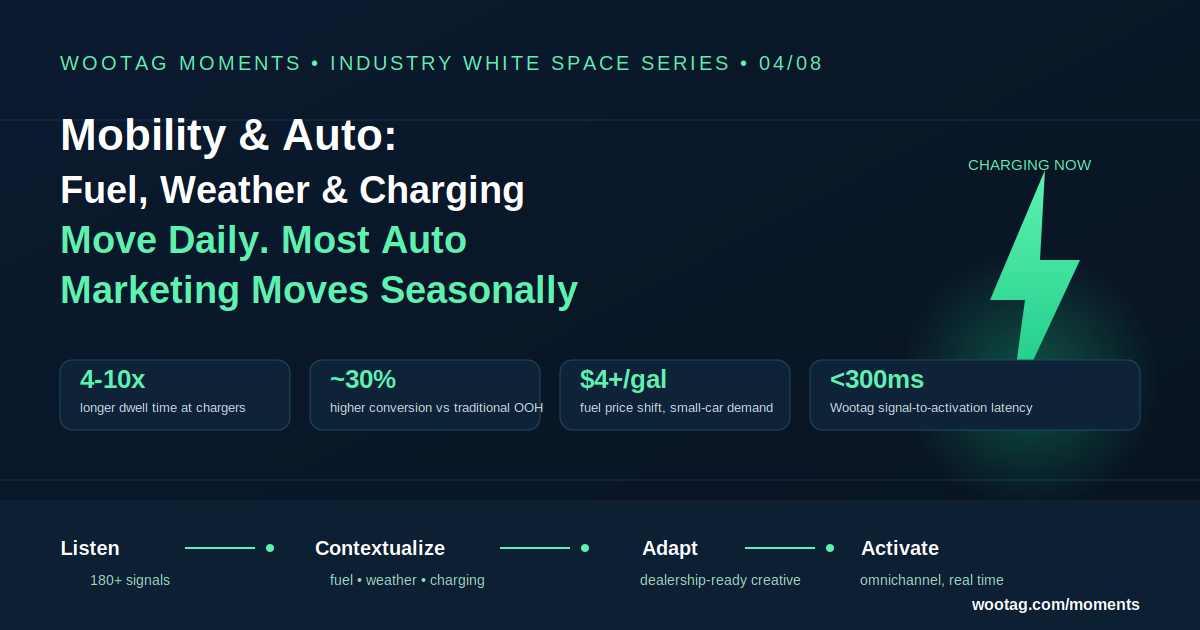

Car buying looks like a slow, considered decision from the outside — weeks of research, a handful of dealership visits, a purchase that happens once every few years. But the signals that shape which vehicle a household leans toward, and when they finally act, move far faster than that: a fuel price spike, a cold snap, a charging-station queue, a monsoon warning. Auto and mobility marketing, by contrast, is still largely bought the way it was for the last twenty years — seasonal launch campaigns, quarterly incentive pushes, and dealership promotions locked to a fixed calendar. The category’s own data shows how responsive real buying behaviour actually is to daily signals. The marketing built to meet it mostly isn’t.
The gap: fuel, weather and charging signals move demand fast — and specifically
Start with fuel price volatility, because its effect on vehicle preference is now well documented and fast-acting. Recent oil price surges above $100 a barrel, with pump prices moving above $4 a gallon in many U.S. markets, have already triggered a measurable near-term shift in demand away from full-size trucks and large SUVs toward smaller, more fuel-efficient vehicles, hybrids and EVs. Multiple industry analyses point to the same pattern: consumer demand for vehicles above a certain fuel-economy threshold drops sharply once local gas prices cross a specific psychological line, and interest in hybrids and EVs rises in near-direct correlation with perceived fuel-price instability. This is a signal dealerships and OEMs can see coming — fuel futures and pump-price trends are public — yet inventory promotion and creative messaging are rarely re-weighted toward the right vehicle segment in the days the shift is actually happening.
Weather tells a similarly granular story, and the industry already has a working example of what “listening” to it well looks like. Subaru partnered with The Weather Company to build a Driving Difficulty Index — a real-time tool combining weather data with road conditions to warn drivers of hazardous commutes — reinforcing the brand’s safety positioning at exactly the moment it was most relevant to a driver’s mindset. That’s a strong proof point for reactive, safety-first messaging. What’s less common is extending that same weather-reactive logic to the buying and service side of the funnel: nudging a test-drive offer for an AWD or safety-featured model the week local snow or storm warnings spike, or prompting a battery or tire check the moment a cold snap is forecast.
Then there’s the newest and fastest-growing signal in the category: charging behaviour. EV charging sessions create a genuinely unusual advertising moment — drivers dwelling 20–40 minutes at a charger compared with just 3–5 minutes at a traditional fuel stop, four to ten times the exposure window of a typical fuel-station visit. Early case data on content served during charging wait times has shown close to 30% higher conversion than traditional outdoor advertising in the same format. And EV buyers themselves are telling researchers exactly what they’re anxious about in that window — maintenance cost concerns cited by 46% of researchers, charging concerns by 42%, and driving-quality questions by 31%, according to Weather Company research among EV-interested audiences. That’s a remarkably precise brief for what a brand should be saying to someone standing at a charger right now — and most of the inventory in that moment is still generic OOH, not signal-matched creative.
Why fuel price signals need a sharper kind of real-time
Fuel deserves one more look on its own, because it behaves differently from most of the other signals in this series — and that difference has real implications for how “real-time” a platform actually needs to be to use it well.
Most days, fuel prices don’t move dramatically. They crawl by fractions of a cent, sometimes updated more than once a day at the pump. But the behavioural research on fuel pricing shows this signal isn’t linear — what matters isn’t the cumulative drift, it’s the exact moment a price crosses a specific psychological line. The $4-a-gallon mark is the clearest documented example: as one marketing professor studying the phenomenon put it, nobody reacts to “gas prices just broke $3.96” the way they react to gas breaking $4.00 exactly, even though the two numbers are four cents apart. On one recent date, AAA had the U.S. national average sitting at $3.943 a gallon — under six cents from that threshold — and the accompanying reporting was explicit that the threshold itself, not the approach to it, is what “drivers feel immediately.” Separate AAA research backs this up directly: 59% of Americans say they’d change their driving habits once gas hits $4 a gallon, rising to 75% at $5, and fuel retailers report a measurable jump in savings-app downloads and deal-seeking behaviour specifically once prices cross that line.
That’s the structural challenge for any platform trying to use fuel price as a marketing signal: the input needs to be tracked with far more precision than the output behaviour suggests. A system that checks fuel prices once a day, or that treats fuel the way it treats a broad weather band (“hot” vs. “cold”), will systematically miss the exact hour a regional average ticks from $3.99 to $4.00 — which is precisely the hour deal-seeking behaviour, brand switching and promotional responsiveness spike. Because the meaningful moment isn’t a gradual slope but a hairline crossing, a marginal, decimal-point price change can have a maximum, threshold-triggered behavioural impact — and a platform that only samples fuel data periodically will consistently be a step behind the exact window when that impact is happening.
This is where continuous signal ingestion and sub-300ms signal-to-activation latency stop being a spec sheet number and start being the actual difference between catching the moment and missing it. A moments platform built to handle fuel pricing well needs to monitor price feeds essentially continuously, and be able to fire dealership, DOOH and media activation the instant a defined threshold — a national or regional $4 mark, or a brand-specific equivalent — is crossed, rather than waiting for the next scheduled campaign refresh or daily data pull. Because so much of the behavioural response clusters right at the threshold rather than building up gradually beforehand, a same-day or next-day reaction has usually already missed the concentrated spike in attention and switching behaviour that made the signal valuable in the first place.
Why the white space persists
- Vehicle purchase cycles are long, so marketing defaults to always-on brand building rather than moment response. Because no single household buys often, most auto marketing optimizes for broad awareness across a multi-year consideration window, leaving little organizational muscle for reacting to a signal that might matter for only a week.
- Fuel, weather and charging data sit with completely different vendors than media buying. Fuel price feeds, weather APIs and charging-network telemetry are rarely connected to the DSP, social ad account or DOOH network actually running the campaign, so a real-time shift in one rarely reaches creative in the other.
- Dealership-level execution adds a local layer of friction. Even when an OEM spots a national fuel-price or weather trend, thousands of individual dealerships, each with their own local media budget and creative approval process, make same-week, hyperlocal activation operationally difficult without shared automation.
Why the layer needs to be independent of any one channel
Most of the tools that already exist to catch real-world signals — weather-ad networks, retail media platforms, DSP-side contextual targeting — are built inside a single channel. A weather-triggered DOOH vendor can only activate DOOH. A retail media network’s real-time bidding logic only fires inside that retailer’s own inventory. A DSP’s contextual layer only reaches programmatic display. Each one is genuinely useful, and each one is also a silo: the same fuel-price spike, the same storm warning, the same charging-network signal has to be re-detected, re-briefed and re-created separately for every channel team that wants to react to it.
This is the structural reason most real-time campaigns stay confined to the channel they were built for. A campaign designed around broadcast, a single retail media network, or a single DSP’s contextual layer has no natural mechanism to also re-trigger a brand’s other programmatic buys, social feeds and retail media placements the moment the same signal recurs somewhere else. Each of those channels sits with a different team, a different vendor and a different creative pipeline.
An independent moments platform solves this by sitting above the channel layer rather than inside it. Wootag listens to signals once, contextualizes them once, and then adapts and activates that single decision across every channel a brand already buys — social feeds, publisher content, programmatic and retail media, CTV/streaming, and shoppable/commerce surfaces — whether that media is owned (a brand’s own app, site or CRM) or paid (a DSP, a retail media network, a social platform’s ad stack). Because the detection and decisioning layer isn’t married to any one channel’s ad server, it doesn’t matter whether the next signal-triggered moment needs to land as a charging-station DOOH creative, a DV360 line item, a dealership’s local social post, or a push notification to a fleet customer — the same signal drives all of them from one place.
For auto and mobility marketing teams specifically, that channel-agnosticism is what turns a national OEM-level signal into a coordinated, dealership-level response: one fuel-price or weather threshold, detected once at the brand level, can adapt automatically into the right creative for national CTV, regional DOOH, and the individual dealership’s local social and DOOH inventory — without each dealership rebuilding the logic on its own.
Mapping the white space across mobility & auto
| Segment | Live signal white space today | What “moment-activated” looks like |
|---|---|---|
| ICE / traditional dealerships | Fuel price swings shift segment demand quickly, but inventory promotion rarely reprioritizes in step | Dynamic creative shifting emphasis toward fuel-efficient or hybrid inventory the moment local fuel prices cross a known threshold |
| EV & charging networks | Charging dwell time is a uniquely long, high-attention window that’s mostly filled with generic advertising | Signal-matched creative addressing live buyer concerns (range, cost-per-charge, maintenance) served during the actual charging session |
| Vehicle servicing & aftersales | Weather (cold snaps, storms, monsoon onset) predicts service needs (battery, tires, wipers) but reminders are usually calendar-based, not weather-triggered | Weather-triggered service reminders and booking nudges timed to the forecast, not a fixed six-month interval |
| Ride-hailing & mobility apps | Weather and live events (matches, concerts) drive demand and pricing surges that are handled algorithmically for supply, rarely for brand marketing | Brand and promotional messaging synced to the same live demand signals already driving the platform’s own surge logic |
| Fleet & commercial mobility | Fuel and commodity price signals affect fleet operating costs and buying timing, but B2B outreach is rarely triggered by them | Account-based outreach and offers triggered when fuel or maintenance-cost signals make a fleet upgrade conversation timely |
What’s ours, and what’s independently sourced
For transparency: the fuel-price and vehicle-preference figures (the shift toward smaller and fuel-efficient vehicles following the 2026 oil price surge above $100/barrel and gas prices above $4/gallon, the psychological fuel-price threshold effect), the $4-per-gallon behavioural tipping point research (the 59%/75% AAA driving-habit-change figures, the deal-seeking and savings-app behaviour at the threshold), the Subaru Driving Difficulty Index example, and the EV charging data (20–40 minute charging dwell time vs. 3–5 minutes at fuel stations, the near-30% conversion lift for charging-session content, and the 46%/42%/31% EV buyer concern figures) all come from independently published third-party sources — CBT News, Clean Fleet Report, AAA, Marketplace.org, Upside, The Weather Company and AdQuick/linkpowercharging industry research — not from Wootag’s own client campaigns. Wootag’s own platform specifications (180+ signal categories, 47 markets, sub-300ms signal-to-activation latency) are the company’s stated figures. Any mobility- or auto-specific Wootag pilot data will be labelled separately from this research as it becomes available.
Where this leaves auto and mobility marketers
The category has some of the clearest, fastest-moving demand signals of any industry in this series — fuel prices update by the hour, weather by the day, charging behaviour by the session. What’s missing isn’t proof that these signals matter; it’s a shared layer that can catch a national or regional signal and turn it into the right creative, at the right dealership, charging station or fleet account, before the window that made it relevant closes.
Ready to map your fuel, weather and charging signals to a coordinated, dealership-ready activation layer? Book a demo with Wootag to see how the Listen → Contextualize → Adapt → Activate framework applies to your specific vehicle and mobility portfolio.
