
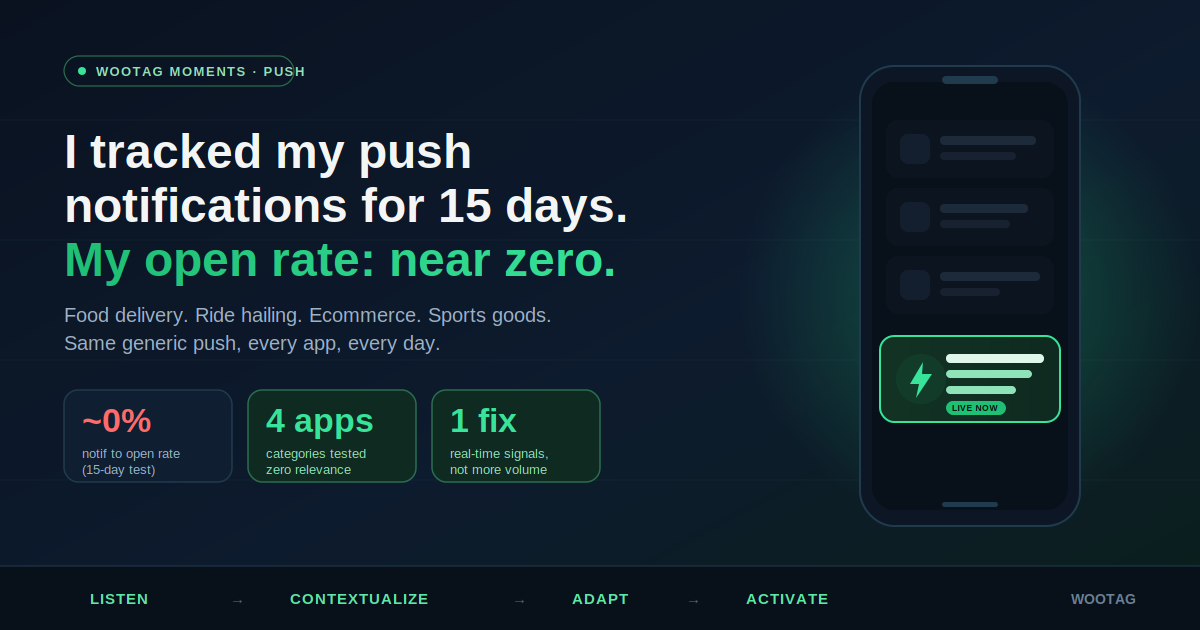

Fifteen days ago I started an experiment. Nothing scientific, just a habit shift: every time a push notification landed on my phone from a food delivery app, a ride hailing app, an ecommerce marketplace, or a sports goods app, I looked at it before I dismissed it. I wanted to know what these apps were actually trying to say to me, and whether any of it had anything to do with my life at the moment it arrived.
By day fifteen I had a number I wasn’t expecting. My notification to app open rate across all four categories sat close to zero percent. Not low. Close to zero.
That’s not a personal failing as a user. It’s a design failing on the other side of the screen.
What fifteen days of notifications actually looked like
A few examples, lightly paraphrased from memory because I didn’t screenshot everything:
The food delivery app pushed me a “hungry? order now” message at 7pm, every single day, regardless of whether it was raining outside, whether I’d just eaten, or whether it was a weekday or a weekend. Same tone, same offer structure, different day.
The ride hailing app sent me promo codes for routes I never take, at times I’m usually asleep. Not once in fifteen days did it acknowledge that a cricket match, a concert, or an office rush hour was about to dump a crowd of people onto the street looking for a ride.
The ecommerce marketplace sent me category recommendations that read like they were generated from my purchase history six months ago and never updated since. No sense of a heatwave, a payday, a festival, or anything happening in the world that might make one category more relevant than another on that particular day.
The sports goods app was the most telling. I follow football. There were three separate weekends in my test window where a major match ended in the final minutes, the kind of moment that spikes searches for jerseys and gear industry-wide. I got a generic “new arrivals” push the following Tuesday.
Four categories. Four different business models. One shared symptom: the notification had no idea what was happening around me when it fired.
Why an open rate near zero isn’t actually surprising, once you look at the data
I went and checked whether my experience was an outlier or the norm, and it turns out it’s closer to the norm than most Growth teams like to admit publicly. Industry platform data commonly places average push open rates around 4 percent, low enough that most marketers see it and assume something is broken, when in many cases it’s simply how the channel behaves. Other benchmark analyses put the range even lower for standard promotional push, describing app push notification open rates as sitting in the low single digits, with many reports showing engagement somewhere between 3 and 7 percent depending on industry and how an open is defined.
The gap becomes obvious once you separate notification types. One 2026 industry report tracking thousands of branded apps across retail, logistics, and financial services found that push notifications enriched with personalized, contextual recommendations reached open rates in the 70 to 80 percent range, well above the baseline for standard promotional pushes. The pattern holds across multiple sources: transactional messages, the kind tied to something the user is actually expecting or something actively happening around them, post open rates many multiples higher than generic promotional blasts, precisely because they carry information the recipient can act on immediately.
Read that gap carefully, because it’s the entire argument. It isn’t that push as a channel is dying. It’s that generic push is dying, while contextual, real-time push is doing the opposite. Growth and Retention teams keep measuring the channel, when the actual variable that’s failing is relevance.
Why this gap persists, even though every team knows about it
If the fix sounds obvious, that’s because it is. So why does almost every app in my test still default to batch and blast?
Three structural reasons, none of which are about lack of intent:
The signal doesn’t reach the campaign. A CDP or CEP knows a lot about a user’s history. It knows almost nothing about what’s happening in the world around that user right now, unless something is explicitly wired to feed it that information. Weather, live sporting outcomes, traffic conditions, air quality, commodity prices, none of these live inside a typical customer data stack by default.
Segmentation gets confused with context. Most teams have invested heavily in audience segmentation, who the user is, what they’ve bought, how they behave, and assume that’s enough to personalize a message. Segmentation answers “who.” It doesn’t answer “what’s happening right now that makes this message worth opening.” Those are two different questions, and only one of them is usually being asked.
Real-time infrastructure looks harder to build than it is. Teams assume that tying a notification to a live weather event or a live match result requires a new engineering roadmap, a new vendor relationship for every signal type, and months of integration work. That assumption is what keeps most Growth teams stuck on scheduled campaigns instead of triggered ones, even when they can see the open rate difference in their own benchmark data.
The channel doesn’t matter. The relevance does.
It’s worth being precise here, because this isn’t an argument specifically about push. Push happens to be the channel I tested, but the underlying problem, a message with no awareness of the moment it’s landing in, shows up identically in email, in-app banners, social ads, and CTV. Whatever channel a brand uses to reach someone, the same real-world signal, a storm rolling in, a match ending, a payday hitting, a commute turning into gridlock, should be able to shape the message. The channel is just the pipe. The signal is what makes the message worth a tap, regardless of which pipe it travels through.
That’s the argument for building a signal layer once and letting it feed every channel, rather than trying to bolt context onto each channel separately.
What moments-based notifications look like across the four categories I tested
Each of the four app categories I tracked has an obvious, industry-specific version of this fix. None of it requires reinventing the app. It requires the notification knowing something true about the world at the moment it fires.
| App category | Generic push (what I got) | Moments-based push (what should fire) | Signal that triggers it |
|---|---|---|---|
| Food delivery | “Hungry? Order now, 20% off.” Sent to everyone at 7pm daily. | “It’s pouring in your area, hot soup and comfort food, delivered in 25 minutes.” Comfort food carousel auto-curated for the weather. | Rain, temperature drop, heatwave |
| Ride hailing | Generic promo codes for routes I don’t take, at random hours. | “Game over, 4,000 fans heading out, grab your ride now.” Surge-aware ride options surfaced near the venue exit. | Match or event ending, stadium footfall, flight arrival |
| Ecommerce marketplace | Stale category recommendations unrelated to anything current. | “Air quality is unhealthy today, purifiers and masks, same-day delivery.” Air-care category pinned to the top of the feed. | Air quality index, weather, payday cycle |
| Sports goods | Generic “new arrivals” push, days after a major match ended. | A jersey or gear push firing within minutes of full time, tied to the specific match and team that just played. | Live match result, goal, buzzer-beater |
The pattern across every row is the same. The product listing inside the app changes along with the notification copy. It’s not just a smarter subject line, it’s the entire experience adapting to what’s true right now.
Why this matters beyond a single open rate metric
An open rate near zero isn’t just a vanity metric problem. It compounds. Every notification a user ignores makes the next one slightly more likely to be ignored too, and eventually it makes the user opt out of the channel entirely. Opt-in rates on Android have already fallen sharply following recent permission policy changes, and iOS opt-in rates remain considerably lower still, as users increasingly have to actively choose to keep receiving these messages. Every generic blast a brand sends is spending down a shrinking pool of attention that gets harder to win back once it’s gone.
Meanwhile, the same benchmark data shows that when a message is genuinely tied to something happening in a person’s life right now, whether that’s an order status, a weather event, or a live outcome, engagement climbs into a completely different range than the promotional baseline. That gap is not a nice-to-have. It’s the difference between a channel that compounds in value and one that decays.
For Growth and Retention teams, this reframes the KPI conversation. The goal isn’t “increase push volume” or “test more subject lines.” It’s closing the gap between what’s happening in the world and what the notification says, in real time, at the moment intent and emotion are highest.
The fix isn’t a new channel. It’s a signal layer underneath the one you already have
None of this requires replacing a CDP, a CRM, or a CEP. Wootag Moments plugs directly into the customer engagement platforms Growth and Retention teams already run, MoEngage and Braze today, with more on the way, and turns live real-world signals like weather, sports outcomes, air quality, traffic, and commodity prices into triggers for the campaigns already built. No engineering ticket, no rebuild of the notification stack, just a live signal layer sitting underneath the stack that’s already there.
For a category like sports goods, where a goal, a buzzer-beater, or a match point creates a window of intent that closes fast, that signal layer is the difference between a push that fires days after the moment has passed and one that fires while the crowd is still cheering. Wootag’s sports moments feed is built for exactly that kind of window.
Fifteen days of near-zero opens told me something every Growth team already suspects but rarely acts on: the problem was never the channel. It was that the message never knew what was happening around the person it was sent to. Fixing that isn’t a moonshot. It’s a signal layer, wired into the campaigns already running, activated in minutes.
Book a walkthrough and see what a contextual push looks like for your category.
