

A brand does not run out of signals. A stock index moves, a heatwave rolls in, a match hits its final over, a customer walks past a shelf and picks something up, then puts it back. All of it is data. Almost none of it gets acted on before the moment that made it valuable has already passed.
That gap, between a signal happening and a brand actually responding to it while it still matters, is what Signal Orchestration is built to close. It is worth being precise about what that term means, because it gets used loosely, and precision here is the whole point.
What Signal Orchestration Actually Means
Signal Orchestration is the discipline of listening to live signals from more than one source, deciding which ones are worth a response, and coordinating what a brand says, to whom, and at what moment, across whichever channel the audience is already in. It sits as a layer of infrastructure above the raw data and beneath the media, creative, and CRM systems most teams already run. It is not a dashboard that shows you a signal happened. It is the system that decides what to do about it and does it fast enough for the moment to still count.
Wootag Moments is built on exactly this layer, and the platform statement is simple on purpose: Wootag is a Signal Orchestration Platform that turns live signals into real-time brand moments.
The part worth sitting with is what comes next, because this is where most orchestration claims get vague and where this one does not need to.
Two Independent Capabilities, Not One Bundle
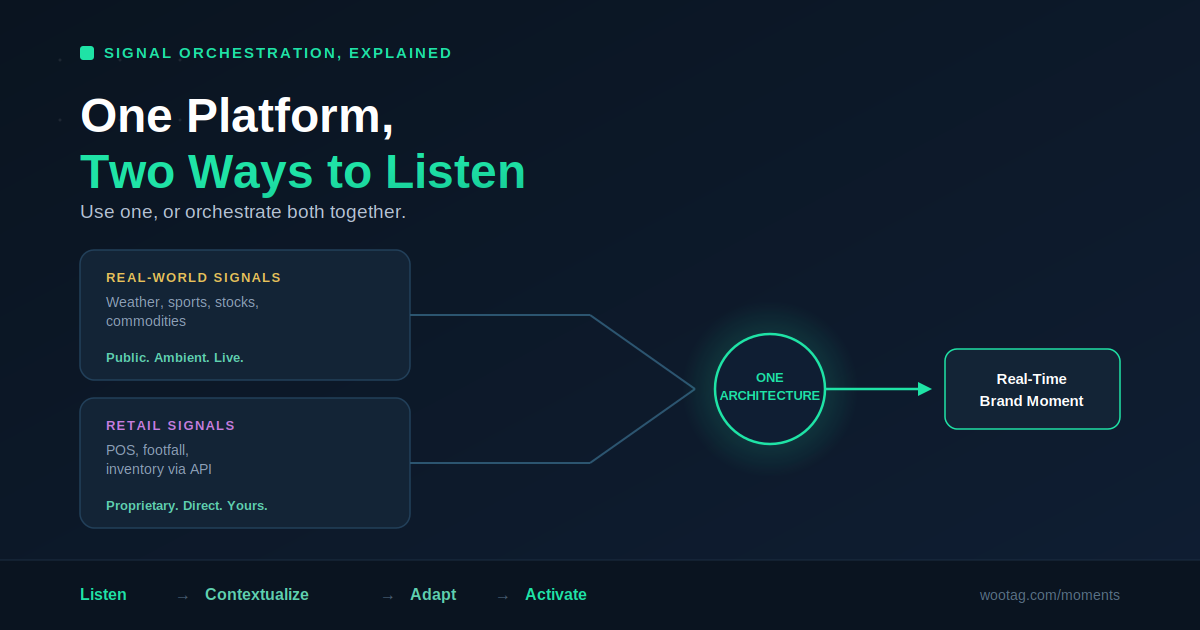
Wootag Moments listens to two distinct classes of signal, and each one stands on its own.
Real-world signals are ambient and public. Weather, live sports events, stock and commodity movements, and similar external triggers that anyone can observe but almost no one is built to react to at speed. A brand does not need a storefront, a loyalty program, or a point of sale system to use this capability. If your audience feels a market move or watches a match, that is enough.
Retail signals are proprietary and private. Point of sale data, footfall, and inventory levels, brought in through a direct integration with a brand’s own systems. This capability serves a brand with a physical or transactional footprint, where what happens inside a store or a transaction is the trigger worth acting on.
These two capabilities are not stacked on top of each other, and one is not a lesser version of the other. A brand that only wants to react to what is happening in the world gets a complete platform experience from real-world signals alone. A brand that only wants to react to what is happening inside its own stores gets the same completeness from retail signals alone. Neither one is half a product waiting for the other half to show up.
Same Sequence, Regardless of the Signal
What makes this one platform rather than two separate tools is that both capabilities run through the same underlying sequence.
Listen. The platform ingests the signal, whether that signal is a public feed like a weather change or a stock movement, or a proprietary feed like a footfall count coming in through an enterprise’s own API.
Contextualize. The signal is checked against brand rules, audience relevance, and offer logic, so a market rally is not treated the same way a slow week of foot traffic is, and neither is treated as automatically worth a response just because it happened.
Adapt. This is the decision point. What should the brand say, to whom, and in what tone, given this specific signal. Creative is one output of that decision, not the whole of it, and the decision looks different depending on whether the signal came from the open world or from inside a store.
Activate. The response goes live across whichever channel the audience is in, social, CTV, programmatic, or owned properties, in near real time.
The signal source changes. The sequence that turns it into a moment does not. That consistency is the actual architecture, and it is why this is fairly called one platform with two ways to listen, rather than two products sharing a name.
Use One, or Orchestrate Both Together
Most brands will start with whichever capability matches the shape of their business. A brand with no retail footprint has no reason to wait on a retail integration to get value from real-world signals. A brand whose growth depends on store visits has no reason to build a real-world signal strategy before they have addressed the data sitting inside their own four walls.
Both capabilities are also built to run on the same layer at once, for a brand that wants to listen to the world and its own stores simultaneously and let one system decide how the two should work together. That is a natural extension of the architecture rather than a separate offering, and it is worth stating plainly instead of dressing it up as a named package before it has earned one.
Why the Distinction Matters More Than It Looks
It would be easier to describe Wootag Moments as one flat capability and let brands figure out later which parts apply to them. That is not the honest version of the story, and it is not the useful one either. A brand evaluating a signal orchestration platform deserves to know upfront whether they need a store to benefit from it. They do not. Real-world signals stand alone. Retail signals stand alone. Together, they are the fuller expression of the same idea, listen broadly, decide fast, respond everywhere the audience already is.
That is the platform. Two ways to listen, one architecture underneath, and no requirement to use both to get the whole of either one.
To see how each capability applies to your category specifically, start at wootag.com/moments.
Signal Orchestration, Explained: One Platform, Two Ways to Listen
