
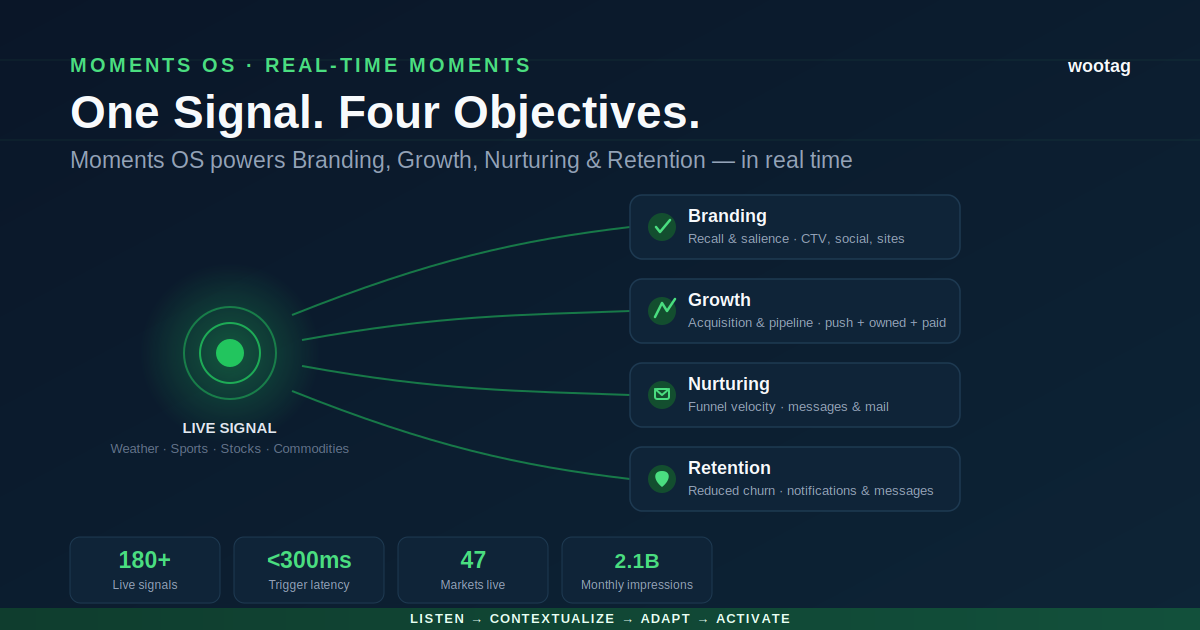

Every marketing org runs four different games at once. Branding wants attention and recall. Growth wants acquisition and pipeline. Nurturing wants a prospect to keep moving. Retention wants an existing customer to stay. Four objectives, four teams, four sets of KPIs — and in most stacks, four disconnected sets of tools that have no idea what’s happening in the real world at the moment they fire.
That’s the actual gap. Not a content gap. A timing and context gap. A brand awareness campaign and a churn-prevention message are built by different people, on different platforms, on different calendars — but they’re both trying to reach the same human being, and neither one knows that a heatwave, a payday cycle, a market swing, or a match result just changed what that human is thinking about.
This is where Moments OS earns its name. It isn’t a campaign tool bolted onto one funnel stage. It’s a real-time moments layer that sits underneath the tools each team already owns — the CDP, the CRM, the CEP, the ad stack — and feeds all of them the same live signal at the same instant, adapted to what each objective actually needs to do with it.
The gap: one customer, four disconnected systems
Here’s what actually happens inside most marketing orgs today:
- Branding runs a media plan built weeks in advance, locked to a creative calendar, largely blind to what’s happening the day the ad actually airs.
- Growth runs acquisition campaigns on a fixed budget curve, pushing the same offer to a cold audience regardless of what’s currently top of mind for them.
- Nurturing runs a drip sequence on a fixed cadence — day 1, day 3, day 7 — regardless of whether anything relevant to the prospect happened in between.
- Retention runs win-back and loyalty flows triggered by account behavior, but rarely by anything happening outside the account — weather, price movements, local events, seasonal cycles.
Each team is optimizing its own slice correctly. The problem is that none of them share a signal layer, so none of them can answer a simple question in real time: what is true about the world, right now, for this person?
Why the gap persists
It’s not for lack of trying. It persists because the infrastructure that would answer that question doesn’t naturally sit inside any single existing tool:
- A CDP unifies identity and history, but it isn’t built to ingest live external signals — weather, sports results, commodity prices, market volatility — at sub-second latency.
- A CEP (Braze, MoEngage, Iterable, CleverTap) is excellent at orchestrating messages once it knows what to send and when — but it needs an upstream trigger and contextual content, which it doesn’t generate itself.
- A DSP or ad platform can target an audience, but it can’t tell that audience’s creative to change because it started raining in their city an hour ago.
- A CRM holds the relationship, but has no live connection to the outside world driving that relationship’s next best action.
Each system is a channel. None of them is a signal layer. Building one from scratch, per team, per channel, is exactly the kind of duplicated infrastructure spend that never survives a budget review — which is why the gap between “the world just changed” and “our messaging reflects it” tends to stay open for years, not weeks.
The channel-independence argument
This is the core design decision behind Moments OS, and it’s worth stating plainly: the signal layer and the channel are separate concerns.
A live moment — a heatwave, a payday cycle, a market spike, a match point — doesn’t belong to email, or push, or social, or programmatic. It belongs to the customer’s current state of mind. Moments OS listens once, contextualizes once, and then adapts that single moment into whatever format and channel each objective already uses — social, sites, ads, CTV, and retail screens, or contextual push notifications and in-app messages through the CEP a team already runs. Nothing about the platform is tied to one channel, one vertical, or one region. That’s what lets the same underlying moment power a brand video on CTV, a growth ad on paid social, a nurture email, and a retention push — without four teams rebuilding the same contextual logic four separate times.
That’s the “OS” framing: Moments OS doesn’t replace the CDP, CRM, or CEP a team already has. It’s the layer beneath them that keeps all of them in sync with what’s actually happening in the world.
How each objective curates moments differently
The same signal categories — sports, weather, stocks, commodities, and 100+ others — feed all four objectives. What changes is which signals matter, how they’re curated, which channels carry them, and how success is measured.
Branding: earn attention at peak emotional relevance
Objective. Recall, salience, and association — get noticed and remembered at the moment attention and emotion are naturally highest, rather than interrupting an unrelated moment.
How moments are curated. Branding moments are curated around peak-emotion signal categories rather than peak-need ones: a wicket falling, a last-minute goal, a pole-position finish, a record-breaking heatwave, an all-time-high market move. The Listen → Contextualize → Adapt → Activate loop identifies the signal, maps it to brand-safe creative and tone, and adapts format for the channel it’s about to appear on — feed, story, banner, or CTV spot.
Channel mix. Predominantly high-reach, high-emotion channels: CTV and streaming, social feeds (Instagram, TikTok, YouTube Shorts, X, Snap), publisher and content sites, and programmatic display. Branding leans on channels people are already watching or scrolling, not channels they’ve opted into for direct messages.
How it’s measured. Recall and salience metrics rather than direct-response ones: brand recall lift, engagement rate against the moment, share of voice during the trigger window, sentiment shift, and view-through or completion rate on the adapted creative. Branding success is judged by whether the moment — not just the media buy — is what people remember.
Growth: convert attention into pipeline
Objective. New customer acquisition and top-of-funnel pipeline — turning a live signal into a reason for someone unfamiliar with the brand to take a first action.
How moments are curated. Growth curates around signals that create urgency or timeliness for a first purchase or sign-up decision: a payday cycle, a fuel price shift, a heatwave driving demand for a category, a market-volatility moment relevant to a fintech offer. The same Contextualize and Adapt steps generate the offer and creative, but tuned for a cold or unfamiliar audience rather than an existing one.
Channel mix. A mix of push notifications (where an app relationship already exists), owned channels (site, app), and paid channels — paid social, programmatic, search, and retail media — where the moment’s context is baked directly into the ad’s targeting and creative rather than added after the fact.
How it’s measured. Growth-strategy metrics rather than raw media metrics: cost per acquisition, conversion rate on moment-triggered offers versus generic offers, incremental customers acquired within the trigger window, and pipeline or demo volume for B2B contexts. The comparison that matters is always moment-triggered versus batch-and-blast performance for the same spend.
Nurturing: keep an existing lead or prospect moving
Objective. Move a known-but-not-yet-converted lead or prospect further down the funnel — without relying on a fixed drip cadence that ignores what’s currently relevant to them.
How moments are curated. Nurture moments are curated around signals that make a specific message more relevant right now than it would be on a generic schedule — a relevant market movement for a finance lead, a weather event affecting a travel prospect’s plans, a seasonal or local-event signal that gives a nurture email or message a real reason to land today instead of on day 7 of a fixed sequence.
Channel mix. A mix of messages and mail — email sequences and in-app or SMS messages — enriched with the live moment rather than replaced by it. Nurturing stays largely on owned, opted-in channels, since the goal is relationship-building with someone already in the funnel, not reach.
How it’s measured. Funnel-velocity and engagement metrics: open and click-through rate on moment-triggered versus scheduled nurture messages, time-to-next-stage, lead-to-opportunity conversion rate, and re-engagement rate among previously stalled leads. The key comparison is whether inserting a live moment shortens the nurture cycle compared to the fixed-cadence baseline.
Retention: give existing customers a reason to stay engaged
Objective. Keep an existing customer active, reduce churn risk, and extend lifetime value — often by reconnecting a relationship that’s gone quiet, rather than acquiring a new one.
How moments are curated. Retention moments are curated around signals tied to renewed relevance for someone who already has a relationship with the brand: a weather-driven need spike for a category they’ve bought before, a price or market movement affecting a financial product they hold, a local event or seasonal cycle that reintroduces a reason to re-engage. The push notification and CEP integration pattern — install the CEP app, map moments to existing retention campaigns, activate — is built specifically for this: it plugs into MoEngage, Braze, and similar platforms without a new campaign build.
Channel mix. A mix of notifications and messages — push, in-app, and direct messaging — carried through the CEP a retention team already runs, with contextual copy and product listings replacing generic reminders.
How it’s measured. Retention-specific metrics: churn rate within the moment-triggered cohort versus control, reactivation rate among dormant users, repeat-purchase or repeat-usage rate, and customer lifetime value delta for users receiving moment-based versus generic retention messaging.
Mapping table: one framework, four objectives
| Branding | Growth | Nurturing | Retention | |
|---|---|---|---|---|
| Core objective | Recall & salience | Acquisition & pipeline | Funnel velocity | Reduced churn, extended LTV |
| Signal focus | Peak-emotion moments (sports, milestones, records) | Urgency/timeliness moments (payday, price shifts, demand spikes) | Relevance moments (market, weather, seasonal, local) | Renewed-relevance moments (category need spikes, price/market shifts) |
| Primary channel mix | Social, CTV/streaming, content sites, programmatic display | Push + owned channels + paid social/programmatic | Messages & mail (email, SMS, in-app) | Notifications & messages via CEP (push, in-app) |
| Moments OS role | Listen + Contextualize brand-safe creative for high-reach channels | Contextualize + Adapt offers for cold-audience conversion | Contextualize relevance signal into existing nurture cadence | Trigger existing CEP campaigns the instant a moment goes true |
| Primary KPIs | Brand recall lift, sentiment, share of voice, view-through rate | CAC, moment-triggered conversion rate, incremental customers, pipeline/demo volume | Open/click-through vs. scheduled baseline, time-to-next-stage, lead-to-opportunity rate | Churn rate vs. control, reactivation rate, repeat-usage rate, LTV delta |
Read across the table and the pattern behind Moments OS becomes clear: the signal categories and the underlying platform stay constant — 180+ live feeds, sub-300ms trigger latency, one orchestration layer — while the curation logic, channel mix, and measurement model change based on which objective is asking.
Sourcing note
Platform specifications referenced above — 180+ live signal feeds, sub-300ms trigger latency, 47 live markets, 2.1B monthly impressions, and the push-notification/CEP integration pattern with MoEngage and Braze — are drawn directly from wootag.com/moments and wootag.com/moments/push-notifications.
The broader case for real-time, contextual engagement over generic scheduled messaging is supported by third-party research, kept separate from Wootag’s own figures: McKinsey research indicates personalization can reduce customer acquisition costs by as much as 50 percent, lift revenues by 5 to 15 percent, and increase marketing ROI by 10 to 30 percent. McKinsey’s survey work also finds that only about 15 percent of CMOs believe their organization is on the right track with personalization — a gap consistent with the siloed, channel-by-channel tooling described above. These figures describe the personalization category broadly and are not Wootag-specific outcomes; they’re included here only to frame why a shared, real-time signal layer addresses a documented industry gap, not as claims about Moments OS performance.
The takeaway
Branding, Growth, Nurturing, and Retention will always be separate objectives, run by separate teams, judged on separate KPIs. They don’t need to be run on separate signal infrastructure. Moments OS gives every team the same real-time moments feed and lets each one curate, channel, and measure it against what actually matters to their objective — so a heatwave, a payday, a match point, or a market swing becomes a branding moment, a growth moment, a nurture moment, and a retention moment, all from the same signal, all at once.
