
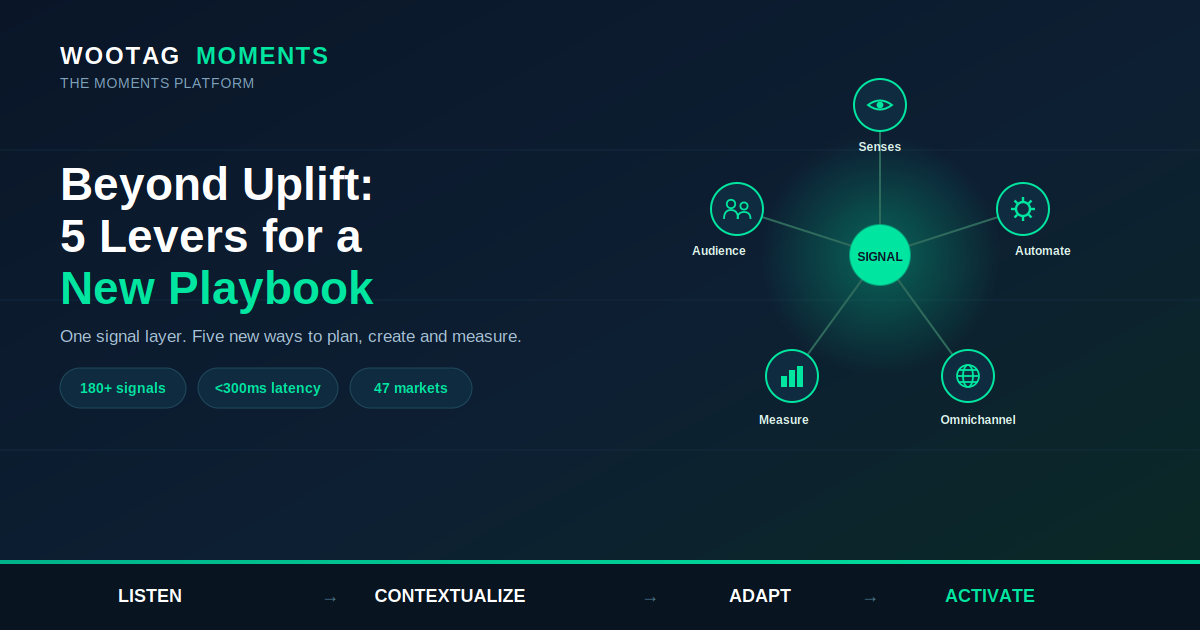

Every Moments case study opens with a number. Engagement lift. Recall lift. Incremental reach. Those numbers matter — they’re what get a pilot funded. But if a growth or marketing leader reads Moments as “a way to get better uplift on the campaigns I’m already running,” they’ve missed the bigger shift sitting underneath it.
Uplift is what happens inside a channel when you get the timing right. The real change Moments introduces is outside any single channel — it hands growth and marketing teams five new levers that don’t exist in the standard channel-by-channel playbook at all. None of these levers are about spending more on media. They’re about changing what a “campaign” is built from in the first place.
Here’s what that looks like in practice.
The old playbook treats channels as five separate businesses
Most marketing stacks are organized by channel, not by moment. Social has its own calendar, its own creative team, its own KPIs. Programmatic has its own DSP logic. CTV runs on a production cycle measured in weeks. Email and push run on send schedules. Each one optimizes locally — for its own CTR, its own completion rate, its own open rate — with almost no shared understanding of why now is the right time to say anything at all.
Wootag’s Moments Platform starts from a different premise: the trigger for brand activation shouldn’t live inside any one channel’s calendar. It should live in the real world — a wicket falling, a heatwave breaking, a currency move, a payday — and every channel should simply be a place that trigger is allowed to reach. Wootag’s own numbers give a sense of the surface area this opens up: the platform ingests 180+ live signal feeds across sports, weather, stocks and commodities, operates in 47 markets, and fires creative in under 300 milliseconds of a signal landing — all figures Wootag reports about its own platform, not third-party research.
That’s the infrastructure. The five levers below are what growth and marketing teams actually get to do with it.
Lever 1: One signal, every human sense
The standard playbook still largely assumes attention arrives through one channel at a time — you read a banner, you watch a pre-roll, you scroll a feed. But a real-world moment doesn’t announce itself through only one sense, and neither does the response it deserves.
Because Moments separates the signal from the format, the same trigger can become a headline someone reads, a visual someone sees mid-scroll, a video someone watches on CTV, or a voice/audio cue someone hears — without a separate production cycle for each. Wootag’s own sports work shows the range this covers in one workflow: a wicket falling, a century, or a final-over thriller can be translated into contextual overlays, dynamic creative, and emotion-matched messaging at the moment it happens, then reshaped for whichever sense the destination channel engages.
This matters more than it might sound. Consumer research from VML Intelligence’s Future 100 trend report found that a majority of consumers — 63% in their survey — actively want brands to engage more than one sense in a brand experience, not just sight. A playbook still organized around “which banner size” or “which :15 cutdown” is optimizing one sense at a time in a world where the audience is asking for more.
For growth teams, the practical unlock is that “which sense does this moment want to be felt in” becomes a creative brief question, not a channel-by-channel production bottleneck.
Lever 2: Contextualization and creative adaptation run as a workflow, not a project
In the standard playbook, “let’s tailor the creative to the moment” is a project — a brief, a review cycle, a production sprint, usually measured in days. By the time it ships, the moment that inspired it is gone.
Moments turns that into an automated trigger-to-output workflow. Wootag frames its own process as four stages — Listen, Contextualize, Adapt, Activate — where the platform’s AI maps an incoming signal to brand-safe creative, offers and hyperlocal triggers, then reshapes the asset for the format it’s about to land in, all before a human would have finished reading the brief. The sub-300ms trigger latency Wootag reports isn’t really a spec-sheet flex; its value shows up in categories where the decision window for a consumer is short — a price crossing a psychological threshold, a weather alert changing someone’s plans for the next hour, a match going into a final over. If the creative adaptation takes longer than the decision window, the moment has already closed by the time the ad appears.
WARC’s research on dynamic creative optimization in programmatic out-of-home describes the same underlying shift happening industry-wide: brands increasingly adjust creative in real time based on triggers like time of day, weather, footfall and product availability, rather than pre-scheduling variants and hoping one fits. Moments applies that same logic beyond DOOH, across every channel a brand touches.
For a growth team, this lever means contextualization stops being a creative production milestone and becomes a standing capability — always on, triggered by the world rather than the content calendar.
Lever 3: Genuine omnichannel activation, not channel-by-channel repetition
“Omnichannel” in most stacks means the same campaign, resized and rescheduled, running in parallel across channels with separate targeting logic in each. Moments treats it differently: one signal, one contextualized creative decision, activated everywhere at once because the underlying trigger and the adaptation logic are shared infrastructure rather than per-channel work.
Wootag’s own distribution model shows this as a single pipeline, real-time triggers feed an adaptation engine, which then distributes to OTT & CTV, display, and every major social platform from one place, rather than five separate teams each deciding independently whether and how to react. The channel list itself spans social feeds, publisher content and news apps, programmatic and DSP bid logic, CTV/OTT, and shoppable commerce surfaces — described on Wootag’s site as a single resonance layer sitting underneath all of them.
The practical difference for a marketing team: instead of asking “what’s our CTV plan, our social plan, our programmatic plan” as three separate exercises, the question becomes “what’s our moment plan” — with channel selection as a downstream output, not the starting point.
Lever 4: Measurement reorganized around the moment, not the media line
Standard reporting rolls up by channel and by campaign flight. Moments makes it possible to roll up by moment instead — and to cut that view by location, creative variant, channel, format, or product, because every activation is already tagged to the signal that triggered it.
That reframes some familiar questions. Instead of “how did paid social perform this quarter,” a growth team can ask “which moment types outperform — heatwave triggers or price-rally triggers — and does that hold across our top five markets or just one.” Instead of “which creative won the A/B test,” they can ask “does the same creative concept hold up across a wicket-falling moment and a final-over moment, or do those need different messaging.” Wootag’s own IPL work with UltraTech Cement illustrates the kind of moment-level breakdown this produces — a single campaign reported by engagement lift, brand recall lift, incremental reach and total real-time impressions, tied specifically to boundary, wicket and powerplay moments rather than a blended campaign average. That’s Wootag’s own client case study, not a third-party benchmark, and it’s worth reading it that way — as one documented example of what moment-level reporting can surface, not a guaranteed outcome.
For a growth team building out measurement, the shift is from a media plan with channels as rows to a moments taxonomy with channels, formats, locations and products as cuts within each moment.
Lever 5: Audiences built by moment, not just by demographic or intent
The standard playbook builds audiences from who someone is (demographic, declared interest) or what they’ve done (browsing history, past purchase). Moments adds a third axis: what real-world moment someone was in when they engaged. Someone who responded to a heatwave-triggered offer, a payday-triggered offer, or a match-day trigger has revealed something about their situational responsiveness that a static demographic segment can’t capture.
WARC’s research on identifying consumer touchpoints describes this as “situational equity” — the idea that a brand’s relevance to a person changes by context, and that the moments where relevance peaks are where real-time marketing should concentrate, rather than treating every touchpoint as equally persuasive. Moments operationalizes that concept directly: because every activation is logged against the signal that triggered it, a brand can build and retarget an audience defined as “people who engage during commodity-price moments” or “people who convert during weather moments” — a segment definition that simply doesn’t exist in a demographic-only or intent-only stack.
This is where the growth-stack case gets strongest: a moment-based audience isn’t a media tactic, it’s a durable segment that compounds across campaigns, because every future activation adds to the same behavioral profile rather than starting the targeting logic over.
Why this has to sit underneath the channels, not inside one of them
Every lever above breaks if the signal layer is owned by a single channel instead of sitting independent of all of them. A sensory-adaptation capability that only exists inside the CTV team’s tooling can’t reach social. A moment-based audience built only from programmatic data can’t be activated on CTV or push. A measurement view that rolls up by moment is only as good as the channels reporting into it — if three of five channels aren’t wired to the same trigger, the “moment-level” report is really a partial one.
That’s the structural argument for a channel-independent layer: the signal has to be detected once, contextualized once, and then handed to every channel as a shared input — social, CTV, programmatic, shoppable, push — rather than rebuilt five separate times with five separate lag times and five separate definitions of “the moment.” The playbook only becomes genuinely new — rather than a faster version of the old one — when the infrastructure sits below the channels instead of inside any one of them.
A note on sourcing
Figures describing Wootag’s own platform — 180+ live signal feeds, 47 markets, sub-300ms trigger latency, and the results — come directly from Wootag’s Moments and Sports pages and are Wootag’s own reported platform specs and client case study, not third-party benchmarks. Consumer statistics on multisensory preference are attributed to VML Intelligence’s Future 100 research. Points on dynamic creative optimization and situational equity are attributed to WARC. Where a claim is illustrative rather than a confirmed, published result, that’s noted in the text above rather than implied.
Where this leaves a growth or marketing team
None of these five levers require a bigger media budget. They require treating “the moment” as the atomic unit of planning instead of “the channel” or “the campaign.” That’s a genuinely different operating model — one where sensory format, creative adaptation, channel selection, measurement cuts and audience definition are all downstream of the same signal, rather than five separate decisions made by five separate teams on five separate schedules.
Curious what a moment-based plan looks like against your own channel mix? Book a demo with Wootag to map the signals, channels and product fit for your stack.
