
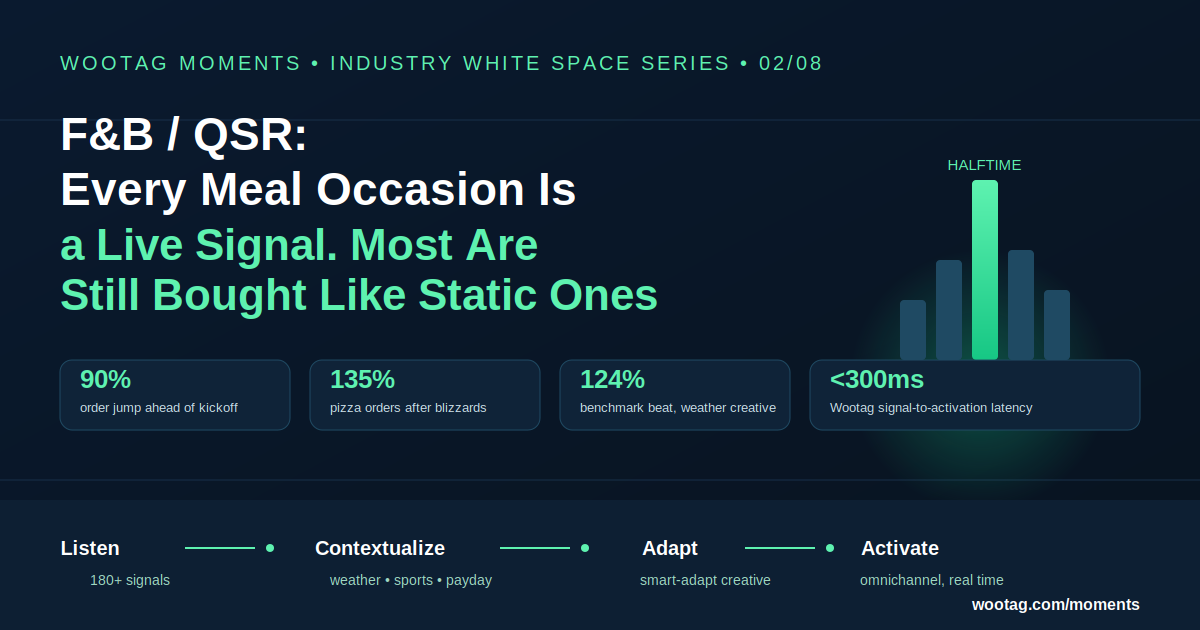

Few industries have a demand curve as spiky as food and quick-service restaurants. A halftime whistle, a sudden downpour, a heatwave, a payday Friday — each one moves orders by double digits within the hour. And yet most F&B and QSR media plans are still bought the way packaged goods were bought a decade ago: dayparted, geo-targeted, seasonally-themed, and locked days or weeks in advance. The signals are live. The buying isn’t. That mismatch is this industry’s white space.
The gap: demand spikes are documented, granular, and still mostly unmonetized in real time
Start with weather, because it is the most consistently proven driver of F&B demand of any signal category. Food delivery orders have been shown to surge by up to 13% during heatwaves, and by considerably more during snowstorms — with pizza orders climbing as much as 135% after major blizzards in cities like New York. On the QSR side, one campaign that synced hot-food promotions to incoming cold weather drove a documented sales increase for the chain, while a separate QSR effort that swapped soup creative for salad creative above and below a 60-degree threshold beat its own performance benchmarks by 124%. Rain, snow and extreme cold reliably push customers from dine-in toward delivery — often with almost no warning — which means the operators fastest to react to a live forecast, not a seasonal campaign, capture the disproportionate share of that spike.
Sport is the other unmissable signal, and the data on it is now remarkably granular. During a recent global football tournament, one delivery platform saw an 11% surge in food and grocery orders in a single market during the opening weeks, a national market recorded a 90% jump in orders ahead of kickoff with fried chicken orders spiking nearly 10x, and another platform’s own data showed halftime — not full time — as the single highest-demand moment of the match. Cricket delivers the same pattern at even greater scale: when India won a recent T20 World Cup final, one quick-commerce platform recorded a 60% order spike by 9pm as viewing parties built around the match. These aren’t soft brand-awareness effects — they’re same-hour, measurable transaction spikes, and they are entirely predictable in advance down to the specific match and kickoff time.
Then there’s the pattern that sits underneath both of the above: payday. Independent restaurant-delivery data shows the weekend immediately after payday can bring a noticeable lift in delivery spend and average ticket size in many markets — a signal that’s completely predictable on a calendar, yet rarely built into always-on media the way a seasonal LTO calendar is.
Why F&B/QSR still buys these moments like static campaigns
- Menu and promo planning runs on a quarterly LTO cycle. Limited-time offers are locked into national supply chains and franchise operations months ahead, leaving no natural mechanism to also flex the media around a live signal the week it actually happens.
- Weather and sports data live with different vendors than the media buy. A chain might have weather-triggered DOOH from one partner and a sports sponsorship from another — with no shared decisioning layer that can turn “halftime, in this city, 34°C” into one coordinated creative moment across every channel at once.
- Franchise and local-store marketing add execution friction. Even when head office spots a signal, thousands of individual locations, POS systems and local ad accounts make same-day, hyperlocal activation operationally hard without automation.
Why the layer needs to be independent of any one channel
Most of the tools that already exist to catch real-world signals — weather-ad networks, retail media platforms, DSP-side contextual targeting — are built inside a single channel. A weather-triggered DOOH vendor can only activate DOOH. A retail media network’s real-time bidding logic only fires inside that retailer’s own inventory. A DSP’s contextual layer only reaches programmatic display. Each one is genuinely useful, and each one is also a silo: the same heatwave, the same commodity spike, the same live-match moment has to be re-detected, re-briefed and re-created separately for every channel team that wants to react to it.
This is the structural reason most real-time campaigns stay confined to the channel they were built for. A campaign designed around broadcast, a single retail media network, or a single DSP’s contextual layer has no natural mechanism to also re-trigger a brand’s other programmatic buys, social feeds and retail media placements the moment the same signal recurs somewhere else. Each of those channels sits with a different team, a different vendor and a different creative pipeline.
An independent moments platform solves this by sitting above the channel layer rather than inside it. Wootag listens to signals once, contextualizes them once, and then adapts and activates that single decision across every channel a brand already buys — social feeds, publisher content, programmatic and retail media, CTV/streaming, and shoppable/commerce surfaces — whether that media is owned (a brand’s own app, site or CRM) or paid (a DSP, a retail media network, a social platform’s ad stack). Because the detection and decisioning layer isn’t married to any one channel’s ad server, it doesn’t matter whether the next signal-triggered moment needs to land as a TikTok creative brief, a DV360 line item, a retail media placement on a grocer’s app, or an email send — the same signal drives all of them from one place.
For F&B and QSR marketing and growth teams specifically, that channel-agnosticism is what actually makes automation possible:
- One integration, not one per franchise system. A chain doesn’t need to wire a bespoke real-time pipeline into every regional DSP, delivery-app ad account and local DOOH network it touches. The signal-to-decision logic is built once and orchestrates everywhere — the only realistic way to run “real-time” across thousands of locations.
- Consistent creative logic across every buy. Smart-adapt reshapes one contextualized decision — “it’s halftime, it’s hot, promote the cold beverage LTO” — into the right format for app push, social, CTV and DOOH simultaneously, instead of five channel teams each interpreting the moment differently.
- Media-neutral measurement. A layer that isn’t owned by a specific delivery app or DSP has no incentive to over-credit its own inventory, making it easier to compare true incrementality of a moment-triggered promotion across owned app, delivery marketplace and paid media side by side.
Mapping the white space across F&B/QSR formats
| Format | Live signal white space today | What “moment-activated” looks like |
|---|---|---|
| QSR / fast food | Weather-threshold demand (hot vs. cold menu swap) proven at the campaign level but rarely automated chain-wide | Real-time creative and app push swapping hot/cold LTO promotion the moment local temperature crosses the chain’s known threshold |
| Food delivery & quick commerce | Match-day and halftime order spikes are well documented but promotions are typically pre-scheduled, not live-triggered | Push notifications and in-app banners firing at kickoff/halftime in the specific city with the live match, not a blanket in-app promo |
| Casual dining / sit-down | Rain and extreme weather shift customers from dine-in to delivery with little warning | Dynamic messaging nudging existing dine-in bookings toward delivery/pickup as weather deteriorates in real time |
| Cafés & beverage chains | Heatwave/humidity spikes for cold beverages are a known but under-automated driver | Weather-triggered creative and offers for iced/cold SKUs synced to live temperature and humidity by store cluster |
| Grocery-adjacent quick commerce | Payday and pre-event (match, festival) stock-up windows are predictable but usually generic promos | Calendar + live-signal blended triggers (payday weekend and live-event stacking) for basket-building promotions |
A closer look: moments-powered push notifications inside your CEP
Push deserves its own section here, because it’s the one channel where QSR brands already have most of the infrastructure in place — and are still leaving the signal layer out of it.
Customer engagement platforms (CEPs) like Braze, MoEngage, CleverTap and Iterable already support API-triggered scheduling: a push that fires automatically when a defined condition is met, rather than on a fixed send calendar. Braze’s own documentation cites weather data and location feeds as a standard example of what can trigger a message. The delivery mechanism has existed for years. What’s usually missing is the live signal feed itself — a QSR brand’s CEP team would otherwise need to build and maintain its own weather API integration, its own sports-schedule feed, its own commodity or payday calendar, and wire each one separately into campaign logic before a single “it’s hot, order something cold” push can go out.
This is exactly where a moments platform earns its keep as infrastructure rather than a campaign tool. Wootag’s Listen layer already ingests 180+ live signal categories — weather, sports, commodity, cultural — across 47 markets. Instead of building that detection layer from scratch inside the CEP, a QSR brand can have Wootag push a contextualized “moment” as a triggered event directly into Braze, MoEngage, CleverTap or any comparable platform, using the CEP’s own existing trigger and segmentation logic to decide who gets it, how often, and alongside what other messaging. Wootag handles the what’s happening right now, and what it means; the CEP handles the who, how often, and via which of push, in-app, email or SMS.
What that unlocks in practice for a QSR or delivery brand:
- Weather-triggered menu recommendations. A live temperature or humidity signal in a specific city or store cluster triggers a push recommending the cold-beverage or comfort-food SKU that’s proven to convert at that threshold — rather than a generic “check out our menu” blast.
- Live sports moments. A kickoff, halftime, or a nail-biting finish in a specific market triggers a push for shareable snack bundles or combo deals timed to the exact minute demand is shown to spike — not a pre-scheduled “match day” campaign sent at 9am.
- Payday and commodity-aware offers. Predictable calendar signals like payday weekends, blended with live commodity or price-sensitivity signals, can trigger value-tier combo pushes exactly when spending intent is highest.
- Blended food recommendations. Because the CEP already holds a customer’s order history and loyalty data, the live signal doesn’t have to replace personalization — it sharpens it. A returning customer’s “usual order” recommendation can be re-ranked in real time by what a live signal says is relevant today (their usual iced coffee bumped up on a heatwave day; a spicy wing bundle promoted ahead of a big match), rather than treating loyalty personalization and moment relevance as two separate, disconnected systems.
The effectiveness case for this is already well established in push-marketing benchmarks, even before the live-signal layer is added: personalized push has been shown to lift open rates by roughly 27–29% over generic alerts, segmented messaging has driven conversion lifts as high as 200% in Braze’s own client data, and industry benchmarks suggest advanced targeting can roughly triple reaction rates while deeper personalization can roughly quadruple them. A related grocery delivery case built on triggered, data-driven push messaging reported a 22% increase in average daily orders per store and a 23% lift in daily revenue per store. None of these figures are QSR-specific or Wootag-attributed — they’re general push-personalization benchmarks cited here to size the opportunity, not a promise of results. What a live moments signal adds on top of standard personalization is relevance to right now, which is the one variable static CRM segmentation can’t supply on its own.
What’s ours, and what’s independently sourced
For transparency: the weather-linked delivery-surge figures (13% heatwave lift, up to 135% pizza-order increase after blizzards), the QSR campaign results (the 124% benchmark outperformance, the cold-weather hot-food sales increase), and the sports-driven order data (11% and 90% order surges, the 10x fried chicken spike, the 60% quick-commerce spike during a T20 World Cup final) all come from independently published third-party sources — The Weather Company, WeatherAds, Delivery Hero, and reported quick-commerce/BigBasket data — not from Wootag’s own client campaigns. The push-notification benchmarks (27–29% open-rate lifts from personalization, the 200% segmentation-driven conversion lift, the tripling/quadrupling of reaction rates from targeting and personalization, and the 22%/23% grocery-delivery order and revenue lift) are general industry benchmarks from Braze, CleverTap and Airship, cited to size the opportunity — they are not QSR-specific and not Wootag-attributed results. Wootag’s own platform specifications (180+ signal categories, 47 markets, sub-300ms signal-to-activation latency) are the company’s stated figures. Any F&B/QSR-specific Wootag pilot data will be labelled separately from this research as it becomes available.
Where this leaves F&B and QSR marketers
The industry doesn’t lack proof that live signals move orders — it has some of the best-documented demand data of any category, updated match by match, degree by degree. What it lacks is an operating layer that can catch that signal and turn it into a coordinated, cross-channel response before the moment passes — a halftime window, a temperature threshold, a payday weekend — rather than a quarter later, in the next LTO cycle.
Ready to see how a live signal-to-activation layer could work across your menu calendar, delivery app and local media? Book a demo with Wootag to map your brand’s specific weather, sports and commerce signals to the Listen → Contextualize → Adapt → Activate framework.
