

A wicket falls. A heatwave alert fires. A stock breaks out. A gold rally spikes. Every one of these is a fully-formed audience — attentive, emotionally engaged, and completely unclaimed by any media plan. Most brands will never reach them, not because the moment wasn’t valuable, but because no single marketplace was built to sell it to them in time.
That gap has a name in media planning circles: white space — the space between the campaigns you’ve booked and the moments your audience is actually living through. Sponsorship packages, upfronts, and even programmatic private marketplaces are built around inventory that’s known in advance: a match, a slot, a publisher, a quarter. The real world doesn’t move in quarters. It moves in seconds. And every second a signal goes unaddressed is a white space a competitor — or no one — gets to own instead.
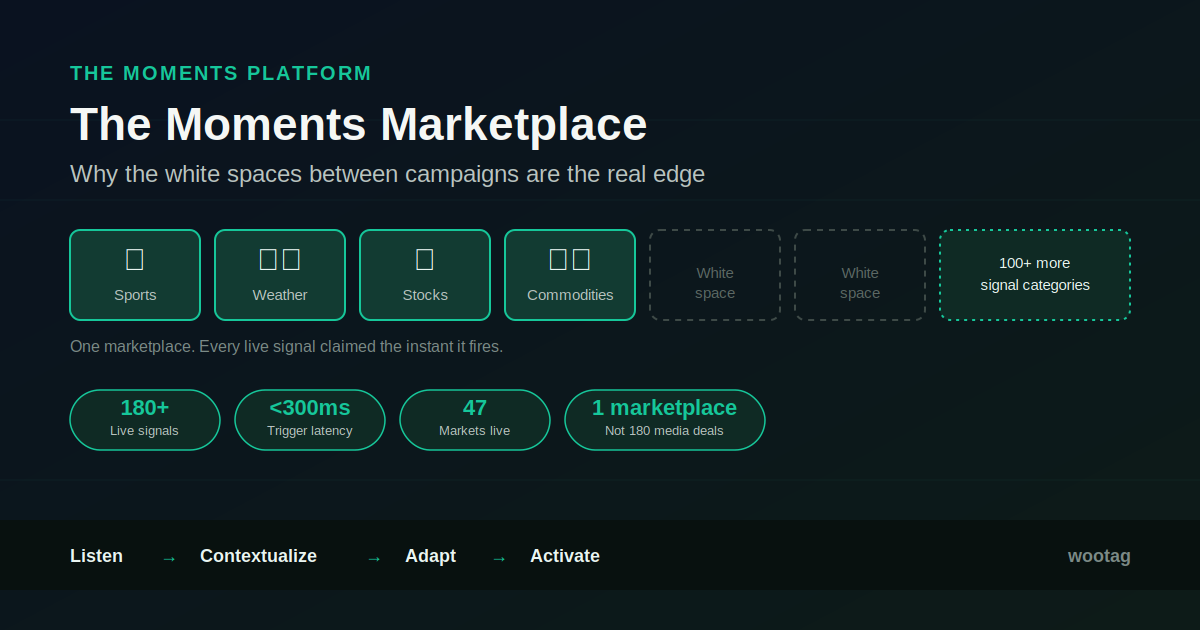
Wootag’s answer isn’t another media buy. It’s a Moments Marketplace: a single, standing marketplace of real-world signals — sport, weather, stocks, commodities and 100+ other live categories — that any brand can tap into the instant a moment fires, across every channel they already use. It’s worth unpacking why that structure, not just the individual signals, is what makes it hard to replicate.
Why “white space” is a marketplace problem, not a creative problem
Most brands already know how to make good moment-triggered creative. Ask any marketing team and they’ll describe the Oreo blackout tweet, or a fintech’s rate-cut offer, or a beverage brand’s heatwave push. The idea isn’t new — reactive, signal-based marketing has been maturing as a discipline since the early 2010s, moving from opportunistic social posts into dedicated newsroom-style teams and signal feeds.
What’s stayed broken is the buying layer underneath it. Today’s premium inventory marketplaces — private marketplace (PMP) deals, programmatic guaranteed, upfronts — work by pre-vetting a specific publisher or audience pool and locking in access ahead of time, which is precisely the source of their brand-safety and transparency appeal to buyers (according to industry ad-tech sources covering PMP mechanics). That model works well for planned inventory. It has no mechanism for a signal that didn’t exist when the deal was struck — a last-over thriller, a surprise rate cut, a heatwave that wasn’t in the forecast three weeks ago.
The scale of the problem is growing, not shrinking. Industry forecasting from WARC puts 2026 global ad spend growth at 9.1%, reaching roughly $1.3 trillion — but that growth is landing unevenly, with close to four-fifths of it absorbed by retail media, paid search and social platforms alone, according to WARC’s Future of Media 2026 report. That concentrates budgets into a handful of buying channels that were never designed around live-world signals in the first place. At the same time, WARC also projects contextual targeting to grow at roughly 14% a year through the end of the decade, and separate WARC research finds a strong majority of consumers say the surrounding content shapes how they perceive an ad — audiences are clearly primed to respond to context, even as most marketplaces still aren’t built to sell that context to brands moment-by-moment.
Every one of those unaddressed signals is white space: real, valuable, and structurally invisible to a media stack organized around static inventory.
What a Moments Marketplace actually is
Wootag’s Moments Platform is built around a simple loop — Listen → Contextualize → Adapt → Activate — but the part that makes it a marketplace, rather than a single campaign tool, is breadth and standing access. Instead of negotiating one signal at a time, brands plug into a marketplace that already spans:
- Sports — wickets, goals, last-second buzzers, powerplays, and match points across cricket, football, F1, NBA, tennis and NFL
- Weather — heatwaves, monsoons and snowstorms, each forecast treated as a live creative brief
- Stocks — bull runs, IPO listings and earnings beats, triggered the moment capital moves
- Commodities — crude shifts, gold rallies and crop cycles that ripple through category demand
- 100+ other signal categories — from box-office openings to election results to festival calendars, with custom signals available on request
That’s 180+ live data feeds, sub-300ms trigger latency from signal to activation, and reach across 47 markets — one marketplace, not 180 separate media deals. Brands don’t book a moment months out; they subscribe to a category of moment and let the marketplace fire the creative the instant it happens, adapted automatically for whatever channel — social, CTV, programmatic, DOOH, shoppable — the audience is actually in.
Why the marketplace structure matters more than any single signal
The comparison below is illustrative — it’s meant to show the structural difference between a moments marketplace and the buying models most teams already use, not a claim about any specific competitor.
| Traditional PMP / sponsorship buy | Wootag Moments Marketplace | |
|---|---|---|
| What’s for sale | Known inventory booked in advance (a slot, a publisher, a season) | Live signals across 180+ categories, available on standing access |
| Trigger | Fixed schedule or negotiated deal ID | Real-world event, detected and fired in <300ms |
| Coverage | One category or one publisher per deal | Sport, weather, stocks, commodities and 100+ others, one platform |
| Channel adaptation | Manual, per-placement | Automated — creative reshaped per channel at activation |
| White space addressed | None — only what was pre-booked | Every signal in the marketplace, as it happens |
| Where brands buy again | Renegotiate per season, per publisher | One marketplace, continuously live |
The reason this is hard to copy isn’t the individual triggers — most ad-tech vendors can hook up a weather API or a sports feed. It’s running Listen, Contextualize, Adapt and Activate as one marketplace-grade system across every category simultaneously, at the latency a live moment demands, in 47 markets, without every brand having to build that pipeline itself.
What it looks like when a brand plugs into the marketplace
Wootag’s sports vertical of the marketplace has already been proven with category-defining brands. UltraTech Cement activated real-time shoppable overlays during key IPL moments — boundaries, wickets and powerplay milestones — with branding triggered instantly across CTV and social. FedEx and CSK, Castrol, and Evara by PGI have run comparable moment-triggered activations through the same marketplace infrastructure. Franklin Templeton and Clear have applied the same signal-to-activation model outside sport, in finance and services categories respectively.
The same structure extends the value beyond the brand buying media. Sports teams can package their own live moments as premium inventory inside the marketplace to open new sponsorship revenue; players can monetize personal-brand moments tied to their own performance. It’s a genuinely two-sided marketplace — signal owners and signal buyers — not just a targeting layer bolted onto existing ad buys.
A note on the numbers
In the interest of transparency: figures like 4.2x higher brand recall, 67% more engagement vs. standard creative, and the UltraTech IPL results (3.2x engagement lift, 42% brand recall increase, 18% incremental reach, 12M+ real-time impressions) are Wootag’s own platform and case-study data, published on wootag.com and drawn from specific campaigns — they describe what happened in those activations, not an independent, third-party benchmark of the category. The market-level statistics on programmatic growth, contextual targeting, ad spend concentration, and PMP mechanics cited above come from WARC and independent ad-tech industry sources, linked at each reference. Brands evaluating any moments-based platform, Wootag included, should ask for methodology behind vendor-reported lift figures the same way they would for any other media partner.
Where this leaves brand marketers
The white space between planned campaigns isn’t a gap that better creative closes — it’s a gap that only exists because most marketplaces weren’t built to sell what the real world produces in real time. A Moments Marketplace changes what’s for sale in the first place: not a slot, but a standing subscription to every signal that matters to your category, ready to activate the second it fires.
If your team is still buying media the way the world stood still, the next moment worth owning is already happening without you.
Explore the Moments Platform → · See sports moments in action →
