

A data analytics company and a Premier League football club walk into a Brooklyn rooftop. It sounds like the setup for a joke, but it’s the opening scene of a shift that Adweek just put a name to.
In a recent piece, Adweek reported that enterprise brands like SAS and Salesforce are increasingly reaching business decision makers through sports, culture, and creators, not through the usual whitepapers and trade show booths. The example: SAS, a $3 billion analytics provider, signed on as Liverpool FC’s official AI marketing automation partner. Their activation of choice wasn’t a keynote. It was a plexiglas booth where fans and influencers tried to replicate a footballer’s technique using a foam ball, while SAS’s technology scored their performance in real time.
SAS’s CMO called it a way to describe what the company does “in a way that is more relatable and emotionally connective.” That line is worth sitting with, because it’s the whole thesis. For years, B2B marketing operated on the assumption that emotional, real-time media was a consumer indulgence and enterprise buyers responded only to logic, ROI decks, and category reports. That assumption is cracking. The people signing seven-figure software contracts are the same people who feel their stomach drop when a last-minute goal goes in. B2B brands have finally noticed that the buyer and the fan are the same human being.
The Move Is Right. The Mechanism Is Still Half-Built
Here’s where the gap shows up. What SAS did in Brooklyn, and what Salesforce and others are doing across sports and culture, is genuinely smart brand strategy. It borrows the emotional register of consumer marketing and applies it to categories that have historically been starved of it: data platforms, cloud infrastructure, fintech rails, enterprise software.
But look closely at how it’s being executed. It’s a physical booth at a single jersey launch event. It’s a sponsorship logo on a perimeter wall. It’s a one-off activation tied to one match, one city, one night. That’s presence. It is not yet performance.
The gap is this: enterprise brands are getting very good at attaching themselves to sports moments, and still early at activating inside them. A booth at Yankee Stadium reaches the few hundred people who walked past it. It does not reach the millions watching the match on CTV, scrolling highlights on social, or checking the score on their phone during a work call. The emotional spike SAS is chasing, the second a shot goes in, the second a milestone is broken, happens in a fraction of a second and it happens simultaneously across every screen a fan owns. A rooftop event, however well designed, cannot be everywhere that moment is happening.
Why This Gap Persists
It’s not for lack of ambition. It persists because most sponsorship and brand partnership deals were built for reach and brand lift, not for moment-level activation. A logo on a shirt or a stadium board is bought and measured the same way whether the match is a nail-biter or a dead rubber. There is no mechanism inside a traditional sponsorship to say: the instant this specific, emotionally charged event happens, on any channel, trigger this specific piece of brand messaging, and prove what it did.
That mechanism is exactly what real-time moment activation is built to solve, and it doesn’t require an enterprise brand to build its own analytics booth or hire an events agency for every fixture.
From Attaching to Activating: What Moment-Level Engagement Looks Like
This is where sports stops being a sponsorship line item and starts being a signal.
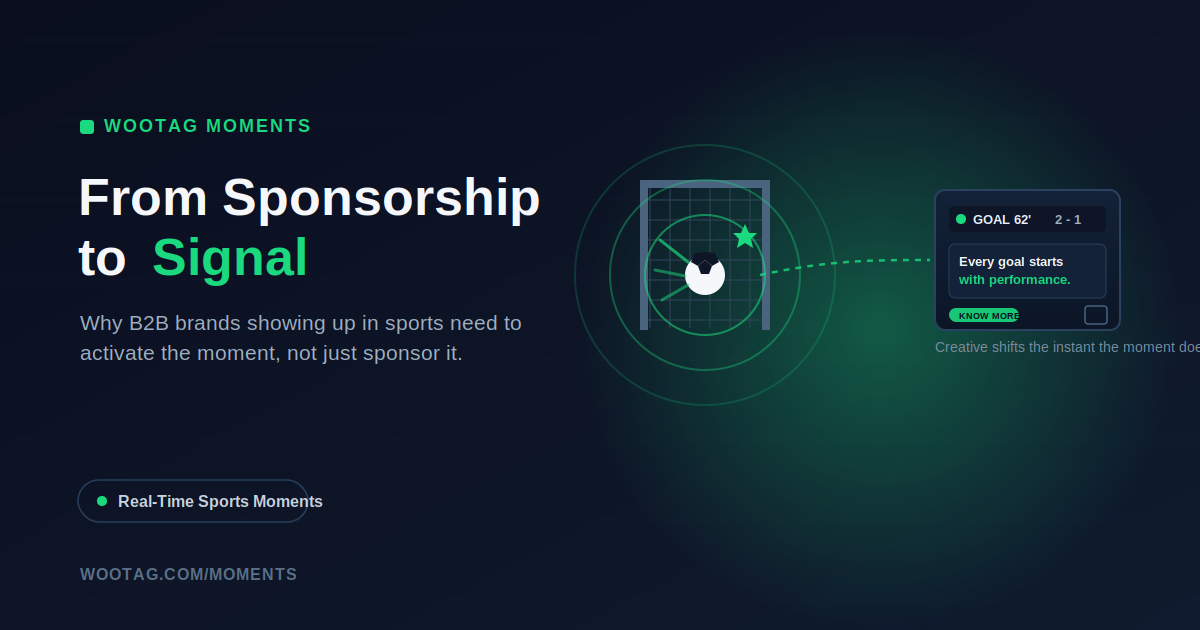
A goal, a wicket, a podium finish, a match point: each of these is a real-time, high-emotion trigger that already exists inside the broadcast and the data feed. The opportunity for a B2B brand isn’t to build a physical booth for every one of these moments. It’s to plug into the moment itself, the instant it happens, and let contextual, dynamic creative activate automatically across every channel the audience is already on, CTV, display, social, owned apps, all from the same trigger.
That’s the difference between a brand that shows up once at a stadium and a brand that shows up every time the crowd gasps. One is an event. The other is a system.
This works the same way regardless of the channel it lands on. A real-time trigger from a match doesn’t care whether it’s activating a CTV overlay, a social post, or a push notification, the moment is channel-independent by design. What changes from channel to channel is the creative format, not the underlying signal or the timing logic. That’s what makes moment-level activation scalable in a way a one-off rooftop event never can be: build the trigger once, let it adapt everywhere.
Why This Matters More for B2B Than It Looks
It’s tempting to read the Adweek piece and think this is a consumer-marketing tactic that enterprise brands are borrowing. It’s actually a better fit for B2B than for a lot of consumer categories, for a specific reason: B2B brands are chasing a much smaller, much more considered audience, and they need every impression to work harder.
An enterprise analytics company sponsoring a football club isn’t trying to sell boots to millions of fans. It’s trying to be remembered by the handful of decision makers in that fan base who also happen to run procurement for mid-market companies. That’s a low-frequency, high-value audience. Wasting that shot on a static logo, instead of pairing it with the exact second the audience is most emotionally open, is the more expensive mistake, not the cheaper one.
| B2B Category | What the Adweek Trend Looks Like Today | What Moment-Level Activation Adds |
|---|---|---|
| Enterprise software & analytics | Club sponsorship, jersey branding, one-off fan activations | Real-time creative triggered on goals, milestones, match moments, tied to measurable recall |
| Fintech & banking | Stadium naming rights, athlete endorsements | Instant, contextual offers or messaging tied to live match events across CTV and social |
| Cloud & data infrastructure | Data-partner branding on broadcasts | Dynamic creative that adapts in real time to the exact play or statistic being shown |
| Cybersecurity & enterprise tech | Logo placement, hospitality boxes | Moment-triggered messaging during high-tension plays, when attention is at its peak |
| Telecom & connectivity | League or tournament sponsorships | Real-time activation across owned channels every time a sponsored player or team scores |
What This Looks Like When a B2B Brand Actually Does It
Valvoline is a useful comparison to SAS, because it’s the same kind of brand facing the same kind of problem: a B2B-adjacent, category-driven brand trying to earn attention in a sport with a global, not regional, fan base. Instead of a one-off stadium activation tied to a single club and a single city, Valvoline ran across an entire FIFA season and let live match events do the targeting. A goal, a halftime whistle, a penalty, a team win, each moment fired its own tailored CTV spot in real time, instead of one static creative playing on loop for the whole match.
That’s the version of “B2B brands showing up in sports” that scales past one rooftop in Brooklyn. The signal already exists inside the broadcast, and it’s the same broadcast a global audience is watching at the same time, not a regional fixture. The brand just needs to be plugged into the moment as it happens.
A Note on the Proof
It’s worth being precise about what’s verified and what isn’t. The SAS and Liverpool FC details above are third-party reporting from Adweek, based on an on-the-ground account of the Brooklyn activation and comments from SAS’s CMO. Wootag had no part in that campaign.
The Valvoline figures referenced above, a 99.03% average video completion rate and 37% cost efficiency across a FIFA season on Connected TV, are self-reported case study results published by Wootag on its own case studies page, not independently audited figures. They’re shared as a proof point of what real-time sports triggers can do, not as an industry-wide benchmark.
The Takeaway for B2B Marketers
Adweek is right that B2B brands are stepping out of the office and onto the field. The next question the best marketers in that group will ask isn’t “which team should we sponsor.” It’s “the moment our audience feels something, are we there, on every screen, at the same second, or are we still waiting for them to walk past our booth.”
Sports has always been full of moments. The brands that win from here won’t be the ones attached to the game. They’ll be the ones built to move at the speed of it.
Want to see how real-time sports triggers turn sponsorship into measurable engagement? Explore Wootag Sports Moments.
B2B Brands Are Showing Up at the Stadium. Most Are Still Missing the Moment.
