

Picture two brands watching the same match. One paid eight figures to put its logo on the pitch-side hoarding. The other has zero official association with the tournament, the league, or a single team on the field. When the ball hits the net in the eighty-ninth minute, the sponsor’s phone lights up with a pre-approved social post going live. The non-sponsor does nothing, because somewhere along the way, someone on their marketing team decided that without the rights, they had no right to the moment at all.
That assumption is costing non-sponsor brands more reach than any legal risk ever could.
The Real Gap Isn’t Access. It’s Confidence.
Every brand with a buyer who follows sports has a stake in that moment, sponsor or not. A fintech app, an enterprise SaaS platform, an insurance company, a telecom carrier, none of them need a stadium naming deal to know their audience is watching. The fans in the stands and the decision makers in your CRM are frequently the same person on a Saturday afternoon.
The problem is that most non-sponsor brands stop at the first legal question and never get to the second one. They ask “can we use the team crest, the match footage, the player’s face?” hear a no, and conclude the entire opportunity is closed. They never ask the question that actually matters: what part of this moment is actually protected, and what part is simply a fact that anyone can react to?
Those are very different questions, and the answer to the second one is where the real opportunity sits.
What’s Actually Protected, and What Isn’t
This is worth being precise about, because most of the hesitation comes from blurring these two categories together.
Protected, and off limits without a license:
- Broadcast footage and match clips
- Team and league crests, logos, and official marks
- Player image rights and likeness
- Official partner language (“Official Partner of,” “Proud Sponsor of”)
- Tournament music, mascots, and trophy imagery
Not protected, and fair game for any brand:
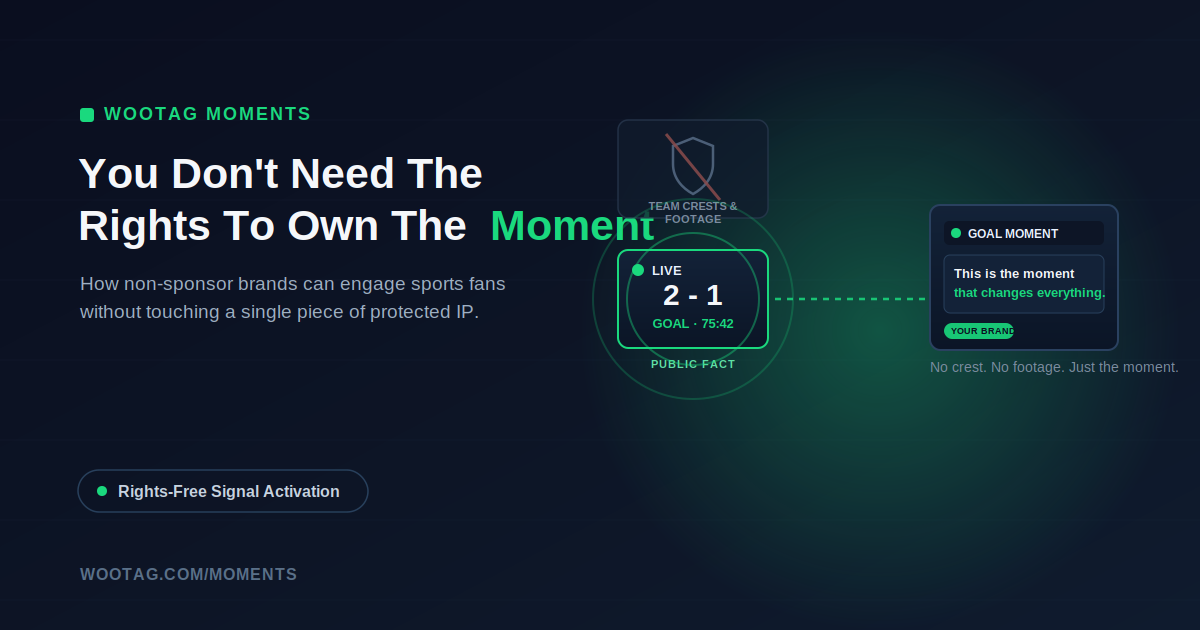
- The fact that a goal was scored, at a given minute, in a given match
- A live scoreline (2-1, 75th minute)
- The fact that it’s kickoff, halftime, or full time
- Generic football, cricket, or sport-specific iconography (a ball, a goalpost, a stopwatch) not tied to any specific team’s branding
- Your own brand’s reaction to a publicly known outcome
A final score is a fact, not a copyright. A brand reacting to that fact with its own creative, its own logo, and its own message isn’t borrowing the league’s IP. It’s simply paying attention in public, the same way a news ticker does.
This isn’t legal advice, and trademark law varies by market and by governing body, so any brand should loop in legal counsel before naming a specific team or league in creative. But the broad principle holds across most jurisdictions: you can react to what happened, you just can’t imply you’re part of who made it happen.
A Framework for Engaging Fans Without Owning the Rights
This is the same Listen, Contextualize, Adapt, Activate approach that underlies every Moments campaign, applied specifically to brands with no sponsorship rights to lean on.
1. Listen to the fact, not the footage. Plug into a live data feed for the events that matter, a goal, a wicket, a penalty, a final whistle. These are public, factual, real-time signals. No broadcast rights required, because you’re not touching the broadcast. You’re watching the same publicly reported outcome a sports app or a news alert would show.
2. Contextualize with your own brand voice. Build creative that reacts to the emotional register of the moment without asserting any association with the teams playing. A goal means tension just broke. A penalty means the whole crowd held its breath. Your brand can speak to that feeling, “this is the kind of moment that changes everything,” without ever putting a club crest next to your logo.
3. Adapt the language to stay clearly on your side of the line. Use scorelines and generic match language (kickoff, halftime, full time, goal, penalty) rather than official tournament naming or team crests in the creative itself. If you want to reference a team by name, treat it as a factual, descriptive reference and get that language checked, since the safe version of this framework never needs a team name to land emotionally.
4. Activate everywhere your audience already is, the instant it happens. The moment doesn’t wait for a campaign brief. A goal-triggered creative needs to reach CTV, display, and social within the same window the crowd is still reacting, not a news cycle later. This is where most non-sponsor attempts fail even when the legal side is clean, because the technology to detect the event and swap the creative in real time across channels doesn’t exist inside a typical media plan.
That fourth step is the one a signal orchestration platform exists to solve. Everything upstream of it is a legal and creative decision. Getting the moment to the right screen in the right second is an execution problem, and it’s the one most brands quietly give up on.
What This Looks Like in Practice
Two campaigns on the Wootag Moments Platform show exactly how this mechanism works, and it’s worth being precise about what they do and don’t prove.
Valvoline ran a real-time sports moments campaign across an entire FIFA season on Connected TV. The trigger was a live match event, goal, halftime, penalty, team win, and the platform swapped in a matching Valvoline creative the instant it happened, instead of one static ad looping through the whole match. The campaign averaged a 99.03% video completion rate with a 37% cost efficiency gain.
Budweiser ran a similar model during the FIFA World Cup 2026 window across programmatic display. Kickoff, goal, halftime, penalty, and team win each triggered its own contextual creative, showing the live scoreline alongside the brand’s own messaging. That campaign saw a 3.2x engagement uplift and 39% cost efficiency.
Both of these ran as official brand marketing during FIFA windows, and both figures are self-reported case study results published by Wootag on its own case studies page, not independently audited numbers. What’s relevant for a brand with no sponsorship rights at all isn’t the sponsorship status of these two campaigns. It’s the mechanism underneath them. The trigger was a live match event. The creative on screen showed a scoreline and generic football iconography, not exclusive broadcast footage or a licensed team crest. That mechanism doesn’t require a sponsorship deal to work. It requires a signal, a piece of owned creative, and a way to connect the two in real time. Any brand with those three things can run the same model.
Where This Fits by Category
| Category | The Sponsorship-Free Moment | Why It Works Without Rights |
|---|---|---|
| Fintech & banking | A market-volatility message triggered the moment a major match goes to penalties | Reacts to shared tension, not team affiliation |
| Insurance | A “protect what matters” message triggered on a last-minute goal or a match-defining injury update | Uses the emotional beat of the moment, not the league’s branding |
| Enterprise SaaS & B2B tech | A “performance under pressure” message triggered on a penalty or a photo finish | Draws a parallel to the brand’s own value prop, not to the team |
| Telecom & connectivity | A “never miss a moment” message triggered on kickoff or halftime | Speaks to the fan’s experience of watching, not the tournament itself |
| QSR & beverages | A contextual offer triggered on a goal or full time | Reacts to the scoreline as a public fact, not as sponsored content |
The Real Cost of Sitting It Out
Every match your buyers watch without your brand present isn’t a neutral outcome. It’s a moment the sponsors are claiming by default, not because they earned it more, but because the non-sponsor brands assumed the door was closed. It usually isn’t. It’s just guarded by a legal question most teams never get around to asking properly.
The brands that figure this out first won’t be the ones who paid for the rights. They’ll be the ones who realized the moment was never the rights holder’s to license in the first place. It’s the fact of the game itself, and that’s public the second it happens.
Want to see what a rights-free, signal-triggered campaign would look like for your category? Explore Wootag Sports Moments.
