

The average phone owner sees roughly 46 notifications a day. Most get swiped away without a second glance. But somewhere in that noise sits a different kind of message — one that arrives because something just happened: a wicket fell, the rain started, a fare surged, a stock moved. That message doesn’t compete with the other 45. It answers a question the user was already asking.
That’s the gap between a push notification and a moment-triggered push notification, and the data on the difference is not subtle. Personalized push notifications pull in roughly 4x the click-through rate of generic broadcasts, and the industry-wide average CTR across all app categories now sits around 7.8% — about three times what email delivers, at a fraction of the cost of paid media. Push has quietly become the highest-leverage owned channel most apps have, and the moments layered on top of it are what decide whether it’s used well or wasted.
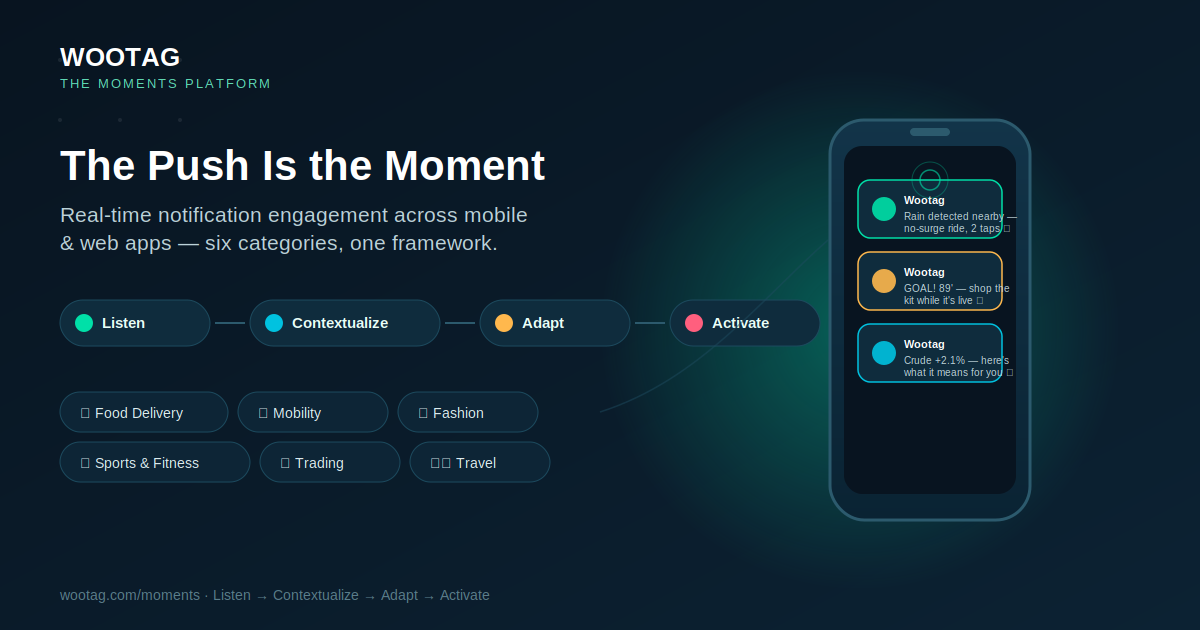
At Wootag, this is the exact mechanism our Moments Platform is built around: Listen → Contextualize → Adapt → Activate. Applied to push and in-app notifications specifically, that framework looks like this:
- Listen — ingest the live signal (weather, sports, markets, commodities, traffic) the instant it crosses a meaningful threshold.
- Contextualize — match the signal to the right user segment and the right emotional register (urgency, relief, FOMO, reassurance).
- Adapt — reshape the message for the channel: a push notification lives or dies on its first six words, so format and length matter as much as timing.
- Activate — fire the notification within the window that actually matters — often under an hour, sometimes under a minute.
Below, we’ve broken down what this looks like across six app categories, using current industry benchmarks alongside Wootag’s own trigger logic.
1. Food Delivery — weather and hunger cycles as triggers
Food delivery has some of the clearest cause-and-effect between a real-world signal and an order. Academic research on notification timing (cited in ACM and CHI proceedings) finds that pushes tied to genuine need — like a reminder that lands near someone’s usual lunch hour — convert two to three times better than untimed broadcasts. Weather is the other major lever: DoorDash is known to run micro-campaigns timed to rain and local activity, offering incentives like free pickup from nearby cafés on wet days, while transactional messages (order confirmed, driver two minutes away) reliably post open rates around 69%, far above promotional sends.
Wootag trigger: heatwave alert crosses 34°C in a metro → push fires with a hydration or cold-item offer and a “beat the heat, skip the queue” framing, geofenced to the delivery radius.
2. Mobility / Ride-Hailing — turning surge into trust, not friction
Rain is the single biggest driver of fare volatility in ride-hailing: Uber fares have been shown to climb 5–8% in New York on rainy days, with demand jumping 20–25%, and monsoon downpours in Mumbai and Delhi pushing surge two to three times higher. Left unmanaged, that’s a trust problem. Handled well, it’s an opportunity — industry data shows 90% of app users who receive a timely, relevant push are more likely to book, and loyalty-style nudges (“you’re one ride from your reward”) have lifted repeat bookings by up to 30% over three months.
Wootag trigger: rainfall signal crosses threshold in a hyperlocal zone → push offers a “no surge, dry ride” comfort message to loyal riders before competitors’ surge pricing even kicks in — utility framing, not upsell.
3. Fashion / Apparel — the personalization gap is enormous
Fashion is the category where the spread between generic and personalized push is most dramatic. One fashion social-commerce platform, Bantoa, built notifications around individual style, color, and pattern preferences and reported a 91.9% CTR alongside a 37% lift in 30-day retention — versus an all-industry average push CTR closer to 2–7.8% depending on the source. The pattern holds more broadly too: personalized messages convert up to 202% better than mass sends in retail contexts.
Wootag trigger: temperature drop or heatwave signal + a user’s browsing history → dynamic push surfaces the right layer, fabric, or seasonal category instead of a blanket “new arrivals” blast.
4. Sports & Fitness — the second screen is the real screen
Sports apps have a structural advantage: the moment is the content. Push notifications timed to live match events are reported to lift engagement by around 50%, and second-screen behavior during live sport is well documented — research has found roughly a 25% rise in multichannel engagement around televised sport, driven by fans checking scores, stats, and commentary on their phone while the game plays elsewhere. The risk is over-sending: fatigue and mass unfollowing of alerts is consistently cited as the top restraint on second-screen sports products.
Wootag trigger: wicket falls, goal scored, or match point reached → contextual push fires to fans following that team, paired with a brand’s shoppable or hyperlocal offer at the exact second attention peaks. This is a direct extension of what we already do for live sports moments — wickets, goals, poles, and buzzer-beaters, translated into the push channel.
5. Trading & Fintech Apps — the highest-stakes moment of all
Fintech notifications carry an unusual advantage: they’re expected. Security alerts and transaction confirmations already post some of the highest CTRs of any push category, because users treat them as safety-critical rather than promotional. Layer market volatility on top and the effect compounds — price-threshold and volatility alerts are now a baseline feature across mobile trading apps, precisely because a delayed notification during a fast-moving market has a direct cost to the user. The tradeoff app teams have to manage carefully: alert fatigue in this category doesn’t just cost engagement, it can push users toward impulsive trades, so quality and threshold-tuning matter more than frequency.
Wootag trigger: commodity or index move crosses a defined volatility band → push alerts relevant segments with context (not just the number), tying the signal back to a brand’s advisory, brokerage, or hedging product.
6. Travel & Hospitality — the category built entirely on disruption
Travel apps are worth adding to this list because almost nothing in the category is scheduled the way it appears on paper — flights slip, gates change, weather reroutes. Health & Fitness and Travel & Hospitality apps are specifically called out in CleverTap’s research as needing longer-form push copy (around 90 characters) to land well, because the message usually needs to explain a change, not just announce one. Live, real-time delivery formats — like iOS Live Activities showing flight status directly on the lock screen — are becoming the expected standard rather than a nice-to-have for this category.
Wootag trigger: flight delay, gate change, or a weather signal at the destination city → push adapts a brand’s message (lounge access, rebooking assist, local weather-appropriate offer) to the traveler’s actual situation in real time.
How the categories compare
| App Category | Best-performing trigger | Reported push CTR / lift | Primary moment signal |
|---|---|---|---|
| Food Delivery | Time-of-need reminders | 2–3x conversion lift vs. untimed sends | Weather, meal-time cycles |
| Mobility / Ride-Hailing | Weather-driven comfort offers | 90% more likely to book on timely push | Rain, surge conditions |
| Fashion / Apparel | Style-personalized recommendations | Up to 91.9% CTR (best-in-class case) | Weather, browsing behavior |
| Sports & Fitness | Live match-event alerts | ~50% engagement lift | Goals, wickets, match points |
| Trading / Fintech | Volatility & security alerts | Among highest CTRs of any category | Price/index thresholds |
| Travel & Hospitality | Real-time disruption updates | Longer-format push (~90 characters) outperforms | Flight delays, weather at destination |
The honest caveats
A few things worth being direct about, in the spirit of not overselling this:
- The category benchmarks above are aggregated from public industry research (Airship, CleverTap, MoEngage, Pushwoosh, Business of Apps, and others cited inline) rather than a single controlled study, so treat them as directional ranges, not guarantees for any specific app.
- The Wootag trigger examples above are illustrative of our platform’s capability, not confirmed client campaigns. They describe how Wootag’s Listen → Contextualize → Adapt → Activate pipeline would apply push notifications to each vertical — mapping hypothetical activations rather than reporting live client results.
- Personalization only pays off if the base targeting is right. The same research that shows a 4x lift for personalized push also shows that irrelevant or excessive messaging is the top reason users disable notifications or uninstall entirely — so “real-time” is not an excuse to over-send.
- Platform differences matter. Android and iOS opt-in behavior differs meaningfully (Android sits far higher by default), which changes reach even when message quality is identical.
Where this goes next
Push and in-app notifications are simply the fastest lane in a much bigger idea: that every real-time signal — a goal, a rain cell, a rate cut — is an opportunity to reach someone with something relevant, in the moment it actually matters to them. That’s the premise behind Wootag’s Moments Platform, connecting 180+ live signal feeds to brand experiences across every screen a user carries.
If you’re a brand in one of the categories above and want to map out what a real-time push (or broader omnichannel) trigger workflow could look like for your app, book a time with the Wootag team.
