

Every brand knows what it sells. Almost none of them know how to tell a customer why now.
That gap — between product messaging and moment messaging — is the reason Wootag exists as The Moments Platform today. Not as a feature bolted onto an ad tech stack, not as a campaign add-on, but as its own dedicated, purpose-built system. This is the story of the hypothesis that got us there, the twelve months we spent stress-testing it, and the five things we’re now engineering to make it hold at global scale.
The hypothesis: “your product” is not the same message as “why now”
Most advertising still answers one question: what is this product or service. A push notification tells you a ride is available. A display ad tells you a fund exists. A social post tells you a phone has a new camera. All true, all necessary — and all missing the second, more persuasive half of the sentence: why does this matter to you right now.
We set out to test a simple but unproven idea: that pairing a brand’s “what” with a real-time, contextually relevant “why now” — a heatwave, a wicket falling, a market breakout, a fuel price spike — would outperform product-and-creative messaging alone, and that the gap would be large enough to justify building an entire platform around it.
So over 12 months, across 20+ brand partners and more than 50 million unique users, we ran that comparison in the field: standard product-led creative versus the same offer wrapped in the real-world moment driving the customer’s attention at that instant.
What the pilot told us
Two patterns showed up consistently enough that we stopped treating them as anecdotal:
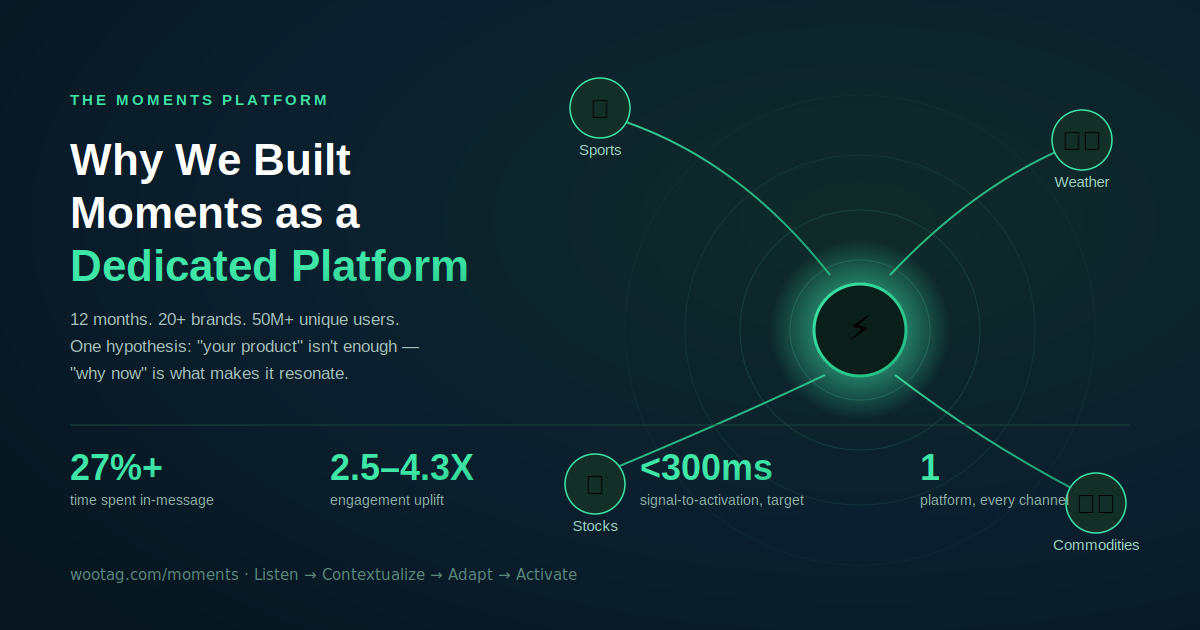
- Attention held longer. Users spent more than 27% of their time within the message itself when it was anchored to a live, relevant moment, rather than skimming past a generic product unit.
- Engagement moved meaningfully. We saw a 2.5–4.3x uplift in engagement on moment-contextualized creative versus the product-only control — a range wide enough to reflect real variance across categories, but consistently directional.
That range lines up with what the wider industry has independently found. WARC’s contextual-targeting research, run with Playground XYZ, reported that contextually targeted ad units <cite index=”3-1″>consistently outperformed industry benchmarks, delivering nearly 70% more attention for skippable ads, with both skippable and non-skippable formats surpassing benchmarks in the large majority of cases</cite>. The conclusion researchers drew was the same one our pilot pointed to: <cite index=”3-1″>contextual relevance and timing, not audience data alone, is what drives engagement and conversion</cite>. We weren’t discovering a new law of marketing. We were confirming one, and then asking what it would take to operationalize it at scale.
The second finding was just as important as the first: it only worked if the “why now” showed up consistently, wherever the audience happened to be. A monsoon-triggered message that only lived on display, while the same brand ran generic creative on social and CTV, underperformed a coordinated version of itself. The moment had to travel with the audience — not just appear once and disappear.
A note on these figures: the 27% and 2.5–4.3x numbers are drawn from Wootag’s internal 12-month pilot program across 20+ brand partners and are reported here as aggregate, anonymized pilot findings rather than named client case studies. Results vary by category, market and creative execution, and are not a guarantee of performance for any individual brand.
Why fragmentation was the real enemy, not lack of data
This is where most contextual or “moment marketing” efforts quietly fail: they get built as a channel feature. A weather trigger for display. A sports trigger for CTV. A stock-move trigger for one DSP. Each is executed by a different team, on a different timeline, with a different creative brief — and the result is a fragmented set of one-off activations rather than a single coherent brand moment.
The broader research on cross-channel experience backs up why this matters. Consumer intelligence data has found that as customer journeys fragment across more touchpoints, <cite index=”14-1″>consumers continue to demand consistency, which is a key challenge for brands under pressure to ensure a seamless experience across channels, devices and platforms</cite>. Splitting moment-based execution by channel doesn’t solve that problem — it recreates it, moment by moment, at higher velocity.
That’s the specific problem Wootag Moments is built to remove: being platform-agnostic by design, so that a single detected signal produces one coordinated brand response across every channel simultaneously, instead of a patchwork of channel-specific campaigns that all have to be briefed, built and timed separately. This has become the platform’s defining structural difference — not an additional feature, but the architecture itself.
The framework we built it on: Listen → Contextualize → Adapt → Activate
The pilot data told us contextual moments work. It also told us how they need to be operationalized to work reliably, which is why the platform is structured around four stages:
Listen. Wootag ingests 180+ live signal feeds — sports, weather, stocks, commodities, and more — and detects the moments worth acting on in real time, rather than relying on a marketer to notice and brief a campaign after the fact.
Contextualize. Each signal is mapped to brand-safe creative, dynamic offers and hyperlocal triggers, tuned to what the moment actually means for that audience in that market.
Adapt. Assets are reshaped automatically for where they’ll live — a different format for a feed, a story, a banner, a CTV spot — without re-briefing creative for every channel by hand.
Activate. The moment fires everywhere it needs to, at once: social, streaming, programmatic, retail screens, shoppable overlays — arriving while emotion, attention and intent are still peaking together.
This is the same spine we’ve used across every Moments post — the monsoon-triggered campaigns, the Wimbledon sponsor activations, the fuel-price volatility work — because it’s not a content template. It’s the actual sequence the platform runs, every time a signal fires.
What we’re building next, on top of proven ground
Twelve months of field data gave us permission to stop testing and start engineering for scale. Five things are now in active build:
- The world’s largest moments marketplace. A single, addressable inventory of real-world signals — sports, weather, stocks, commodities and beyond — that any brand can plug into, rather than building bespoke signal integrations one at a time.
- Sub-300ms time-to-activate. Engineering the gap between “signal detected” and “brand experience live” down toward 300 milliseconds, because a moment’s emotional peak is short, and speed is the difference between riding it and missing it.
- Agentic workflows for message and asset adaptation. Automating the creative-and-rules decisioning that currently eats the most operational time — so contextualization scales without a linear increase in production headcount.
- True omnichannel activation. One signal, activated simultaneously across social (Facebook, Instagram, TikTok), push notifications across apps and web, OTT and CTV, DOOH and display, and email and messaging — coordinated, not coincidental.
- A measurement stack built around moments, not just channels. Moving beyond channel-level reporting toward outcome measurement structured around the moment itself — what a specific signal-triggered activation actually drove, not just how a channel performed in aggregate.
Why this matters more than the platform itself
None of this is really about signal feeds or millisecond latency for its own sake. It’s about a much simpler goal: helping brands show up in front of the customer at the exact moment the product or service becomes relevant to them — not a day later in a retargeting sequence, not disconnected from the thing that made them care in the first place.
The world generates that moment constantly — a falling wicket, a heatwave alert, a market breakout. The brands that answer it, consistently and everywhere their audience is, are the ones the data says win the attention. That’s the bet we tested for a year. It’s the reason Moments is a platform now, not a feature. And it’s the reason we’re still building.
Methodology note: the pilot findings referenced above (12 months, 20+ brands, 50M+ unique users, >27% time-in-message, 2.5–4.3x engagement uplift) are Wootag’s own aggregated internal pilot results and are presented as company-reported figures, not third-party audited data or named client case studies. External sources (WARC, GWI/consumer research) are cited separately to corroborate the general industry direction, not to validate Wootag’s specific numbers. Individual brand results will vary by category, market, and execution.
Explore the Moments Platform → · See real-time sports activation →
