
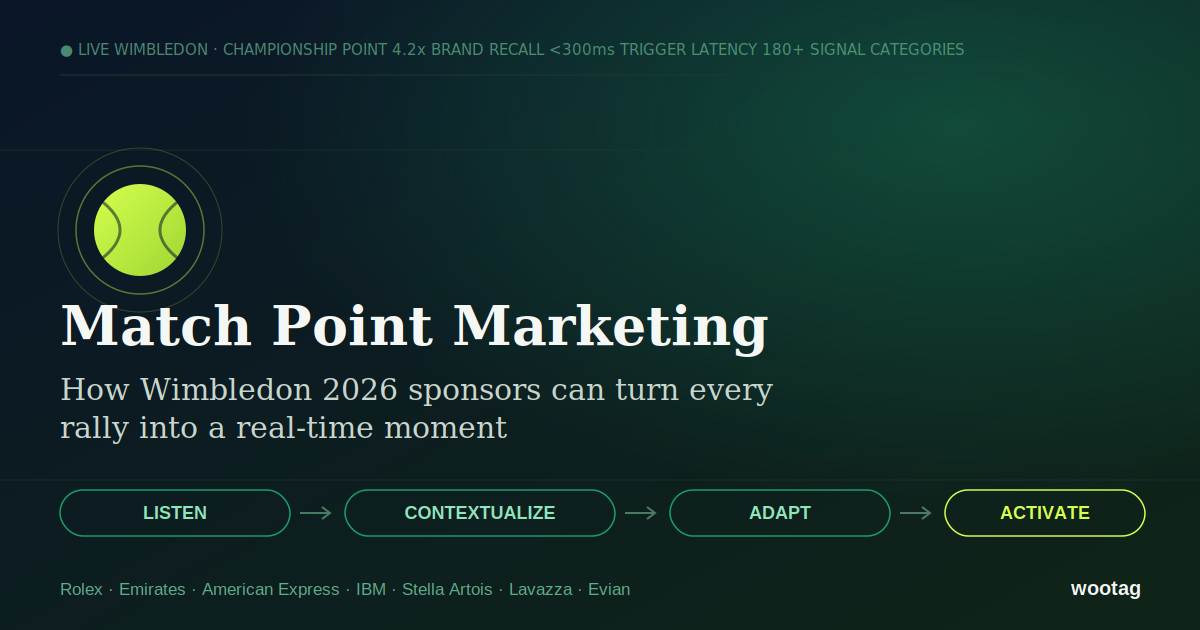

Wimbledon doesn’t do sponsorship the way everyone else does. There’s no title sponsor, no court-side LED ribbons, no logo scrum. The All England Club caps its partner roster at roughly 17 brands and enforces a strict Clean Court Policy — muted colors, no on-court signage, nothing that disrupts the sanctity of Centre Court. It’s the most exclusive, most restrained sponsorship environment in global sport.
Which is exactly what makes the digital layer so important.
If Rolex, Emirates, American Express, IBM, and Wimbledon’s beverage partners can’t win visibility on the court, they have to win it in the two hours a fan spends on their phone before, during, and after a match — checking scores, watching highlights, scrolling reactions to a five-set thriller. That’s a real-time attention economy, and it rewards brands that show up with the right message at the exact second a moment happens, not brands that bought the biggest banner.
That’s the gap Wootag’s Moments Platform is built to close. Wootag ingests 180+ live signal categories — sports moments among them — and turns each one into a brand-ready trigger across social, CTV, programmatic, and shoppable formats, typically inside 300 milliseconds of the signal firing. For a tournament where the branding is deliberately quiet on-site but the second-screen audience is enormous, that’s a natural fit.
Here’s how five of Wimbledon 2026’s official partners could apply Wootag’s Listen → Contextualize → Adapt → Activate framework to specific match moments — and what a real-time workflow would actually look like for each.
Why Wimbledon’s restraint makes real-time digital activation more valuable, not less
Wimbledon’s on-court austerity isn’t an obstacle to sponsorship value — it’s the reason the value exists. Brands compete for a short list of slots precisely because Wimbledon keeps the roster small and holds partners for decades rather than one-off deals. That scarcity raises the stakes for every other touchpoint a partner controls: the app, the broadcast overlay, the retail activation, the social feed.
The 2026 tournament also arrived with a major digital upgrade. Wimbledon and IBM introduced new watsonx AI-powered fan features, including a Key Moments tool that builds on the existing live Likelihood to Win feature, which continuously calculates each player’s win probability from live and historical statistics, expert opinion, and match momentum</cite>. Wimbledon also launched an enhanced Match Chat assistant, built on watsonx Orchestrate, that gives fans conversational, sometimes photo- and video-enriched answers sourced from live match dataWimbledon reported a 16% year-on-year increase in digital engagement in 2025</cite> even before these upgrades landed.
In other words: the audience that matters for sponsors isn’t just in SW19. It’s the hundreds of millions on the app, refreshing Match Chat and Likelihood to Win in real time. That’s precisely the terrain Wootag’s Listen → Contextualize → Adapt → Activate loop is designed to operate in.
1. Rolex — turning “official timekeeper” into a real-time signal
Rolex’s association with Wimbledon dates back to 1978, and its logo on the scoreboard is one of only two brand marks Wimbledon allows on Centre Court. But a scoreboard logo is passive. A match-point signal is not.
Real-time workflow:
- Listen: Wootag’s cricket-style trigger logic (wicket falls, final overs) maps cleanly onto tennis — swap in match point, championship point, and tie-break triggers across every televised court.
- Contextualize: The moment a player reaches championship point, Wootag’s AI matches the signal to pre-approved Rolex creative — understated, precision-themed copy (“Every second, measured”) that fits Wimbledon’s brand-safe tone.
- Adapt: The same trigger reshapes automatically for Instagram Stories (vertical, motion), CTV (a 6-second brand card), and programmatic display (a static badge on partner news sites covering the match live).
- Activate: Creative fires across those channels within moments of the point being won — not the next ad break, not the next scheduled post.
Moments outcome: Rolex converts a single, unbrandable on-court instant — the closing point of a five-set final — into a synchronized cross-channel impression at the exact second global attention peaks, the same emotional-timing principle behind Wootag’s 4.2x higher brand recall and 67% more engagement versus standard placements</cite> in its sports case studies.
2. Emirates — extending the airline partnership beyond the gate
Emirates joined Wimbledon in 2024 as Official Airline Partner in a deal reportedly worth around $12 million a year, and for 2026 the airline leaned hard into digital. Emirates served Wimbledon-themed menus on Dubai–UK routes, added Wimbledon touches to its A380 Onboard Lounge, and ran an interactive Emirates Cup activation on Roblox, alongside live match coverage for flyers via its onboard entertainment system.
Real-time workflow:
- Listen: Wootag flags upset wins, breakout young players, and marquee quarterfinal matchups — the moments most likely to trigger travel and destination search intent among tennis fans.
- Contextualize: A signal like “Fan favorite advances to semifinal” triggers dynamic creative pairing the result with a fare or upgrade offer to London, timed to the emotional high of the win.
- Adapt: Creative reshapes for the channels Emirates already owns — in-app notifications for existing bookers, paid social for lookalike travel audiences, and a shoppable overlay inside a Roblox-style interactive experience.
- Activate: Offer fires across social, programmatic travel inventory, and owned channels simultaneously, riding the same wave of attention that a highlight clip is generating organically.
Moments outcome: Instead of a static “Fly Emirates to Wimbledon” campaign running the whole fortnight, the airline gets a rolling series of high-relevance micro-moments — each one tied to a result fans are already searching for, which is where Wootag’s hyperlocal and shoppable triggers add measurable incremental reach on top of brand awareness.
3. American Express — from pavilion perks to point-triggered offers
Amex’s Wimbledon presence in 2026 leaned heavily into physical activation: the Amex Pavilion on The Hill, a Cardmember Lounge behind No.3 Court, and a “Dash to the Match” experience in the Southern Village. All memorable — and all inaccessible to the 99% of Amex cardmembers watching from home.
Real-time workflow:
- Listen: Wootag tracks match-level signals (set wins, tie-breaks, upsets) alongside audience sentiment cues from social conversation.
- Contextualize: When a marquee match swings into a deciding set, Amex’s system triggers a location-aware offer — a discount at a partner restaurant near the viewer, a bonus-points prompt for booking Wimbledon hospitality next season, or a digital “watch party” perk for card members.
- Adapt: The offer resizes automatically for push notification, in-app banner, and paid social, matching each channel’s format and tone.
- Activate: Delivered instantly to segmented cardmember audiences via CTV and mobile, with a shoppable link straight to redemption.
Moments outcome: This mirrors the pattern in Wootag’s own case studies, where UltraTech Cement paired live cricket triggers with shoppable overlays for a 3.2x engagement lift, 42% brand recall increase, 18% incremental reach, and 12M+ real-time impressions</cite>. For Amex, the same mechanic turns “exclusive at the venue” into “exclusive, and reachable, wherever the card member is.”
4. IBM — the data partner becomes the signal source, not just the destination
IBM’s role is unusual: it’s both a Wimbledon sponsor and, functionally, the infrastructure generating many of the signals other sponsors would want to react to. <cite index=”22-4″>Match Chat, built on watsonx Orchestrate, uses a collection of AI agents trained on Wimbledon’s editorial style and the language of tennis</cite>, while <cite index=”23-3″>Key Moments identifies pivotal plays — marathon rallies, untimely double faults — that quietly reshape a match in real time</cite>.
Real-time workflow:
- Listen: IBM’s own Key Moments engine effectively is the “Listen” layer — it’s already scoring which points matter most, in real time, for every singles match.
- Contextualize: Rather than activating product ads, IBM’s opportunity is thought-leadership positioning: a Key Moments insight (“this rally shifted the win probability by 18 points”) becomes a branded explainer graphic, published the instant the AI flags it.
- Adapt: The same insight reshapes into a LinkedIn card for B2B audiences, a short-form video for TikTok/Reels explaining the AI reasoning in plain language, and a stat-card overlay for broadcast partners.
- Activate: Publishes within seconds of the underlying data event — not as a summary the next morning, but as it happens.
Moments outcome: IBM doesn’t need a shoppable overlay — it needs proof of AI performance in the wild, published at the speed the AI itself operates. A moments-marketing layer turns each Key Moments detection into a live demonstration of watsonx’s real-time reasoning, which is a stronger sell to enterprise buyers than a case study written weeks later.
5. Stella Artois, Lavazza & Evian — the F&B triggers hiding in plain sight
Wimbledon’s beverage partners — Champagne Lanson, Lavazza, Stella Artois, and Evian as official water partner — operate in the category where Wootag’s own research is most direct: brands sponsoring teams or events can engage audiences during live play and structure offers based on outcomes, customized for both positive and negative results</cite>.
Real-time workflow:
- Listen: Trigger on set breaks, rain delays, and the traditional mid-match lull rather than point-level drama — these are attention windows, not emotional peaks, and the creative logic should match.
- Contextualize: A rain delay signal (Wootag already handles weather as a native signal category) triggers Lavazza’s “stay for the interruption” messaging; a set-break signal triggers Stella Artois’ pub/bar partner locator.
- Adapt: Creative reshapes for CTV during the broadcast lull, out-of-home nearby-pub geofencing, and social content timed to the same break.
- Activate: Offers go live across retail media and hyperlocal channels while the delay or break is still happening — not after viewers have already switched tabs.
Moments outcome: This is the clearest fit for Wootag’s hyperlocal walk-in and dynamic product triggers, converting a passive broadcast lull — usually dead time for advertisers — into a targeted, location-aware commerce moment.
Mapping it together
| Sponsor | Trigger Signal | Moment Type | Primary Channel Mix | Outcome Focus |
|---|---|---|---|---|
| Rolex | Championship / match point | Emotional peak | Social, CTV, display | Brand recall |
| Emirates | Upset win / marquee result | Narrative peak | App, paid social, travel inventory | Incremental reach, bookings |
| American Express | Deciding set / tie-break | Emotional peak | Push, in-app, CTV | Shoppable redemption |
| IBM | AI-flagged key moment | Data event | LinkedIn, short-form video, broadcast | Thought leadership |
| Stella Artois / Lavazza / Evian | Rain delay / set break | Attention lull | CTV, geofenced OOH, retail media | Hyperlocal walk-in |
A few honest caveats
This is a hypothetical mapping, not a confirmed Wootag–Wimbledon integration — none of the sponsors named here are disclosed Wootag clients, and the specific uplift figures cited (engagement lift, recall increase, incremental reach) come from Wootag’s published case studies in other sports contexts, primarily cricket, not from Wimbledon campaigns. Results would depend on each brand’s existing data infrastructure, Wimbledon’s own broadcast and data-licensing agreements, and how much creative flexibility a famously restrained tournament grants its partners for off-site activation. Wimbledon’s Clean Court Policy also doesn’t extend to digital by default — any real-world execution would need sign-off within the same brand-safe tone the All England Club enforces everywhere else.
The bigger point
Wimbledon’s whole sponsorship model is built on scarcity and restraint — which pushes the real competitive battle for attention into the two hours fans spend on a phone or a second screen. That’s a real-time environment, and moments marketing platforms like Wootag exist specifically to meet audiences there: listening for the signal, contextualizing it to the brand, adapting the creative to the channel, and activating before the moment passes. For a tournament that refuses to shout on the court, the loudest voice will belong to whichever partner shows up fastest, in the right context, everywhere else.
