

Why non-sponsors out-earned FIFA’s official partners at this year’s tournament — and what it means for brands betting on live-moment activation instead of logo placement.
A new Nectar Social analysis of the 2026 FIFA World Cup just delivered a result that should unsettle every sponsorship committee on the planet: brands that paid nothing for official status generated more earned media value than FIFA’s entire roster of paid partners — combined.
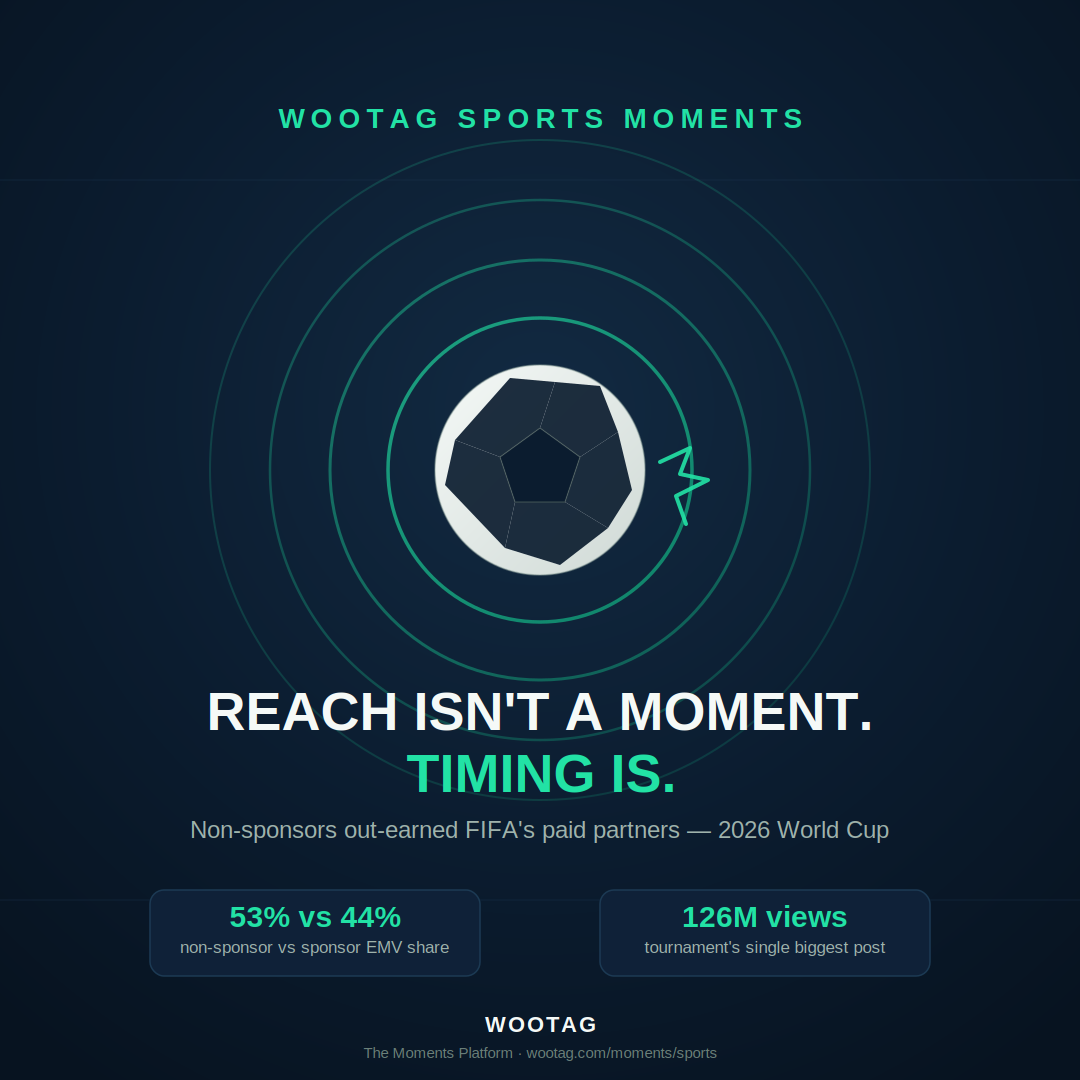
According to the report, non-sponsors captured 53% of total earned media value (EMV) from the tournament’s top 100 branded posts, against 44% for all official sponsors, drawn from 2.7 million pieces of content across TikTok, Reddit, Instagram, X, and YouTube generating over 64 billion impressions before the quarter-finals. Adidas was the exception that proved the rule — its 235.9 million views and $980 million in EMV made it the standout among paid partners. But Nike, without any official status at all, still out-viewed most sponsors, and the single biggest post of the entire tournament didn’t come from a nine-figure sponsorship deal. It came from prediction-market startup Kalshi, whose creator partnership pulled 126 million views — more than 30x the reach of McDonald’s marquee campaign starring David Beckham and Thierry Henry, which managed just 4 million.
That gap is the story. Money bought visibility. It didn’t buy the moment.
The pattern hiding in the data
Look closely at what actually worked, and a theme repeats across every category the report covers:
- Reach and engagement don’t move together. Coca-Cola’s ~250 million views converted to just 1.3% engagement, while Puma’s far smaller audience of roughly 2 million delivered a 6.2% engagement rate — proportionally, an audience nearly five times more responsive.
- Creators beat celebrities on both counts. Median views for creator partnerships hit 929,000 against 573,000 for celebrity endorsements, and 10 of the top 15 posts by EMV were creator-led, not talent-led.
- Small, contextual activations outperformed scale. Kalshi’s creator moment earned $291,000 in EMV against McDonald’s $211,000 from a fraction of the views. Airbnb saw the identical pattern: its creator-led ticket giveaway earned $408,000 from 11.8 million views, while its Abby Wambach celebrity post earned less than a third of that from double the reach.
| Brand | Format | Views | EMV | Status |
|---|---|---|---|---|
| Adidas | On-pitch + creator | 235.9M | $980M | Official sponsor |
| Kalshi | Creator partnership | 126M | $291K | Non-sponsor |
| McDonald’s | Celebrity (Beckham/Henry) | 4M | $211K | Official sponsor |
| Airbnb (creator) | Creator giveaway | 11.8M | $408K | Non-sponsor |
| Airbnb (celebrity) | Wambach endorsement | 23.4M | $112K | Non-sponsor |
| Coca-Cola | Broad reach | ~250M | — | Official sponsor (1.3% engagement) |
| Puma | Niche reach | ~2M | — | Non-sponsor (6.2% engagement) |
Table compiled from Nectar Social’s published World Cup 2026 analysis.
The report’s own framing captures it best: a nine-figure sponsorship secures visibility, but visibility is not cut-through. What separated the winners wasn’t budget — it was whether the brand showed up at the moment an audience was already emotionally locked in, through a voice that audience already trusted.
Why this is exactly the problem Wootag’s sports moments were built to solve
This is not a fashion or celebrity-marketing story. It’s a moment-timing story, and it’s the same one that plays out across every live sporting event, not just a World Cup. Wootag’s sports moments framework exists precisely because the gap between “the tournament happened” and “the tournament happened at 8:47pm when Messi’s shot hit the net and 19.7 billion views’ worth of attention spiked in the same ninety seconds” is where all of this value either gets captured or gets left on the table.
Messi led the individual attention economy of this World Cup with 19.7 billion views across 640,400 posts and +33 net sentiment; Ronaldo followed with 16 billion views and +28 sentiment; Haaland took third with over 10.5 billion. But the report notes something sponsors should sit with: even around the game’s biggest names, unsponsored, organic activity punched above its weight. Nike’s official Haaland partnership generated $1.5 million in EMV — while small businesses like Wild Bill’s Western Store ($590K) and Katz’s Delicatessen ($340K) captured meaningful value from mentions nobody paid to engineer. The emotional spike existed independent of who had rights to it. The only question was who was positioned to answer it in real time.
That’s the exact mechanism Wootag runs on:
- Listen — Wootag ingests live signals across 180+ feeds, and for sport specifically, that means wicket falls, hat-tricks, century celebrations, goals, last-minute winners, pole positions, podiums, match points, upsets, and buzzer-beaters — the precise categories of instants that produced this tournament’s viral spikes.
- Contextualize — the signal is mapped to brand-safe creative and audience sentiment before the emotional window closes, not after a campaign brief clears legal review.
- Adapt — creative reshapes automatically for the channel it needs to live in, whether that’s a shoppable overlay, a CTV spot, or a social-native format tuned to how each platform’s feed behaves.
- Activate — the brand experience fires across social, content sites, programmatic, CTV, and retail screens the instant the moment is live, not the next day when the clip has already peaked and cooled.
Kalshi’s 126-million-view moment wasn’t a fluke of good creative — it was a brand and a creator positioned to move at the speed of a live event, the same speed Wootag’s sports triggers are built to match. Adidas’s $980 million outcome, meanwhile, shows that scale and moment-relevance aren’t mutually exclusive — Adidas won by pairing genuine on-pitch presence with creator partnerships, effectively doing both at once. That combination, not spend alone, is what the report’s own reach-vs-engagement chart visualizes: sponsors cluster in the “billboard” quadrant (high reach, low engagement) unless they also show up with contextual, creator-native timing, in which case they land in “breakthrough.”
A note on sourcing
The performance figures, engagement rates, and EMV data cited throughout this piece are drawn entirely from Nectar Social’s independent analysis of 2026 World Cup social content, published via Marketing-Interactive on 21 July 2026 — Wootag has not audited or contributed to that dataset, and no claim here should be read as Wootag’s own measurement. The application of that data to a Listen → Contextualize → Adapt → Activate framework, and the mapping to Wootag’s sports-moment trigger categories, is our own editorial analysis of what the findings imply for real-time activation strategy — it is illustrative of how the platform’s approach aligns with the trend, not a claim that Wootag powered any of the specific campaigns named (Adidas, Nike, Kalshi, McDonald’s, Airbnb, or any other brand referenced).
The takeaway for the next live moment
Every World Cup, every Grand Slam, every derby weekend produces its own version of this same split: brands that bought a seat at the table, and brands that showed up exactly when the emotional temperature spiked and said the right thing in the right voice. The report’s data says the second group is winning more often than sponsorship budgets would predict. The next tournament, the next match point, the next buzzer-beater will produce the same split again — the only variable is which brands are positioned to move when it happens.
