
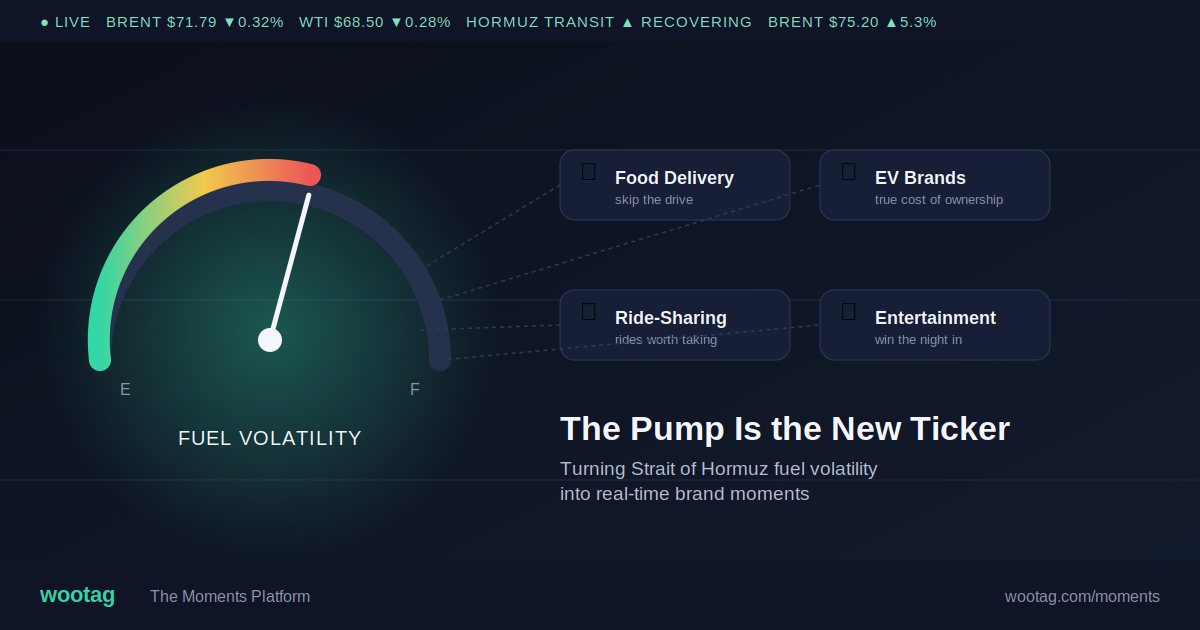

When oil prices swing 5% in an afternoon, the brands that win aren’t the ones with the biggest budgets — they’re the ones that show up in under 300 milliseconds.
Brent crude has swung between roughly $68 and $84 a barrel over the past few weeks alone — sliding to multi-month lows one week as Hormuz shipping traffic recovered, then jumping more than 5% in a single session days later after renewed strikes and a revoked sanctions waiver put the strait “back at the center of energy market concerns.” This is not a slow-burn price story. It’s a volatility story — and volatility, more than any single price level, is what’s rewriting how people drive, order, ride and spend their evenings.
That’s the opportunity most brand calendars aren’t built for. A quarterly media plan can’t react to a tanker being fired on near Hormuz on a Tuesday afternoon. But a moments platform can.
The consumer reality behind the crude chart
Fuel volatility doesn’t stay in the energy pages — it moves straight into household budgets, and the data on how it moves is unusually clear right now:
- 78% of drivers say they’re actively trying to limit how much gas they use, and 72% say higher prices have already forced them to cut spending elsewhere — dining out, travel, even groceries.
- Consumers now expect to spend 91% more on transportation over the next six months, one of the sharpest category swings tracked this year, while dining out, travel and entertainment top the list of discretionary categories being cut or postponed.
- Gig-economy drivers — the backbone of food delivery and ride-hailing — are the most exposed. Diesel has risen over 35% and unleaded gas over 26% year-to-date in the sharpest stretches, and drivers are openly weighing whether short rides and small orders are even worth taking.
Put simply: the moment fuel prices move, four consumer behaviors move with it — people drive less, order in more, look for rides worth taking, and stay home for entertainment instead of going out. Every one of those shifts is a business opportunity for the right brand, activated at the right second.
(Worth naming plainly: this volatility is being driven by an active regional conflict with a real human cost — tanker crews under fire, a fragile ceasefire, and communities in the Gulf living through genuine uncertainty. Brands tapping into this moment should read the room — this is a lens for utility and empathy, not a hook for opportunism.)
Wootag already treats crude oil as a trigger, not just a chart
This is exactly the kind of signal Wootag’s Moments Platform is built to listen for. Inside Wootag’s Commodities moments category, crude oil is explicitly mapped as a first-class trigger: “Trigger fuel-saving, EV and ride-share creative when Brent or WTI breaks key levels.” That’s not a hypothetical — it’s a live signal category sitting alongside gold milestones, crop cycles and natural gas spikes, ready to fire brand experiences the instant Brent or WTI crosses a threshold that matters to your audience.
The mechanics are the same four steps that power every Wootag activation, whether the trigger is a wicket falling or a barrel price breaking out:
- Listen — Wootag ingests live commodity feeds (Brent, WTI, regional pump prices) alongside 180+ other real-time signals, watching for the specific thresholds — a 3% intraday move, a break above/below a key level, a new weekly high — that actually change consumer behavior.
- Contextualize — AI maps the signal to brand-safe creative, dynamic offers and hyperlocal triggers, because a Brent spike means something very different to a driver in Mumbai than to one in Manchester.
- Adapt — Smart-adapt reshapes the same underlying message into the right format for feed, story, banner, CTV or a shoppable overlay — automatically, without a re-shoot or a new brief.
- Activate — The experience fires across social, publisher content, programmatic, CTV and retail screens in under 300 milliseconds of the signal firing.
One signal — a barrel price — many brand categories, all activating at once.
An engagement framework for four categories that live and die by the pump
Here’s how the listen-contextualize-adapt-activate loop translates into a real framework, category by category.
1. Food delivery platforms: make “staying in” the obvious math
When a fuel spike is reported, the instinctive consumer trade-off is: is this trip worth the gas? Food delivery platforms are perfectly positioned to answer that question before it’s even asked.
- Trigger: Brent/WTI or local pump price crosses a threshold that’s already showing up in headlines and search behavior.
- Moment: Dynamic creative reframes delivery not as a convenience upsell but as the cost-rational choice — bundled orders, waived delivery fees during the spike window, or “skip the drive” messaging timed to the exact hours pump prices lead the news cycle.
- Format: In-feed video and CTV during news-adjacent content, shoppable in-app banners the moment someone opens a delivery app after seeing a fuel headline.
- The honest caveat: this only works if the offer is real and the timing is authentic — a delivery discount that appears a week after the price spike reads as noise, not relevance.
2. EV brands and OEMs: turn the pump anxiety into a pitch for permanence
Every crude rally is, in effect, free top-of-funnel media for EV adoption — but only for the brand that’s in the conversation the day it happens, not the quarter after.
- Trigger: Sustained multi-day upward movement in Brent/WTI (Wootag’s platform is built to distinguish a genuine rally from single-day noise).
- Moment: Contextual creative pairs the day’s fuel headline with a concrete, calculable cost-of-ownership comparison — not a brand film, a spreadsheet turned into a 6-second social card. This lines up with what buyers already say drives EV consideration: Deloitte’s 2026 Global Automotive Consumer Study finds lower fuel cost remains one of the top reasons consumers cite for wanting an electrified vehicle next.
- Format: Programmatic display and search bid logic synced to the live signal, CTV spots that swap in a fuel-cost callout during the exact broadcast window covering the price move.
- The honest caveat: EV messaging that leans only on fuel savings during a fast-reversing price war can look opportunistic if crude drops back the following week (as it has done repeatedly this year) — durability of message matters more than the size of the spike.
3. Ride-sharing platforms: protect the driver, don’t just discount the rider
Ride-share is the category most directly squeezed by fuel volatility — drivers are already avoiding short trips to protect margin. A moments-based approach can activate on both sides of the marketplace at once.
- Trigger: Regional pump price crossing a level that’s already changing driver acceptance rates.
- Moment: Rider-facing dynamic offers (“ride-pooling discounts,” off-peak fare incentives) paired with driver-facing surge transparency, activated hyperlocally rather than as a blanket national promo.
- Format: In-app moments, social and CTV creative that acknowledges the trade-off plainly rather than papering over it — audiences increasingly reward brands that reflect the reality they’re living, not just the offer.
- The honest caveat: this is the category where authenticity is most tested. Gig drivers are on record saying they’re already absorbing the pain of fuel volatility — a campaign that treats the moment purely as a rider-acquisition opportunity, with nothing for the driver, risks landing badly with exactly the audience the platform depends on.
4. Entertainment and streaming platforms: win the night people decide to stay in
If dining out and travel are the discretionary categories getting cut first, the corollary is a night at home that needs to feel like an upgrade, not a compromise.
- Trigger: Fuel price headline moment coinciding with weekday evening dayparts, when the “go out vs. stay in” decision is actually being made.
- Moment: Contextual creative positions a new release, live sports package or bundle as the answer to “worth the drive tonight? or worth the watch?” — reframing a home evening as the deliberate, smart choice rather than the fallback.
- Format: CTV and social-native creative, timed to fire alongside the same fuel-price news cycle driving the behavior — this is where Wootag’s Weather and Commodities moment categories can be layered (a heatwave and a fuel spike compound the incentive to stay home).
- The honest caveat: this only resonates if it stays light — nobody wants an entertainment ad that sounds like it’s profiting from a geopolitical crisis. The best version of this moment is helpful and a little self-aware, not triumphant.
Why real time actually matters here — and where it stops mattering
The single most important thing about this moment: the volatility is the story, not the price level. Brent has round-tripped from $84 to $68 and back into the $70s multiple times across a matter of weeks. A campaign planned around “high gas prices” as a static condition will be stale before it launches — sometimes within days. A campaign wired to the actual signal, via Wootag’s Moments Platform, adjusts itself every time the number moves.
That’s also precisely why brands need to build in restraint. Wootag’s own commodities framework treats crude, gas and metals as one category among many real-world signals — the same infrastructure that fires a fuel-saving message on a Brent breakout can just as easily go quiet if the geopolitical situation genuinely stabilizes and the story fades from real relevance to manufactured urgency. A moments strategy that keeps activating a crisis narrative after the crisis has actually cooled is not real-time marketing — it’s just noise with better targeting.
The framework, condensed
| Trigger | Category | Wootag moment type | Consumer trade-off being solved |
|---|---|---|---|
| Brent/WTI breakout | Food delivery | Dynamic offer + shoppable | “Is this errand worth the drive?” |
| Sustained crude rally | EV / auto | Contextual creative + cost comparator | “What does ownership actually cost me?” |
| Regional pump spike | Ride-sharing | Hyperlocal dynamic offer | “Is this ride worth taking / worth paying for?” |
| Fuel headline + evening daypart | Entertainment / streaming | CTV + social contextual creative | “Go out, or stay in and still feel good about it?” |
Four categories, one underlying signal, activated the moment it fires rather than the week after — that’s the difference between a moments strategy and a media plan that happens to mention gas prices.
Fuel markets will keep moving before this post stops being relevant. That’s the point. Explore Wootag’s Commodities moments → or see how the full Moments Platform listens, contextualizes, adapts and activates across sports, weather, stocks and commodities in real time.
Sources: Al Jazeera, Trading Economics, The National, NBC News, CNBC, Resonate, Deloitte 2026 Global Automotive Consumer Study.
