

Unilever’s personal care division did not phone in its 2026 FIFA World Cup activation. Across 35 brands and 120 markets, the CPG giant ran what may be the most ambitious sponsor playbook the tournament has seen — broadcast spots featuring national team stars, a Degree-branded “Club Fresh” at stadiums, armpit-logo placements on officials’ substitution boards, a Charli XCX tour takeover, and House of Fresh, an invite-only creator hub that pulled 200 to 250 creators a day into its New York location. On craft, casting and cultural fluency, the campaign is close to a masterclass.
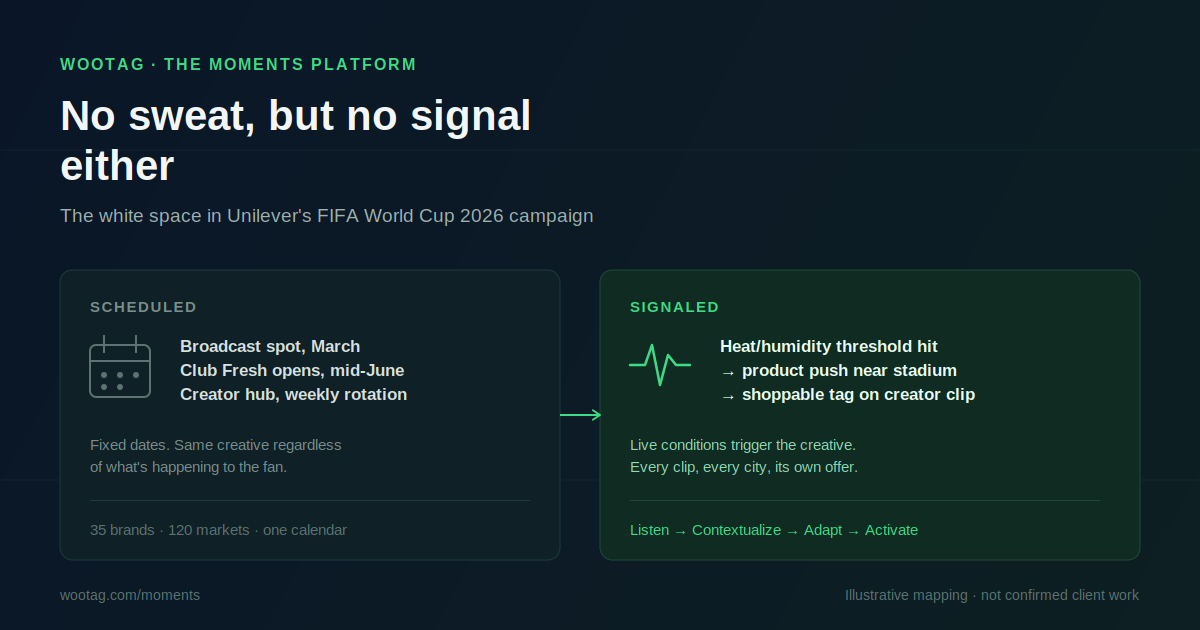
But look closely at the mechanics behind it, and a pattern emerges: almost everything Unilever built was scheduled, not signaled. The Rexona spot rolled out in late March. Dove’s followed in May. Club Fresh opened when the tournament began in mid-June. House of Fresh ran on a weekly rotation. These are all smart, well-produced moments — but they were placed on a calendar months in advance, not triggered by what was actually happening to the audience in real time. For a campaign built entirely around sweat, heat and the physical discomfort of being a fan, that’s the one variable the plan never actually listened to.
That gap is the white space. Here’s where a moments-based layer — the kind Wootag’s Listen → Contextualize → Adapt → Activate framework is built for — could have taken an already-strong campaign and made it responsive instead of just scheduled.
What the campaign got right
Before getting into the gaps, credit where it’s due. Unilever’s execution had three things most sponsor campaigns miss:
- Distributed brand ownership. Rather than one hero brand carrying the tournament, Rexona, Degree, Dove, Dove Men+Care and Axe each got a distinct lane, letting the portfolio show up in multiple emotional registers — confidence, performance, humor, care — without diluting any single brand.
- Physical-to-digital bridging. Club Fresh’s Panini player cards and travel-size product sampling gave the stadium activation a reason to be photographed and shared, which is the hardest part of experiential marketing to get right.
- An always-on creator layer. The Locker Room, described as a 24/7 hub for creators to “deliver real-time responsive content,” was the closest thing in the campaign to a moments infrastructure — it just wasn’t connected to any live signal beyond the match schedule itself.
That last point is the thread worth pulling. Unilever built the creative capacity to respond in real time. What it didn’t build was the signal layer to tell that capacity when to fire.
Idea 1: The campaign never listened to the thing it was selling against
A deodorant sponsorship built around World Cup sweat is, on paper, one of the most natural signal-to-brand fits imaginable. Rising temperatures and humidity are already cited by every major deodorant market report as a direct demand driver for the category — this isn’t a stretch of a brief, it’s the brief. Yet nothing in the public record of the campaign shows creative that changed based on actual match-day heat or humidity conditions in the host city.
With a weather-signal layer switched on, Club Fresh and the broadcast buy could have worked very differently:
- A heat-and-humidity threshold trigger — say, wet-bulb conditions crossing a defined discomfort line in the host city on match day — could fire a Rexona or Degree creative variant an hour before kickoff, tied to that city specifically, rather than a generic spot running on a fixed broadcast date.
- Stadium-adjacent commerce, like QR-driven retail screens near transit hubs and fan zones, could push travel-size product exactly when the forecast (not the calendar) says fans are about to be uncomfortable — turning “we happened to have a kiosk here” into “we knew you’d need this today.”
- Creative tone could adapt to conditions, not just city. A humid, still-air night match reads differently than a dry, breezy afternoon kickoff — Wootag’s resonance layer is built to map the emotional register of a signal (discomfort, urgency, relief) to the offer and copy, rather than running one approved cut everywhere.
None of this requires a new brand idea. It requires the existing idea to actually respond to the condition it’s selling a solution for.
Idea 2: House of Fresh generated the moment but not the transaction
House of Fresh and The Locker Room pulled real cultural weight — Roberto Carlos, Daniel Sturridge, Marshawn Lynch and Trinity Rodman are not small names, and 200-plus creators a day is a genuine achievement in activation density. But based on what’s public, the output of that space was content: talks, social posts, amplification. There’s no visible mechanism turning a creator’s post about Dove Men+Care or Rexona into an immediate, trackable purchase.
That’s a meaningful gap given where the data has moved. Shoppable short-form video with in-video product links now converts at roughly four times the rate of an equivalent static sponsored post pointing to the same product, and a majority of consumers say they’ve bought something directly because a creator recommended it. A creator hub that produces reach without a shoppable layer is leaving the second half of that funnel on the table.
The fix isn’t a new content strategy — it’s plumbing:
- Every House of Fresh clip, whether from Roberto Carlos or a nano-creator in the network, could carry a dynamic shoppable overlay that swaps the linked product and offer by the viewer’s market, so a clip filmed once in New York sells the right SKU in São Paulo, Lagos or Manila.
- Creator content could be tagged to the signal that inspired it — a post filmed the day of a heatwave alert, or right after a last-minute goal, carries a different offer than one filmed on a quiet rest day, letting the brand pay for performance against the moment rather than a flat sponsorship fee.
- Hyperlocal walk-in incentives could turn a creator’s stadium-city appearance into foot traffic — a limited-window offer redeemable at nearby retail only while that creator is in town, verified by geofence.
The rest of the white space
Beyond the two gaps above, a handful of other moments were sitting in plain sight during the tournament and went untriggered:
| Real-world signal during the tournament | What Unilever ran | What a moments layer could have triggered |
|---|---|---|
| Host-city heat/humidity crossing a discomfort threshold | Fixed broadcast spot, scheduled stadium activation | City-specific creative + product push the moment conditions cross the line |
| A goal, red card, or match-defining moment | No visible in-match creative response | Shoppable overlay or social push timed to the goal or last-minute winner, riding peak emotional attention |
| Creator content going live from House of Fresh | Organic amplification across TikTok/YouTube | Dynamic, market-specific shoppable tagging on every clip |
| Underdog upset or shock result | No visible reactive creative | Rapid-response creative celebrating the upset, in the flavor of the brand backing the team that pulled it off |
| Fan travel disruption (heat-related transit delays, crowding) | Not addressed in the campaign | Utility-first messaging (cooling stations, hydration, product sampling) positioned as fan support, not opportunism |
| Post-match commute and watch-party window | Not addressed | Time-boxed offers timed to the actual final whistle in each match’s local time zone, not a generic all-tournament promo |
The common thread: Unilever had the media weight, the creative bench and the retail footprint to act on every one of these. What was missing was the always-on signal layer connecting a live condition — heat, a goal, a viral clip — to the creative and commerce already built to respond to it.
Why this matters beyond one campaign
This isn’t a critique specific to Unilever — if anything, Unilever’s campaign had more of the raw ingredients for a moments-based layer (an emotionally resonant product category, a creator infrastructure, retail presence in every match city) than most sponsors bring to a tournament. That’s exactly why it’s a useful case study: even a best-in-class scheduled campaign shows where the ceiling is once the tournament actually starts and the calendar stops being the thing driving the plan.
The 2027 Women’s World Cup, which Unilever has already signaled interest in via its Gotham FC partnership and Keep Her in the Game initiative, is the next obvious test of whether that signal layer gets built in from the start rather than retrofitted mid-tournament.
A transparency note on this analysis: the gaps identified above are drawn from what Unilever has made public about its campaign, as reported in trade coverage of the activation. It’s possible the brand ran signal-responsive creative internally that wasn’t covered in the press — we’re assessing the public record, not internal campaign infrastructure we don’t have visibility into. Likewise, the “what a moments layer could have triggered” column is an illustrative mapping of Wootag’s platform capabilities against a public campaign, not a claim of confirmed client work with Unilever or any brand named here.
If your brand is planning a major sponsorship — a World Cup, a Grand Slam, an awards season, a monsoon or heatwave-exposed retail push — the question worth asking before the campaign locks isn’t just “what will we say,” but “what will make us say it at the right second.” That’s the layer Wootag builds.
