
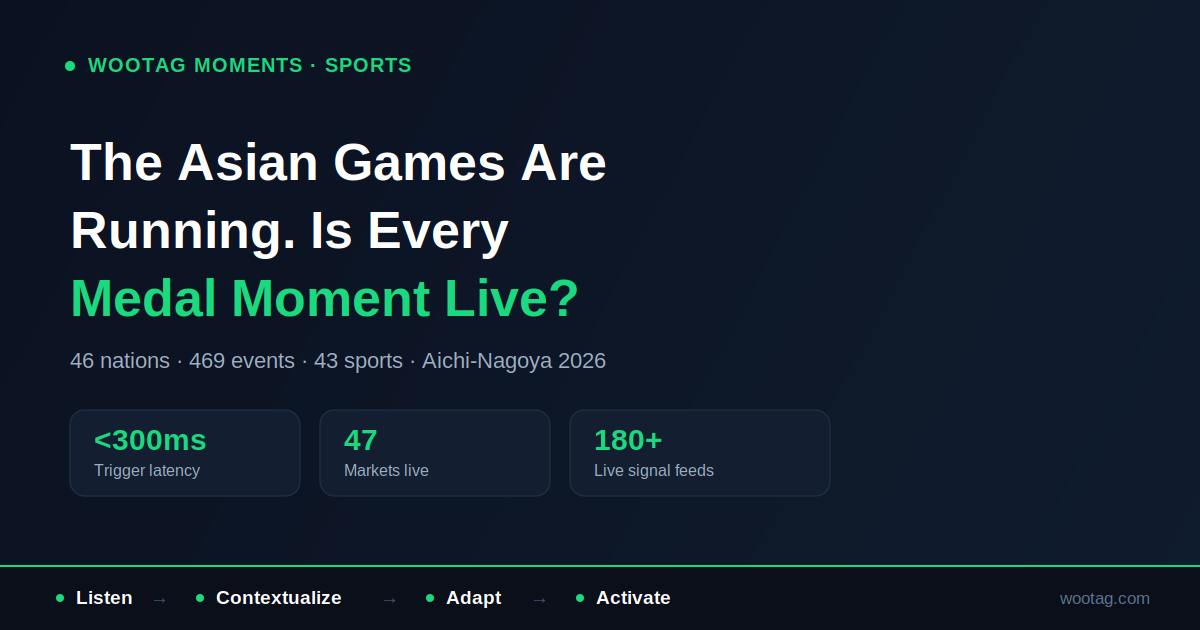

Right now, in Aichi and Nagoya, Japan, 46 nations and more than 10,700 athletes are competing across 43 sports and 469 events at the 20th Asian Games. The Games opened on September 19 and run through October 4, with several disciplines having already started earlier in the month. It is the biggest live signal Asia will generate this year: a 16 day window in which hundreds of millions of people across the continent are checking scores, watching finals, and reacting in real time to medal counts from their own country.
And yet, for most brands sponsoring or advertising around the Games, the plan looks the same as it did for the last one. A hero spot for the opening ceremony. A closing ceremony wrap-up. Maybe a banner that says “proud to support Team X” for the whole two weeks. The 469 individual events in between, each one a moment where a specific country’s audience is emotionally locked in, mostly go unclaimed.
The gap: brands plan for the Games, not for the moments inside them
A multi-sport, multi-country event like the Asian Games does not behave like a single tournament. A football World Cup final is one moment, shared globally. The Asian Games is closer to 469 separate moments, spread across 16 days, each relevant to a different, narrower slice of the audience. A badminton gold for Indonesia does not mean anything to a viewer in the UAE. A medal tally shift that puts South Korea ahead of Japan matters enormously to those two audiences and to almost nobody else.
Most activation plans are not built to work at that resolution. They are built around two or three tentpole moments, opening ceremony, closing ceremony, maybe a marquee final, because that is what a traditional creative production cycle can support. The result is a lot of unclaimed attention sitting between those tentpoles: qualifying rounds, country specific medal moments, and the closing stretch of the Games when medal tallies are actually decided.
Why the gap persists
The honest answer is production speed, not strategy. Briefing, designing, and trafficking a new creative for every country’s medal moment across a 16 day, 43 sport event is not something a normal creative workflow can keep up with. Even well resourced sponsors default to a small number of pre-built assets because building bespoke creative for hundreds of individual triggers, spread across dozens of countries, is operationally out of reach without an orchestration layer sitting between the live signal and the ad.
This is exactly the gap Wootag Moments is built to close. The platform’s four stage model, Listen, Contextualize, Adapt, Activate, ingests the live signal (an event starting, a medal being won, a country qualifying for a final), matches it to the right pre-approved creative logic, adapts the asset to the channel it needs to run on, and activates it in under 300ms. The bottleneck stops being “how many creatives can our team traffic manually” and becomes “how many moments has the brand decided are worth activating.”
The channel does not change the logic
Whatever channel a brand runs on, CTV, social, programmatic display, or owned app, the underlying decision is the same one: what is the signal, what does the audience feel when it happens, and what should the brand say in that instant. Wootag’s orchestration layer sits above the channel, so the same medal tally signal that fires a CTV spot in one market can fire a Meta story in another and a push notification in a third, without the brand having to rebuild the logic three times for three platforms. This is what makes a multi-country event like the Asian Games manageable: one rules layer, adapted per channel, rather than one campaign per channel built from scratch.
The Asian Games rules framework, and what it is actually doing
Inside Wootag Moments, the Asian Games are set up as a rules structure with three layers.
Default: Fallback Ad (No active rules). This is the ad that runs whenever none of the sport or country specific rules are triggered. It is the safety net that keeps the brand present and on message for the entire 16 day window, even during the hours when no qualifying rule is live. Every activation needs this layer, because a live event framework without a fallback risks going dark during the gaps.
Games Events: Opening Ceremony / Games Begin, Closing Ceremony / Games Conclude. These are the two tentpole triggers every brand already plans for, but here they are just two rules among many, not the entire activation. Wrapping them into the same rules engine as everything else means the opening and closing creative is on the same automated rail as the country level moments, rather than being a separate manually trafficked asset.
Country Events: Medal Tally, Final Qualified. This is where the real value sits. A medal tally rule can trigger a creative the moment a specific country’s count changes, meaning a brand sponsoring across multiple markets can run a genuinely local moment, “Congratulations Team Vietnam” or “Team Uzbekistan through to the final”, without a media planner manually watching every country’s results and pushing creative live by hand. A Final Qualified rule captures the moment a country’s team locks in a spot in a gold medal match, which is consistently one of the highest attention, highest emotion windows in any multi-sport event, and does so automatically, per country, for the length of the Games.
Put together, this is not a single Asian Games ad. It is a live decision tree: default creative running as the baseline, ceremony creative firing on the two calendar anchored moments, and country creative firing dozens of times across the Games as medal tallies shift and teams qualify, each instance reaching the specific national audience it is relevant to. A brand active across Southeast Asia, South Asia, and the Gulf can run one framework and let the country signals do the localization work that would otherwise take a market by market production team.
Where this maps across categories
The same rules structure supports very different business outcomes depending on the category. The signal stays the same; what fires in response changes.
| Vertical | Signal that matters | What fires | Where it runs |
|---|---|---|---|
| FMCG / Personal Care | Country medal win, heatwave alongside outdoor events | Localized celebratory creative, product tie-in per market | Meta, TikTok, display |
| Fintech / Payments | Country qualifies for final, medal tally shift | Congratulatory brand message, market specific offer | Push, programmatic video, display |
| Travel & Hospitality | Opening ceremony, country advancing to medal rounds | Destination or fan travel offer tied to the moment | CTV, social, display |
| Consumer Electronics | Marquee event (athletics, swimming finals) | Device tie-in creative timed to peak viewership | CTV, programmatic display |
| Telecom | Medal tally, closing ceremony | Data pack or streaming offer around Games viewership peaks | Push, owned app, display |
| Apparel & Sportswear | Country medal win, athlete performance | Product spotlight tied to the sport just won | Meta, TikTok, own site |
| Retail / QSR | Country medal win, weekend event clusters | Local promotion or in-store tie-in per market | Meta, push, hyperlocal display |
The mechanism is identical across every row: a live signal from the Games triggers a pre-approved creative logic, adapted to the channel, activated in real time. What changes is only the offer and the message, which is exactly the point of building this as a rules engine rather than a one-off campaign.
A note on sourcing
The Asian Games facts in this piece, the 46 competing nations, more than 10,700 athletes, 469 events across 43 sports, and the September 19 to October 4 window, come from Olympics.com’s official coverage of the Aichi-Nagoya 2026 Games and the event’s own published schedule. Wootag’s own platform figures referenced here, the sub-300ms trigger latency, the 47 live markets, and the case study outcomes for Valvoline (99.03% average VCR on FIFA moment triggered CTV) and Budweiser (3.2x engagement uplift on FIFA moment triggered display) are self-reported by Wootag from its published case studies and are called out separately here rather than blended with the independent Games data above.
The Games are already running
This is not a campaign to plan for next year. The 20th Asian Games are in progress right now, and every day without a country level activation layer running is a day of unclaimed medal moments, qualifying rounds, and ceremony attention that a fallback banner cannot capture on its own.
If your brand has any presence across the countries competing in Aichi-Nagoya, the question worth asking this week is simple: is there a rule live for the next country that wins a medal, or is there just one ad running for the whole event?
Book a demo → to see how a Games specific rules framework, default fallback plus ceremony triggers plus country level medal and qualification signals, can be built and running before the next final airs.
