

Every brand still runs on the same rhythm: a quarterly plan, a media calendar, a set of creative assets signed off weeks in advance. It’s a rhythm built for a world that no longer exists. Consumers don’t live inside campaign windows — they live in the white space between them: the ten seconds after a wicket falls, the minute a heatwave alert pops up, the hour a stock breaks out. Brands that only show up on schedule are, by definition, absent for almost all of it.
This isn’t a call to abandon planning. It’s an argument for treating the unplanned moment as a media channel in its own right — one that consumers are already primed to engage with, and one that most marketing organizations are still structurally unable to reach.
The pre-planned campaign is running out of room
The traditional model — lock creative months ahead, flight it on a schedule, optimize within those fixed guardrails — is showing real strain. Ad fatigue is no longer a niche concern: 91% of users now say ads have become more intrusive, and 87% feel there are simply more ads than ever, a saturation point where click-through rates can fall 50–70% within weeks as audiences develop banner blindness to repeated creative. The problem isn’t volume — it’s sameness. Consumers aren’t tuning out advertising; they’re tuning out advertising that ignores the moment they’re actually in.
The funnel itself is bending under the same pressure. GWI’s 2026 consumer research suggests that what marketers label “impulse buying” usually isn’t spontaneous at all — it’s latent demand finally finding its moment, with over half of consumers globally making an online impulse purchase at least once a month, including meaningful shares of typically high-consideration categories like tech and travel. The classic awareness-consideration-conversion funnel increasingly fails to describe how people actually buy: demand is always on, and purchases happen when confidence peaks, not when a brand’s calendar says it’s time to message. GWI’s own framing captures the shift in strategy this demands — moving away from short-term, one-off targeting toward longer-term trust building, and recognizing that impulse and planning have already blurred into each other, so brands need the capacity to meet latent demand the moment it activates, not just when a campaign is live.
A pre-planned campaign, by its nature, can only fire when the plan says so. Latent demand doesn’t wait for the plan.
What “white space” actually means
White space, in this context, isn’t dead air — it’s every moment that falls outside a brand’s pre-scheduled media flight: a live sports event, a sudden weather shift, a market move, a cultural trend cycle. These moments are unplanned by definition, but they are not unpredictable in aggregate. Sports fixtures, monsoon seasons, earnings calendars, and election cycles are all knowable in advance, even if the exact instant of peak emotion — the wicket, the goal, the heatwave alert — is not. The opportunity is building the infrastructure to listen for that instant and respond inside it, rather than trying to predict and pre-produce every possible outcome.
Some of the most-cited real-time marketing moments of the past two years show what happens when brands get this right. When Dua Lipa announced a concert tour, Duolingo’s Albanian-language comment earned 47,000 likes and 2,300 replies — 6.2x its average comment engagement. During the viral “demure” trend, Notion’s tongue-in-cheek response generated 89,000 views in three hours against a typical 12-hour view count of 15,000. Grammarly’s live commentary on Oscars broadcast typos reached 1.2 million impressions in four hours, its best single-event real-time result to date. None of these were scheduled campaigns. All of them outperformed the brand’s own baseline by a wide margin.
But there’s an important nuance here, and it’s one worth being honest about: not all real-time responses are equal. Academic research on real-time marketing messaging has found that planned, pre-structured real-time responses tend to modestly improve engagement, while fully improvised, in-the-moment reactions can actually reduce it — largely because rushed messaging suffers on comprehension and creative quality. In other words, the goal isn’t spontaneity for its own sake. It’s readiness — having the creative logic, brand guardrails, and distribution already built, so that when the signal fires, the response is fast and considered, not just fast.
Context changes whether people remember you at all
There’s a neurological reason white-space engagement outperforms generic scheduled advertising: relevance to the moment directly affects memory formation. Research on contextually matched advertising found that ads aligned with the surrounding context drove a 23% lift in the part of the brain responsible for remembering practical details — key messages, calls to action, branding — and a 27% lift in overall memorability of themes and creative elements. Where an ad’s message matched the specific context a person was already engaged with, detail memory improved by 36% compared to an unmatched ad. Separately, research into out-of-home advertising within multi-channel campaigns found that contextually delivered formats can drive 37% more attention than digital ads shown without that context.
Put simply: the same creative, shown to the same person, performs meaningfully better when it arrives inside a moment that already has their attention than when it’s pushed into their feed on a fixed schedule. Pre-planned media buys optimize for reach and frequency. White-space engagement optimizes for the thing frequency can’t buy — relevance at the instant attention is highest.
Sport is the clearest proof of concept
Live sport is the sharpest illustration of why white space matters, because the emotional peaks are extreme and the windows are short. A wicket falls in seconds. A goal is celebrated for a minute. A last-ball finish is the single most-watched moment of an entire match. A campaign scheduled for “match day” misses all of it; only a system built to detect and activate on the moment itself can be present when it happens.
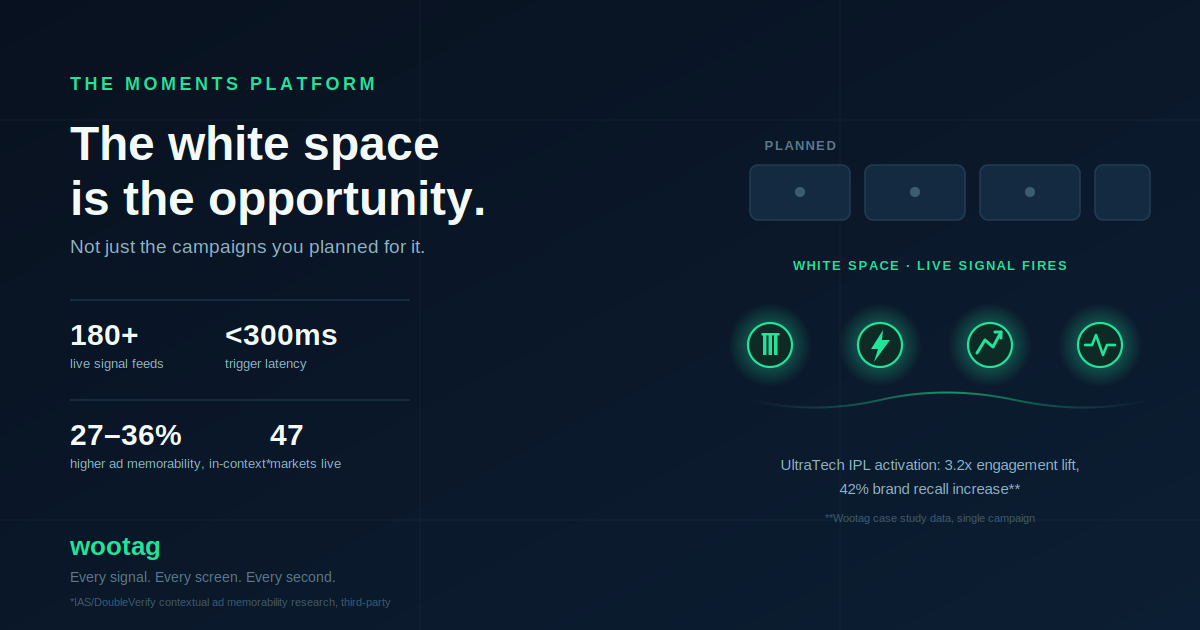
This is precisely the gap Wootag’s Moments Platform is built to close, using a four-step model — Listen, Contextualize, Adapt, Activate — that ingests 180+ live signal feeds across sports, weather, stocks and commodities, detects high-impact moments in real time, and fires brand-ready creative across social, CTV, programmatic and shoppable formats in under 300 milliseconds. In cricket alone, the platform is built to trigger against five distinct in-match moments — wicket falls, century celebrations, powerplay overs, standout catches, and final-over finishes — each mapped to a different emotional register and a different creative response.
The results from brands already doing this are notable. UltraTech Cement’s IPL activation used real-time shoppable overlays tied to boundaries, wickets and powerplay milestones, with branding triggered instantly across CTV and social the moment each event occurred. The campaign delivered a 3.2x engagement lift, a 42% increase in brand recall, 18% incremental reach, and more than 12 million real-time impressions.
Pre-planned vs. white-space engagement, side by side
| Dimension | Pre-planned campaign | White-space engagement |
|---|---|---|
| Trigger | Calendar date / media flight | Live signal (sports event, weather, market move) |
| Creative | Fixed, produced in advance | Dynamically adapted to the moment’s context |
| Audience state | Assumed / modeled | Actual, in the moment — emotion and attention peaking together |
| Memorability | Baseline recall | Up to 27–36% higher detail and global memory when context-matched |
| Risk of fatigue | High — same creative repeats until CTR erodes | Lower — creative varies with the signal, not the schedule |
| Best for | Sustained brand-building, planned product moments | Capturing latent demand exactly when it activates |
The two aren’t competitors — they’re complements. WARC’s global effectiveness research has consistently found that a healthy split between brand-building and performance activity outperforms either extreme on its own. White-space engagement is best understood as the always-on layer that keeps a brand present and relevant between the planned pushes, not a replacement for the planning itself.
A note on the data behind this piece
The engagement, recall and reach figures cited for UltraTech’s IPL activation come from Wootag’s own case study reporting and reflect a single brand campaign; they are not independently audited third-party benchmarks, and results will vary by category, market and execution. The signal-count, latency and market-coverage figures (180+ signals, sub-300ms trigger latency, 47 live markets, 2.1B monthly impressions) are also Wootag platform figures as published on wootag.com. Where this piece draws on ad fatigue, attention, memorability, and consumer demand research, those figures are sourced from third-party research bodies — GWI, WARC, IAS/DoubleVerify-adjacent studies, and peer-reviewed marketing research — and are cited to their original context rather than Wootag’s own data. Readers evaluating white-space engagement for their own brand should treat the case study figures as illustrative of what’s achievable under real-time activation, not as a guaranteed outcome.
The takeaway
Consumers already live moment-to-moment; the funnel research confirms that latent demand doesn’t wait for a media calendar to catch up with it. Brands that only show up in pre-planned windows are, mathematically, absent for the overwhelming majority of the moments that actually move people. The white space isn’t a gap to be tolerated between campaigns — it’s where attention, emotion and intent already converge, and it’s increasingly where the next unit of brand growth is going to come from.
