

Right now, somewhere in the world, a currency is moving, a match is turning, a heatwave is breaking a decade of records, and a stock index just crossed a threshold that matters to someone. None of that is rare. It is happening constantly, on a loop, in every market a brand operates in.
What is rare is a brand that has built a system to catch any of it and turn it into something that moves a business objective. Most martech stacks were built to manage audiences and schedules, not to listen to the world in real time and decide, in under a second, whether a signal is worth acting on and what it should say.
That is the gap Signal Orchestration is built to close. But orchestration on its own is just plumbing. The part that actually matters to a CMO or a brand lead is what comes out the other end: a Moment that is provably connected to a business outcome, not just a clever real-time creative swap.
This post walks through the workflow end to end. How a raw signal becomes a qualified moment, how that moment gets matched to a specific business objective, and what that looks like across a few different categories, using real activations as reference points.
Why “real-time creative” and “signal orchestration” are not the same thing
A lot of what gets called real-time marketing is really just dynamic creative optimization. Swap a headline, swap an image, based on weather or location. That is useful, but it is reactive at the asset level only. It does not answer three questions a business objective actually depends on:
Which signals are worth reacting to, out of the hundreds firing at any moment.
What should this signal mean for this specific brand’s goal, whether that is awareness, consideration, conversion, or cost efficiency.
Where and in what format should the response show up, so it reaches someone while the emotional or contextual window is still open.
Signal Orchestration answers all three before a single creative asset ever changes. It is the decision layer sitting underneath the stack, not a plugin bolted onto one channel.
The workflow: Listen, Contextualize, Adapt, Activate
Every moment that fires, regardless of category, moves through the same four stages. What changes from brand to brand is which business objective each stage is tuned toward.
1. Listen
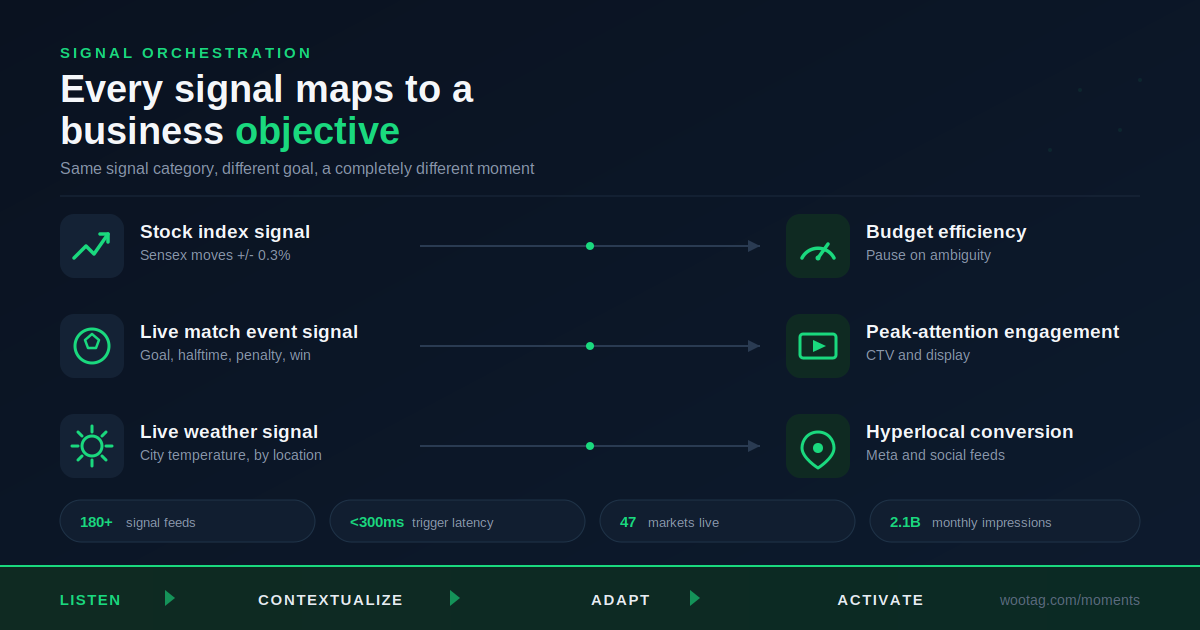
The system ingests live signal feeds. Wootag Moments currently listens across 180+ live signal feeds spanning sports, weather, stocks and commodities, at sub-300ms trigger latency. This stage is pure detection. No brand logic is applied yet. The system is simply watching for the signal thresholds that have been defined as meaningful, whether that is a goal being scored, a city crossing a temperature mark, or an index moving a defined percentage.
2. Contextualize
This is where the business objective enters the workflow. The same signal can mean completely different things depending on what a brand is trying to achieve. A goal being scored in a football match could be treated as a pure attention spike for one brand, or as a specific message trigger for another. Contextualization is the mapping step: signal plus objective equals a defined moment type, along with the tone, offer and message it should carry.
3. Adapt
Once a moment is defined, the creative has to be reshaped for wherever it will land. A moment that works as a CTV spot needs a different format and pacing than the same moment adapted for a Meta feed or a programmatic display unit. Adapt is the stage that does that reshaping automatically, so the underlying message stays consistent while the format fits the channel.
4. Activate
The moment fires live, across whichever channels were selected at the objective-mapping stage: CTV, social, programmatic, retail screens, or shoppable overlays. This is also the stage where the business objective shows up as a measurable outcome, whether that is a lift in engagement, a lift in conversion, or a reduction in wasted spend.
Same workflow, different business objective: four examples
The workflow above stays constant. What changes is which objective is being optimized for at the Contextualize stage. Here is how that plays out across a few different real activations.
Objective: budget efficiency and risk control
Franklin Templeton, a mutual fund brand, needed a way to talk about market volatility without contradicting itself within the same day. The signal orchestrated here was the Sensex index, moving in real time. A rise of 0.3 percent or more triggered a growth-led film. A drop of 0.3 percent or more triggered a stability-led film. Anything inside that band paused the activation automatically, so no budget was spent on a moment that was not clear enough to act on.
The objective was never just engagement. It was precision spend and message accuracy, and the result reported was an 8.3x lift in CTR alongside a 24 percent budget saving and zero wasted impressions, based on Wootag’s self-reported case study data.
Objective: peak-attention engagement on a big screen
Valvoline wanted its CTV presence during FIFA matches to feel like it was reacting to the match, not just running on a loop next to it. The signal here was live FIFA match events: goal, halftime, penalty, team win. Each event triggered its own CTV spot with a message tuned to that specific moment.
The objective was attention capture in a format where a single missed beat means the creative feels stale. The reported result was a 99.03 percent average VCR alongside 37 percent cost efficiency, per Wootag’s case study reporting.
Objective: global brand relevance across a live tournament
Budweiser ran a similar signal set, live FIFA match events including kick-off, goal, halftime, penalty and win, but the objective and channel were different. This was a display and DCO play at global scale during the FIFA World Cup, aimed at staying relevant and present across a tournament without needing a new creative built for every match.
The reported result was a 3.2x engagement uplift and 39 percent cost efficiency, based on Wootag’s self-reported figures. Same signal category as Valvoline, different objective, different channel, different creative logic entirely.
Objective: hyperlocal personalization at scale
Everyuth, a personal care brand, needed a way to make one campaign feel locally relevant across many cities at once, without producing a separate creative for every location. The signal orchestrated was live city temperature. As temperature shifted by location, the matching image and video creative was assembled and served across Meta, in multiple formats.
The objective here was relevance and conversion intent at the individual viewer level, not just reach. The reported outcome was a 2.3x engagement uplift, 2.7x video moments, and 41 percent cost efficiency, per Wootag’s case study data.
A secondary reference point: peak-moment attention in a regional context
FedEx ran a comparable live sports moment structure during IPL matches, orchestrating signals like six, four, wicket and team win into contextual interactive ads synced to the live scorecard. The objective was capturing attention at the exact peak of a match, particularly on days a specific team played. Reported results included a 4x-plus CTR uplift on those match days. This is a useful secondary reference point for markets where cricket carries that kind of cultural weight, though football-based examples tend to travel better for a global audience.
Mapping signal to objective: a quick reference
| Business objective | Signal category | Moment type | Channel | Reported outcome |
|---|---|---|---|---|
| Budget efficiency and risk control | Stock index movement | Contextual video, pause-on-ambiguity logic | Programmatic video, OLV, display | 8.3x CTR, 24% budget saved |
| Peak-attention engagement | Live sports events | Real-time sports moments | Connected TV, OTT | 99.03% average VCR |
| Global brand relevance at scale | Live sports events | Dynamic display, DCO | Display, programmatic | 3.2x engagement uplift |
| Hyperlocal personalization and conversion | Live weather by location | Weather-triggered creative | Meta, Instagram, Facebook | 2.3x engagement uplift |
| Regional peak-attention capture | Live match events | Interactive contextual ads | OTT live stream, programmatic video | 4x+ CTR on match days |
All figures above are self-reported case study results published by Wootag and have not been independently audited. They are included as illustrative benchmarks of what signal-to-moment orchestration has produced in specific activations, not as a guaranteed outcome for every brand or category.
Why the objective has to come before the signal, not after
The pattern across every example above is the same. The signal category barely matters on its own. Sports signals alone do not tell you whether the objective is attention, relevance, or efficiency. Weather signals alone do not tell you whether the goal is conversion or brand warmth. The objective has to be defined first, so the Contextualize stage knows what a given signal should actually mean for that brand.
This is also why Signal Orchestration works best as an infrastructure layer underneath a brand’s existing stack rather than a replacement for it. It does not compete with a CDP or a CRM. It sits below them, listening to the world, and feeding qualified, objective-mapped moments into whatever channel or system a brand already activates through.
The signals are already firing. The question worth asking is not whether to react to them, but whether the reaction is actually tied to something the business is trying to move.
If there is a specific signal category or business objective relevant to your category that you would like mapped out in more depth, that is a conversation worth having before the next moment passes.
