

Keywords: Moments, real-time signals, contextual marketing, moment marketing, growth marketing, marketing efficiency
Most conversations about performance social media start and end with the media plan: audience size, reach, frequency, channel split, click-through rate. That’s a useful lens for buying inventory. It’s the wrong lens for understanding what actually drives growth.
Growth doesn’t come from impressions. It comes from three levers, and only three: acquiring customers more efficiently, reaching people you couldn’t reach before without losing relevance, and building enough brand equity that the first two get cheaper over time. A media plan can describe how a brand shows up. It can’t, on its own, explain why one brand’s spend compounds into growth and another’s just produces impressions.
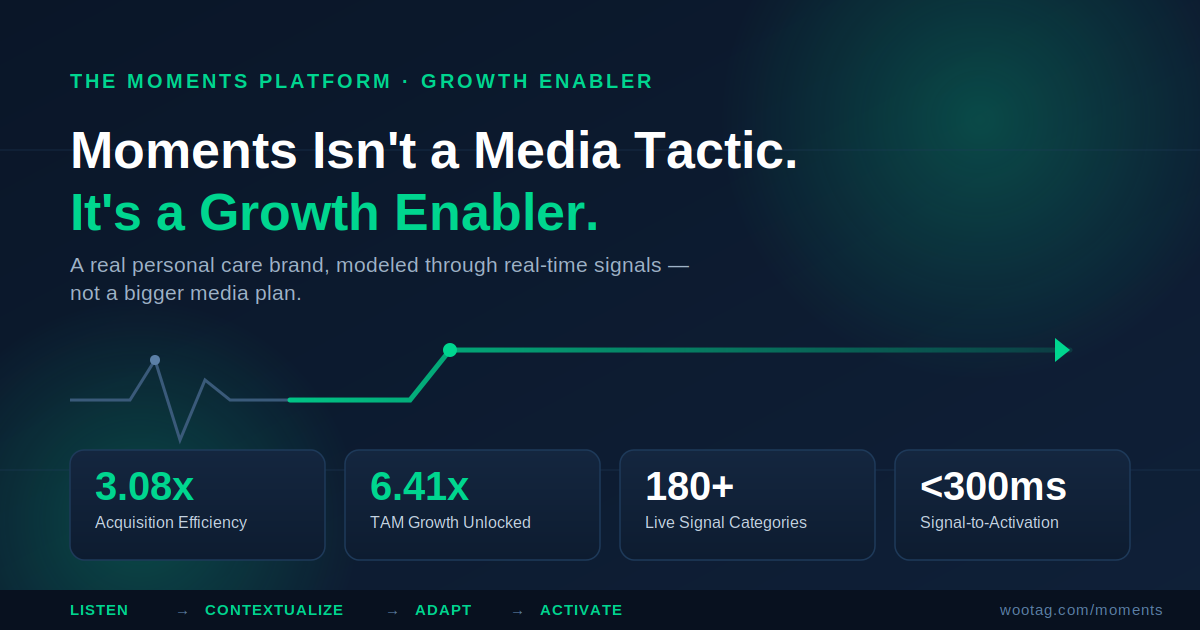
Wootag’s Moments Platform sits underneath the media plan, not inside it. It’s a real-time signal layer — Listen → Contextualize → Adapt → Activate — that continuously reads the world (temperature, humidity, live events, anything contextually adjacent to a category) and tells whatever a brand is already running exactly when to speak. Below, we use a personal care brand targeting 18–45-year-olds on Facebook and Instagram to walk through the two growth levers this actually moves — using the brand’s own numbers, held to the same rigor as any media-plan exercise, but read for what they mean for growth rather than for spend.
Growth Enabler 1: Efficient Acquisition — More Customers From the Same Spend
The first and most direct growth lever is acquisition efficiency: getting more paying customers out of the budget a brand is already committing, without asking for more of it.
Here’s the brand’s current-state acquisition math, unchanged:
| Input | Value |
|---|---|
| Audience Universe (Age, Gender, Cities, Interest, Behaviour) | 50,000,000 |
| Reach | 50% |
| Frequency | 4 |
| Total Impressions | ~100,000,000 |
| Facebook click-to-buy rate | 0.2% |
| Instagram click-to-buy rate | 0.3%–0.4% (0.35% midpoint) |
Split evenly across channels for modeling purposes (50M Facebook / 50M Instagram — a stated assumption, not a benchmark), this produces:
| Channel | Impressions | CTR | New Customers Acquired |
|---|---|---|---|
| 50,000,000 | 0.20% | 100,000 | |
| 50,000,000 | 0.35% | 175,000 | |
| Total | 100,000,000 | 0.275% blended | 275,000 |
275,000 new customers is the acquisition engine’s current output. Every dollar spent above that is spent trying to move this number without changing the budget, the audience, or the frequency — which is exactly what a signal layer is built to do.
Wootag’s moment listeners track live signals relevant to personal care — a heatwave, a humidity spike, a festival calendar, a UV alert — and the platform’s Contextualize and Adapt stages map each one to the right creative and the right format (Display or Video, per channel), firing the moment the signal crosses its trigger threshold. The audience, reach, frequency, and impression volume are held constant — nothing about who the brand talks to changes.
Applying the stated moment-triggered uplift — 2.7x on Facebook, 3.3x on Instagram:
| Channel | Impressions | Moments-Triggered CTR | New Customers Acquired |
|---|---|---|---|
| 50,000,000 | 0.54% (2.7x) | 270,000 | |
| 50,000,000 | 1.155% (3.3x) | 577,500 | |
| Total | 100,000,000 | 0.8475% blended | 847,500 |
847,500 customers from the same budget, same audience, same frequency — a 3.08x improvement in acquisition efficiency. Read as a growth number rather than a media number: this is a brand cutting its effective cost per acquisition to roughly a third of what it was paying, without touching the media plan’s inputs at all. That’s the difference between a campaign win and a structural efficiency gain — one is a spike, the other compounds every time the brand runs media again.
Growth Enabler 2: Addressable Market Expansion Without Losing Relevance
The second growth lever is harder to unlock through media tactics alone: expanding who a brand can profitably reach.
Interest and Behaviour targeting exist for one reason — to guess, in advance, which slice of a broad demographic pool is likely to care. That guess is a tax on total addressable market: every layer of “likely to care” filtering shrinks the pool a brand is allowed to spend against, capping how big the acquisition engine can ever get, regardless of budget.
Real-time signals remove the need for that guess. If the moment itself is doing the work of proving relevance — a heatwave making SPF relevant right now, a humid week making oil-control relevant right now — a brand no longer needs Interest and Behaviour to pre-qualify who’s worth reaching. It can hold onto durable demographic parameters (Age, Gender, Cities) and let the signal do the targeting Interest and Behaviour used to do.
Modeling that shift (illustrative, not a fixed ratio): removing Interest and Behaviour expands the addressable universe from 50M to 80M, and improves achievable delivery from 50% to 65% reach, since the platform is no longer competing for a narrow, over-indexed pool of “interest-matched” inventory:
| Input | Value |
|---|---|
| Audience Universe (Age, Gender, Cities only) | 80,000,000 |
| Reach | 65% |
| Frequency | 4 (held constant) |
| Total Impressions | 208,000,000 |
Applying the same moment-triggered conversion rates from Growth Enabler 1 (proving the efficiency holds even as the pool widens):
| Channel | Impressions | Moments-Triggered CTR | New Customers Acquired |
|---|---|---|---|
| 104,000,000 | 0.54% | 561,600 | |
| 104,000,000 | 1.155% | 1,201,200 | |
| Total | 208,000,000 | 0.8475% blended | 1,762,800 |
1,762,800 customers — 6.41x the original baseline, and 2.08x Growth Enabler 1 alone — by trading a narrow, guessed-relevance audience for a broader, real-time-relevant one. This is TAM expansion, not media inflation: the brand isn’t paying for more reach with weaker targeting. It’s proving that once relevance is handled in real time, Interest and Behaviour were never the source of precision — they were the price a brand paid for not having a signal layer yet.
The Growth Scorecard
| Metric | Baseline | Enabler 1: Acquisition Efficiency | Enabler 2: TAM Expansion |
|---|---|---|---|
| Addressable Universe | 50M | 50M | 80M |
| Reach | 50% | 50% | 65% |
| New Customers Acquired | 275,000 | 847,500 | 1,762,800 |
| Growth Multiple vs. Baseline | 1x | 3.08x | 6.41x |
Read left to right, this is a growth story, not a media story: the same spend produces more customers (Enabler 1), and once that efficiency is trusted, the brand can afford to widen who it reaches without diluting it (Enabler 2). Neither step required a bigger budget — both required a different source of relevance.
Why This Belongs in the Growth Conversation, Not the Media Plan
A media plan answers “where do we spend and how often.” A growth enabler answers a different question: “what makes the same spend produce more, and what makes more people worth spending on?” Moments is built to answer the second question continuously, which is why it functions as infrastructure rather than a campaign:
- It compounds instead of expiring. A campaign produces a result once. A signal layer produces the same 3.08x-style efficiency gain every time relevant signals occur — which, for weather, live events, and cultural moments, is constantly, not seasonally.
- It lowers the cost of growth, not just the cost of media. A 3x lift in conversion efficiency is functionally a cut in customer acquisition cost. That’s a growth-team metric before it’s a media-team metric.
- It’s channel-agnostic, which protects growth from platform risk. The same Listen → Contextualize → Adapt → Activate loop re-shapes for Facebook, Instagram, TikTok, CTV, or retail screens — a brand’s growth engine isn’t hostage to any single platform’s algorithm or ad product changes. That’s a structural point about signal-driven activation generally, not a claim about how any one brand runs it.
- It turns Interest/Behaviour from a requirement into an option. Once real-time relevance is proven (Enabler 1), a brand can choose to trade narrow proxy-targeting for broader real-time-relevant targeting (Enabler 2) — expanding TAM on its own terms, not by loosening standards.
For a personal care brand, the ceiling on growth was never audience size or ad budget. It was that most spend was contextually blind — the same message at the same frequency, whether or not that instant was a heatwave, a humid Tuesday, or a festival weekend. Treating Moments as a growth enabler means asking what it does to CAC and TAM — not just what it does to CTR.
A Note on Sourcing and What’s Modeled vs. Confirmed
- Platform figures sourced directly from Wootag (verifiable at wootag.com/moments and wootag.com/sports): 180+ live signal categories, sub-300ms signal-to-activation latency, 2.1 billion monthly impressions processed on the platform, and case-study results from UltraTech’s IPL activation (3.2x engagement lift, 42% brand recall increase, 18% incremental reach, 12M+ real-time impressions).
- Inputs used in this model — the 50M audience universe, 50% reach, frequency of 4, the 0.2% Facebook and 0.3–0.4% Instagram click-to-buy rates, and the 2.7x/3.3x moment-triggered uplift figures — were provided as planning assumptions for this exercise and are treated as brand-reported or platform-reported inputs, not independently audited third-party benchmarks.
- The 50/50 channel split, the 80M expanded universe, and the 65% reach figure in Enabler 2 are illustrative assumptions built for this model, not confirmed outputs of any specific Wootag deployment.
- The baseline audience universe, reach, frequency, and click-to-buy rates reflect actual reported media performance from a real personal care brand. The brand is not named in this post. The 2.7x/3.3x moment-triggered uplift figures, the 50/50 channel split, and the 80M/65% expanded-universe assumption in Enabler 2 are modeled projections built on top of that real baseline to illustrate the mechanic — not confirmed, in-market results for this brand. Any brand applying this model to its own numbers should substitute its own figures at each step before drawing conclusions.
Want to see what your own acquisition and TAM numbers look like run through this model? Book a demo and Wootag’s team can map the signals, channels, and product fit against your actual growth targets.
