
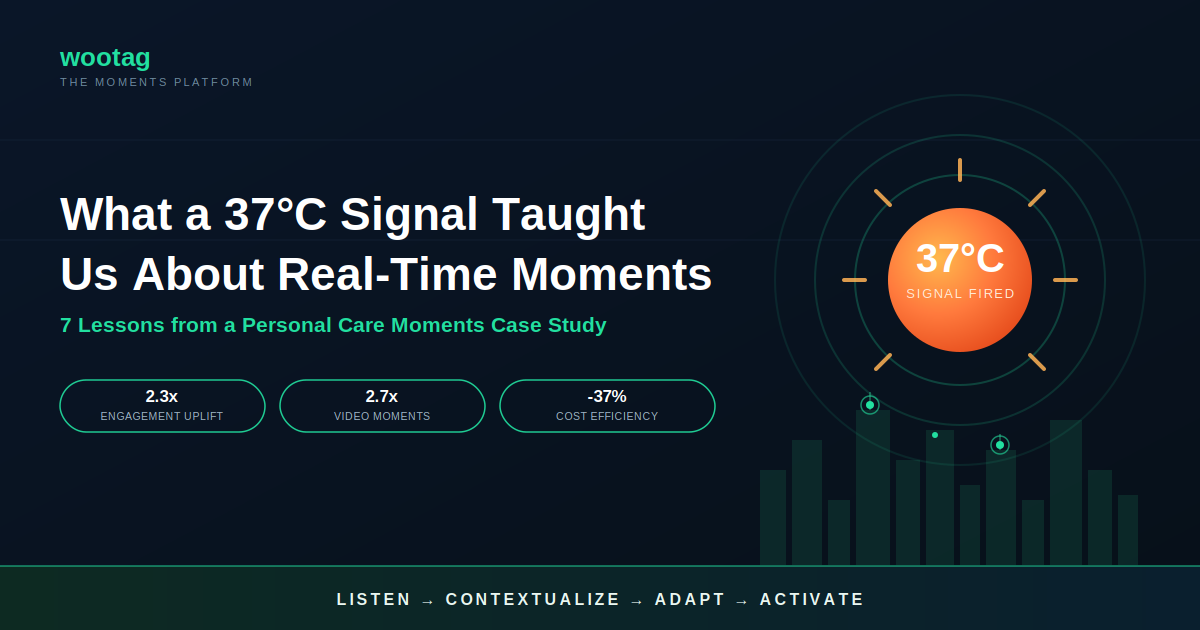

That single line of ad copy — served only to people in Mumbai, only while Mumbai was actually at 37°C — is the entire argument for Real-time Moments in one image. Not “summer campaign.” Not “heat wave push.” One city, one temperature reading, one creative, one instant.
When Everyuth (Zydus) ran its tan-removal scrub campaign on the Wootag Moments Platform, the brief wasn’t a media plan — it was a rule: when the live temperature in a viewer’s city crosses a threshold, assemble and serve the matching creative, in the right format, on the right feed, before the moment cools off. The result was a 2.3x engagement uplift, 2.7x more video moments served, and a 37% improvement in cost efficiency, across Facebook and Instagram, in 9:16, 1:1 and 16:9 formats.
We’ve pulled this campaign apart internally more times than any other case study in our library, because it’s the cleanest illustration of what Real-time Moments actually requires operationally — not the pitch-deck version, the build version. Here are the seven things it taught us.
1. Moments are micro — not seasonal, not weekly, not even daily
The instinct in FMCG and personal care marketing is to plan around seasons: a summer campaign, a monsoon push, a winter refresh. Everyuth’s brief operated one layer below that. The trigger wasn’t “summer” — it was 37°C, in a specific city, on a specific afternoon. A Real-time Moment is a threshold crossing, not a calendar block.
This isn’t just a Wootag thesis — third-party weather-response data backs the granularity. Research on weather-triggered retail shows that a year-on-year change of just one degree Fahrenheit can move sales of everyday products materially — a 24% lift in air conditioner sales, a 2% lift in soft drinks, and a 4% rise in infant apparel purchases. That’s the scale a Moments engine has to operate at: single-degree, single-city, same-hour.
There’s a behavioral layer underneath this too. Studies on temperature and consumer psychology found that people who feel physically warm are measurably more willing to pay for products than people who feel cold, and roughly three-quarters of participants exposed to heat completed a purchase versus fewer than half of those exposed to cold. The 37°C threshold isn’t an arbitrary creative device — it’s close to the point where that psychological shift actually kicks in. Rain, a heatwave alert, a stock index swing, a wicket falling — each is a discrete, momentary state change, and each demands its own micro-response rather than a campaign-length one.
2. Contextualization has to work at the same micro scale as the signal
If the moment is micro, the contextualization engine can’t be coarse. Wootag’s Listen → Contextualize → Adapt → Activate framework exists precisely because a signal isn’t useful until it’s mapped to brand-safe creative, an offer, and a hyperlocal trigger — automatically, at the moment it fires. For Everyuth, that meant the platform had to read live city-level temperature, decide it had crossed the tan-removal threshold, and select the matching visual and copy — all before the moment passed. There’s no manual desk that can sit between a live weather feed and a creative decision at this cadence; the contextualization step has to be structural, not editorial.
3. Creative automation has to account for channel, not just content
The Everyuth campaign didn’t run one ad — it ran the same moment rebuilt across formats: 9:16 for Instagram Stories, 1:1 for feed, 16:9 for other placements, static and video variants of each. A Facebook feed post and an Instagram Story aren’t the same creative resized; they’re different consumption contexts, and Real-time Moments treats them that way.
This lines up with what the broader creative-automation market is finding. A 2025 analysis of over a million dynamic creative variations found platform-specific installs-per-mille lifts of up to 33% on ad networks and 65% on social when creative was automatically adapted per placement, and separate WARC research on audience-matched creative found that aligning creative strategy to the specific audience and channel can improve campaign effectiveness by up to 70%. The lesson: creative automation isn’t “generate more variants,” it’s “generate the right variant for where the moment is actually being seen.”
4. The same moment plays out differently in every city
37°C in Mumbai is not a heatwave — it’s a Tuesday. The same reading in a naturally cooler city, like Shimla or Darjeeling, would be headline weather. A Real-time Moments engine has to know the difference, which means the trigger logic is never national — it’s pin-code and city aware.
This mirrors what regional data specialists keep finding across Indian markets generally: pricing or messaging that works in Bangalore may not convert in Patna, because language, culture, income level and online behavior vary sharply even within a single country. Consumer research firms studying India specifically note the same pattern at the digital-behavior level — what works in Mumbai might fail in Chennai, and digital adoption itself varies widely by region. A single “summer creative” served nationally is, by definition, wrong for most of the country most of the time. Local nuance isn’t a nice-to-have layer on top of Real-time Moments — it’s the reason Real-time Moments exists.
5. The workflow is the actual product
None of the above works if a human has to sit in the loop deciding “is it hot enough in Mumbai yet, and if so, which creative do we push.” By the time that decision gets made manually, the moment — and the audience state that made it valuable — has usually passed. The value in Everyuth’s result isn’t the creative itself; it’s that Listen → Contextualize → Adapt → Activate ran as one automated pipeline, city by city, without a planner re-briefing an agency every time the mercury moved. Real-time Moments only compounds when the workflow removes manual intervention entirely — signal ingestion, creative assembly, and activation all firing on the same automated rail.
Traditional Seasonal Planning vs. the Real-time Moments Model
| Traditional seasonal campaign | Real-time Moments model | |
|---|---|---|
| Trigger | Calendar date / season | Live signal threshold (e.g., 37°C) |
| Geography | National or regional flight | City / pin-code level |
| Creative | One hero asset, resized | Auto-assembled per format and channel |
| Timing | Planned weeks in advance | Sub-second to same-day activation |
| Relevance decay | Runs regardless of local conditions | Pauses/adapts when the signal changes |
| Human involvement | Manual briefing per flight | Workflow-driven, minimal manual touch |
6. What it does for the brand
This is the part every marketing leader actually wants to know, so it’s worth being precise about what’s confirmed versus what’s directional. The published Everyuth case study itself reports 2.3x engagement uplift, 2.7x more video moments delivered, and 37% better cost efficiency — those are the confirmed, named-brand figures. Separately, across personal-care Moments deployments in our internal pilot data more broadly (self-reported, not specific to the Everyuth campaign), we’ve seen sales uplift ranging from roughly 65% to 133% depending on category, signal type, and baseline media mix. We’re flagging that range as internal pilot data rather than folding it into the Everyuth numbers, because the two shouldn’t be conflated — engagement and cost-efficiency gains are a different measurement than incremental sales, and category-wide ranges shouldn’t be presented as if they belong to one named campaign.
Directionally, this tracks with category research: 48% of consumers say weather actively impacts their daily personal care and beauty choices, and 74% say they’ve changed their personal care or beauty routine in recent years — meaning the addressable behavior a temperature-based Moment is targeting is real and widespread, not a niche edge case.
7. Measurement has to run across moments, locations, creative and channels at once
A single “campaign performance” number can’t explain why Everyuth worked, because the campaign wasn’t one thing — it was hundreds of city-level moments, each with its own creative variant, running across two platforms and three formats simultaneously. Understanding what actually drove the 2.3x engagement uplift requires being able to cut the data by which signal fired (temperature threshold), which city it fired in, which creative variant was served, and which channel it ran on — and to see how those four dimensions interact, not just report on them separately. That’s the measurement bar Real-time Moments sets: not “did the campaign work,” but “which moment, in which city, in which format, on which channel, moved the number.”
A note on channels
Everything above is channel-independent by design. The Listen → Contextualize → Adapt → Activate loop that made the Everyuth moment work doesn’t care whether the destination is a Facebook feed, an Instagram Story, a CTV spot, or a retail screen — the same signal-to-creative logic applies. Real-time Moments isn’t a Meta feature or a social-first tactic; it’s an always-on layer that happens to have been activated on Meta in this case because that’s where Everyuth’s audience was.
Sourcing transparency
The Everyuth engagement, video-moment, and cost-efficiency figures are Wootag’s own case study metrics, self-reported and tied to a named brand and campaign. The 65–133% sales uplift range is separately sourced from internal pilot data across personal-care Moments deployments more broadly, and is presented as directional, not as a confirmed Everyuth outcome. Third-party statistics on weather-driven consumer behavior, temperature psychology, creative automation performance, and regional/hyperlocal marketing dynamics are cited to their original sources above and are independent of Wootag’s own reporting.
Where this goes next
If a 37°C threshold can move engagement 2.3x for a tan-removal scrub, the same Listen → Contextualize → Adapt → Activate logic applies to any live signal a brand’s audience actually responds to — a match moment, a market swing, a commodity price. See how it plays out for sports moments and other signal categories at wootag.com/moments.
