

Every ace, break point and match point is a Tennis real-time moment your brand hasn’t claimed yet
For two weeks every August and September, the eyes of the sporting world turn to Flushing Meadows. The 2026 US Open marks the 146th edition of the tournament, with the main draw beginning Sunday, August 30, and the finals scheduled for September 12 (women’s) and September 13 (men’s). Add in qualifying rounds starting August 24 and the main draw ceremony on August 27, and brands have close to three weeks of near-continuous storylines, upsets, comebacks and celebrations to work with — three weeks of what we call the Tennis real-time moment.
A Tennis real-time moment is any live, emotionally-charged instant inside a match — a break point saved, a five-set comeback, a Cinderella qualifier reaching the second week, a crowd roar after a 140mph ace — that creates a short window of peak attention. Most sponsors still buy the tournament, not the moment. They lock in a logo on the net strap or a courtside banner and hope the cameras linger. But a logo doesn’t know that Coco Gauff just saved three match points, or that a heatwave alert has just pushed hydration-beverage intent up in New York. A Tennis real-time moment does. And brands that learn to activate inside it — not around it — are the ones walking away with recall, engagement and revenue the static sponsors can only benchmark against.
This post breaks down how apparel, beverage and consumer goods brands can turn the 2026 US Open into a real-time performance channel, and how official and unofficial sponsors alike can extend their investment well beyond a static logo placement — using the Tennis real-time moment as the organizing idea for the whole campaign.
Why the US Open is the highest-density Tennis real-time moment window of the year
The US Open isn’t just tennis’s biggest stage financially — the 2025 edition carried $90 million in prize money — it’s also the Grand Slam most built for live, always-on media consumption. Night sessions under lights at Arthur Ashe Stadium, a compressed New York media market, and a fan base that skews younger and more social-first than the other three majors all combine to make every Tennis real-time moment travel further and faster than it would at Wimbledon or the Australian Open.
That density is exactly what most brand campaigns are unequipped to capture. A pre-booked media plan is fixed the moment it goes live: same creative, same message, same offer, whether Sinner is cruising through round one or Alcaraz is battling out of a two-set hole under Ashe’s lights. The tournament itself is dynamic. The advertising around it, for almost every brand, is not. That mismatch is the gap — and it’s the gap a Tennis real-time moment strategy is built to close.
The gap: sponsors pay for presence, not for the moment itself
Walk the grounds of the USTA Billie Jean King National Tennis Center and the sponsor list reads like a who’s-who of category leaders: Rolex has been the official timekeeper and timepiece of the US Open since July 2018, Ralph Lauren has served as Official Outfitter since 2005, and Grey Goose marked nineteen years as a promotional partner in 2025, with branded cocktail bars across four locations at the grounds. Chase has sponsored the tournament since 1982 and the Women’s Singles Championship since 1996, while Emirates has been the official airline since February 2012, offering hospitality suites, travel packages and co-branded content. Roland Garros lists 22 marketing partners, and 79 different companies hold official partnerships with at least one of the four Grand Slams, with the US Open alone carrying 25 official partners — more than any other major.
That’s an enormous amount of category-exclusive real estate. And yet, according to brand strategists covering the space, the real battle has moved past the sponsorship line item entirely. One brand strategist who has spent two decades helping global brands work with major cultural moments described the US Open as one of the most valuable platforms for fusing sport, lifestyle and cultural relevance, noting that the brands winning are the ones that insert themselves into the culture of the tournament rather than simply attaching a logo to it. Grey Goose’s Honey Deuce cocktail is the case study everyone points to: the strategist compared its cultural status at the US Open to strawberries and cream at Wimbledon — a product moment so tied to the event that it now drives its own standalone demand.
That’s the opportunity hiding in plain sight. Most sponsors are still buying tournament-length presence. Very few are buying, or building, the individual Tennis real-time moment — the exact second a signal (a match point, a comeback, a crowd eruption, a weather shift over Flushing Meadows) creates a spike in attention a brand could ride, live, across every channel its audience is already on.
Why the gap persists
Three structural issues keep most apparel, beverage and goods brands locked into static, pre-booked tournament media instead of a true Tennis real-time moment strategy:
- Creative and media are built weeks in advance. Campaigns are approved, trafficked and locked before the first ball is struck, with no mechanism to reshape messaging around what’s actually happening on court.
- Activation is channel-siloed. A brand’s stadium signage, its social team, its CTV buy and its retail media desk typically operate on separate calendars and separate creative — so even when a real moment happens, the response (if any) is fragmented and slow.
- On-site experiential doesn’t extend digitally in real time. Grand Central pop-up bars, photo-op booths and sampling kiosks — like the ones Grey Goose and Dobel run during the tournament — are excellent for the fans physically present, but the digital audience watching at home rarely gets an equivalent live, contextual experience tied to what’s unfolding on court.
The result: sponsors pay Grand Slam prices for a Grand Slam’s worth of moments, then activate against almost none of them individually.
How apparel brands can own the Tennis real-time moment
Apparel is arguably the category best positioned to capitalize on a Tennis real-time moment, because outfits are literally on screen every time a camera cuts to a player. A few ways this plays out:
- Outfit-triggered creative. The instant a sponsored or on-brand player wins a decisive point in a signature outfit, dynamic social and display creative can push “shop the look” and player-capsule product pages — while the emotional high from that Tennis real-time moment is still active.
- Comeback and milestone tie-ins. A player fighting back from a set down, or reaching a career-first quarterfinal, is a message-ready moment for performance-wear positioning — resilience, endurance, grit — without waiting for a post-match recap.
- Heat and humidity signal pairing. New York in late August and early September regularly produces heat-advisory days at the Tennis Center. Apparel brands built around cooling fabric or moisture-wicking technology can pair that weather signal directly with a Tennis real-time moment on court for a message that feels earned, not opportunistic.
How beverage brands can own the Tennis real-time moment
Beverage sponsors already understand experiential activation better than almost any other category at the US Open — Grey Goose’s Honey Deuce and Dobel’s tequila activations are proof. The next step is extending that on-site energy into a live, always-on Tennis real-time moment strategy for the much larger audience watching remotely:
- Match-point and celebration triggers. The seconds after a decisive match point are peak emotional and social-sharing moments — ideal windows for a dynamic cocktail-recipe overlay, a “toast the win” social prompt, or a limited-time delivery offer synced to that specific Tennis real-time moment.
- Hydration and heat-signal offers. On days when on-court temperature readings spike, water, electrolyte and non-alcoholic beverage brands can trigger hyperlocal offers and retail-media placements tied to that live weather signal layered on top of match action.
- Session-based dayparting. Day-session tennis and night-session tennis under the lights carry very different moods — alcohol and cocktail messaging can adapt tone and offer by session without a media team manually re-trafficking each block.
How consumer goods brands can own the Tennis real-time moment
Beyond apparel and beverage, the broader consumer goods and CPG landscape — from personal care to electronics to snacking — has just as much to gain from a Tennis real-time moment approach:
- Underarm and personal-care sponsors activating around long five-set matches and hot-weather sessions can trigger “beat the heat” messaging exactly when heat and match-length signals combine, rather than running a flat campaign for the full fortnight.
- Snack and grocery brands can sync limited-time offers to changeover breaks, tiebreaks and match points — the natural pause-and-peak rhythm of tennis lends itself well to short, repeatable commerce windows.
- Electronics and streaming-adjacent brands can trigger CTV and second-screen creative the moment a marquee match goes to a deciding set, when second-screen behavior and search intent both spike.
How sponsors — official and unofficial — can leverage the whole tournament, not just the logo
Whether a brand holds one of the US Open’s 25 official partnership slots or is running an unofficial, ambush-adjacent campaign timed to the tournament, the leverage point is the same: a Tennis real-time moment strategy turns a fixed sponsorship fee into a compounding media asset.
- Category-exclusive sponsors (timepieces, banking, airline, spirits, apparel) can extend their exclusivity beyond signage by owning the real-time creative response to specific moment types — match points for a banking partner’s “every point counts” messaging, travel-and-hospitality triggers for an airline sponsor tied to a player’s home-country run deep into the draw.
- USTA Foundation and community-linked sponsors, in the mold of partnerships like Chase’s ongoing support for National Junior Tennis and Learning chapters in under-served communities, can pair real-time on-court moments with always-on brand storytelling that connects tournament excitement to grassroots access — reinforcing purpose alongside performance.
- Non-endemic and challenger sponsors without stadium signage can still ride the cultural wave of a Tennis real-time moment through social and programmatic channels, competing for share of attention during the exact minutes engagement peaks, rather than trying to outspend official partners on always-on media.
Across every one of these plays, the throughline is the same: a Tennis real-time moment isn’t valuable because it’s on court — it’s valuable because it’s the instant a global audience’s attention and emotion peak together. Sponsorship buys the right to be present. A Tennis real-time moment strategy buys the ability to actually be relevant in that instant.
Why the real-time layer has to sit underneath every channel, not inside just one
None of this works if a brand’s real-time response lives on only one channel. A Tennis real-time moment happens once, but the audience experiencing it is scattered across streaming apps, social feeds, publisher live-blogs, retail media placements and, for the fans on-site, physical activations. A signal-response system built for a single channel — say, social alone — will always miss the audience watching on CTV, the audience scrolling a sports app, and the audience walking past a retail screen on their way home from the office.
That’s why the layer that listens for a Tennis real-time moment and decides how to respond to it has to be independent of any single channel. It needs to sit underneath social, CTV, display, programmatic, email, push and DOOH simultaneously — so that the moment a break point is saved or a match point is won, every channel a brand’s audience might be on can respond in the same instant, with creative shaped for where it’s actually being seen.
How Wootag’s Moments Platform is architected for the Tennis real-time moment
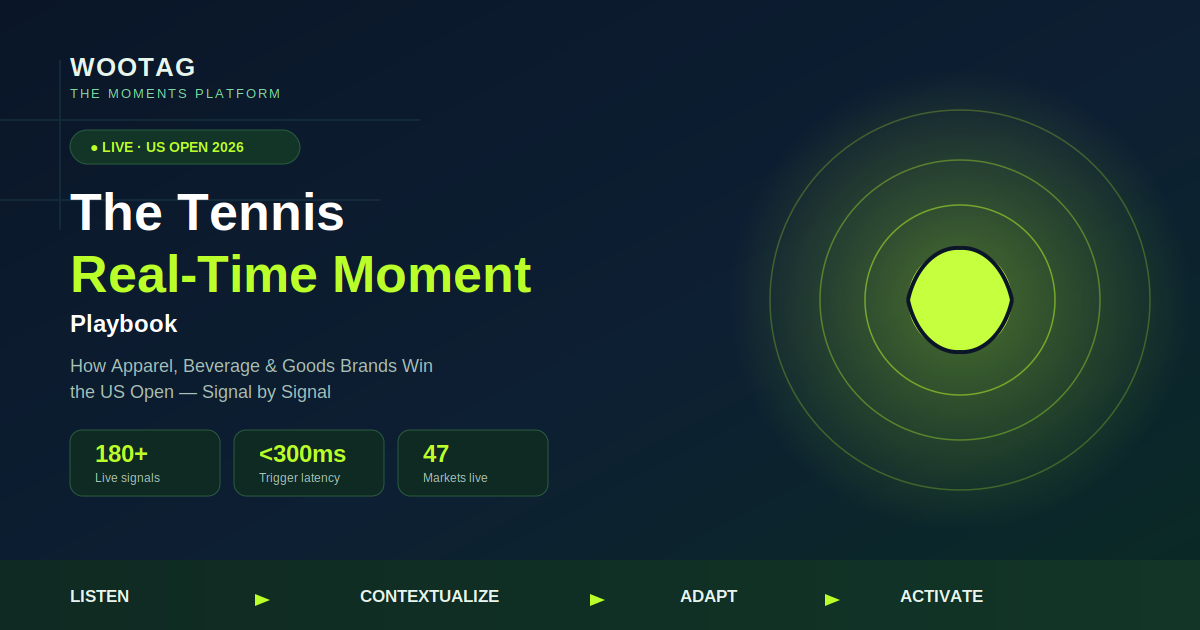
This is precisely the problem Wootag’s Moments Platform is built to solve. Wootag ingests 180+ live signal feeds — sports, weather, markets and commodities among them — and detects high-impact moments the instant they happen, live in 47 markets. The platform’s four-stage framework maps directly onto what a Tennis real-time moment strategy requires:
- Listen — Wootag’s sports signal layer tracks tennis moments alongside cricket, football, Formula 1, NBA and NFL triggers, watching for match points, comebacks, milestone wins and crowd-defining moments as they happen.
- Contextualize — Each Tennis real-time moment is mapped to brand-safe creative, dynamic offers and hyperlocal triggers tailored to audience sentiment, so a match-point celebration and a rain delay don’t get the same message.
- Adapt — Smart-adapt assets reshape automatically for the channel they’re landing in — social feed, publisher site, CTV spot or shoppable overlay — from a single creative source.
- Activate — The response fires in under 300 milliseconds across OTT and CTV, display, programmatic, and every major social platform simultaneously, so no channel is left running yesterday’s creative during today’s Tennis real-time moment.
On the sports side specifically, Wootag’s platform is designed around the same trigger logic across tournament, country, player and match-level moments, feeding into an adaptation engine that produces personalized offers and dynamic product placements before distributing across OTT/CTV, display and social — the same architecture that would let an apparel, beverage or goods brand respond to a US Open match point the moment it happens, everywhere its audience is watching.
Sourcing note
Tournament dates, sponsor tenure figures and prize-money data referenced above come from public reporting via Legit.ng, FlashscoreUSA, SportsKhabri, Score and Change, and Fox Business, alongside the 2025 US Open Wikipedia entry, as cited inline. Wootag platform specifications — 180+ signal feeds, 47 live markets, and sub-300ms trigger latency — are Wootag’s own published product figures from wootag.com/moments and wootag.com/sports, not third-party research, and are presented here as company specifications rather than independently verified benchmarks. Any illustrative brand scenarios described in this post (apparel, beverage and goods examples) are hypothetical applications of the Tennis real-time moment framework, not confirmed Wootag client campaigns.
Turn the next Tennis real-time moment into a brand moment
The 2026 US Open will produce hundreds of these windows — some lasting a single rally, some an entire five-set arc. The sponsors and brands who treat the tournament as a fixed media buy will get a fixed return. The ones who build for the Tennis real-time moment, and activate the instant it happens across every channel their audience lives on, are the ones who turn two weeks in Flushing Meadows into a compounding brand asset.
Book a demo to see how Wootag’s Moments Platform can turn this year’s US Open into your brand’s biggest real-time activation window yet.
