
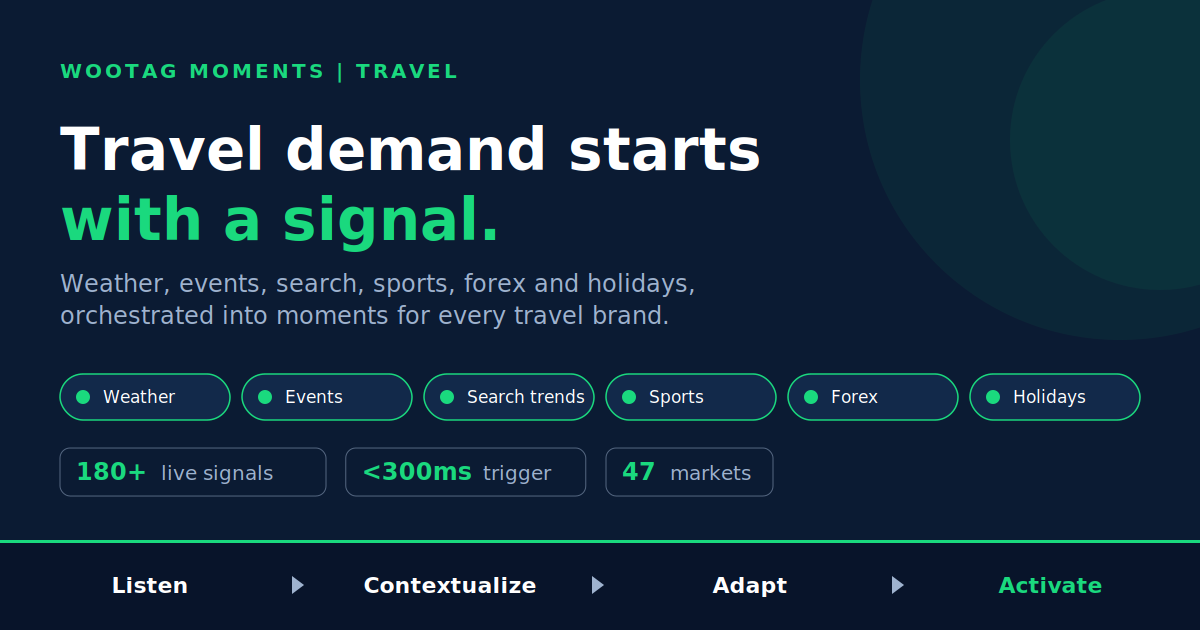

How airlines, hotels, resorts, destinations and travel marketplaces can build and own the moments that actually move bookings.
A heatwave settles over a major city on Thursday. By Friday evening, thousands of people are quietly searching for somewhere cooler, and a long weekend begins in 48 hours. A currency has slipped a few percent against the dollar. A stadium two time zones away is about to host a final. A beachfront hotel has 40 rooms unsold for Saturday night.
Every one of those facts is a signal, and every one of them is a travel moment waiting to be claimed.
Most travel brands will see these signals on separate dashboards, in separate meetings, days after they peaked. By then the traveler has already booked, usually with whoever was in front of them at the right second.
The gap: travel is the most signal-rich category, and the least responsive
Travel is a category where demand is created by things outside the brand’s control. Weather, events, holidays, exchange rates and sporting calendars shape when people leave, where they go and how much they are willing to spend.
Yet most travel marketing still runs on a planned calendar. A summer sale. A festive fare. A “book early” push. These activations matter, but they are built around when the brand is ready, not when the traveler is. The traveler’s intent shows up in bursts, tied to something happening in the real world, and those bursts close fast.
The data on how sharp these bursts are is striking. Hotels.com reported that hotel prices tend to climb ahead of big events, with sharp spikes starting around three weeks out, and that searches for a summer solar eclipse were already up 445%. Amadeus tracked flight bookings around a major stadium tour in Spain and saw bookings for Barcelona concert dates jump more than fifteen hundred percent in a single week after tickets went on sale. Moments like these do not wait for a quarterly plan.
Why the gap persists
It is rarely a lack of data. It is a lack of connection between the data and the message.
- Revenue management watches the forex rate, but marketing does not see it.
- The social team notices an event trending, but the offer team needs three days to approve a fare.
- Weather sits with operations, not with the people writing creative.
- Inventory sits in a reservations system that the ad platform has never heard of.
So the moment passes, and the brand falls back on a generic message to a generic audience. The signal was available. The decision layer between the signal and the activation was missing.
The six signals that shape travel moments
Wootag Moments listens to more than 180 live signal feeds across 100+ categories, and travel draws on nearly all of them. Here are the six that matter most for travel brands, and what each one actually does to demand.
1. Weather patterns
Weather works on travel in two directions. It pushes people out of where they are, and it pulls them toward where they want to be.
Booking.com’s latest traveler research found that nearly three quarters of travelers factor extreme weather into where and when they book, and that 31% changed or cancelled a trip in the past year because of extreme weather or a natural disaster. More than half said some destinations are now too hot at their preferred time of year. Skift’s read of the same data is useful: this is redistribution, not retreat. Heat and crowds are pushing demand into shoulder seasons and cooler destinations.
For a brand, that means a heatwave in a source city is not just a weather story. It is a demand signal for mountain resorts, lake destinations and “coolcation” itineraries. A cold snap or monsoon is a signal for sun escapes. A storm at the destination is a signal to reassure, to rebook, or to redirect.
2. Events: concerts, trade shows, festivals
Events create demand that is dated, located and predictable, which makes them ideal for orchestration.
Amadeus found that around a major stadium tour in Spain, hotel occupancy grew 8.1% year on year in Barcelona and 5.1% in Madrid. A hostel brand reported that bed bookings at its Madrid property tripled during a major K-pop act’s dates compared with the year before. Industry data from the UK shows music tourists spent about 11% more year on year, growing faster than the number of travelers themselves.
Trade shows follow the same logic on the business side. A large exhibition fills hotels, tightens flights and creates a window for corporate travel offers, airport lounge access, late checkout and extended stay packages. The event calendar is public. The only question is whether your brand has a moment ready when the announcement lands, when the lineup drops, and in the final three weeks when prices climb.
3. Search trends
Search is the earliest visible form of intent. A spike in searches for a destination, an event or a type of trip tells you where demand is forming before it shows up in bookings.
The solar eclipse example is a clean illustration. Hotels.com saw searches climb 445% for a niche, date specific event, well before the event itself. A brand that listens to search velocity can respond while the traveler is still choosing, not after the choice has been made.
4. Sports events
Sports create some of the largest travel moments in the world, and they come with a built in schedule, a built in emotion and a built in set of rivalries and host cities.
Wootag’s own sports work shows how real-time sports signals can be turned into brand moments. In the Valvoline FIFA activation, live match events such as goals, halftime and penalties each triggered their own creative on connected TV. In the Budweiser FIFA World Cup 2026 activation, defining match events served the most relevant creative in real time.
For travel, the same logic applies in two ways. Before the tournament, host city and fan travel moments: flights, hotels and packages tied to a fixture. During the tournament, in-destination moments: tours, dining and attractions for fans between matches. Industry commentary around the 2026 World Cup noted that fans search and book in the hours between matches, and that travelers are taking fewer trips but packing more activities into each one.
5. Forex price impacts
For international travel, the exchange rate quietly rewrites the price of everything. A hotel that cost the equivalent of 10,000 in home currency can stretch to 12,000 or 13,000 when the currency weakens, according to one forex provider’s analysis of outbound travel from India. The same movement can make a destination suddenly attractive for travelers going the other way. IATA’s economics team has shown how a weak currency can dampen outbound travel from a market while boosting inbound arrivals into it.
This is a signal most travel brands know about and almost none activate on. A favorable swing is a moment to promote the destination to the market whose currency just strengthened. An unfavorable swing is a moment to promote fare locks, forex bundles, nearer destinations or flexible payment options.
Wootag already runs this kind of logic on financial signals. In the Franklin Templeton activation, a move of 0.3% or more in a market index triggered a growth led film, a fall of the same size triggered a stability led film, and anything inside the band paused the activation entirely. A travel brand can apply the same threshold thinking to a currency pair.
6. Occasions: long weekends, holidays and festivals
A public holiday that falls on a Monday or a Friday is one of the most reliable demand creators in travel.
An Indian travel app reported flight searches running about 75% above the weekday average five weeks before a Good Friday long weekend. Agoda recorded an 80% month on month rise in accommodation searches from Malaysia, Indonesia and Singapore ahead of the Hari Raya long weekend. A South African airline reported more than 20% more passengers on a three day weekend than on a mid-week public holiday.
The pattern is consistent. Demand starts building weeks out, peaks in a predictable shape, and rewards the brand that shows up with the right offer at each stage: inspiration early, price and availability in the middle, last minute convenience at the end.
How a travel moment is actually constructed
A signal alone is not a moment. A moment is a decision about what to say, to whom, in what tone, and at what instant. Here is how that decision gets built.
1. The signal. What is the real world event? A temperature crossing a threshold, an event announced, a search spike, a currency move, a holiday on the calendar.
2. The threshold. When does it matter? Not every signal deserves an activation. A heatwave alert at 38 degrees may trigger a message. A forecast at 24 degrees should not. Thresholds are also what protect budget. When nothing meaningful is happening, nothing runs.
3. The audience context. Who is this for, and what state are they in? A traveler in the heatwave city is in a different place than one in the cool destination. The same signal produces different moments for different audiences and locations.
4. The offer and the tone. What does the brand say? Reassurance after a storm, urgency before a price spike, celebration around a match, practicality around a currency move. The creative adapts to the emotion the signal carries.
5. The inventory and the fallback. Can the brand actually deliver? If seats, rooms or packages are available, push them. If they are not, route the demand to a sister property, an alternate date or a marketplace partner rather than losing it. This is where retail and inventory signals, integrated by API for each enterprise, close the loop between the message and the shelf.
The real power is in stacking
Single signals are useful. Stacked signals are where travel gets interesting.
Picture a heatwave in a source city, plus a long weekend in 48 hours, plus open inventory at a hill resort within a three hour drive. That is not three signals. That is one very strong moment, with a clear audience, a clear offer and a clear deadline. Now add a favorable forex move and the same moment can extend to an international option.
Multi signal moments tend to outperform single signal ones because relevance compounds. The more of the traveler’s real situation the message reflects, the less it feels like advertising and the more it feels like timing.
Why this is not tied to any one channel
The decision layer sits beneath the channels. Once a travel moment is defined, the same decision can fire across Meta, TikTok, push notifications, connected TV, programmatic display and shoppable surfaces, each adapted to its format.
That matters because travelers move between surfaces constantly. They see a heatwave offer on a social feed, check a fare on a marketplace, and receive a push notification the day before departure. A moment that lives in only one channel is a moment with a hole in it. A signal layer that lives beneath the channels means the brand responds as one, in under 300 milliseconds from signal to trigger.
It also means this is not a rip and replace decision. The signal layer sits beneath the CRM, the CDP and the ad platforms a brand already uses, deciding what should fire and when.
Where each travel business wins
| Travel business | Strongest signals | Example moment | Where it lands |
|---|---|---|---|
| Airlines | Long weekends, forex moves, events, weather disruptions, search spikes on routes | A long weekend in 5 weeks plus a rising search trend on a route triggers an early fare moment for that origin city, and a flexible rebooking message when a storm is forecast | Meta, push notifications, programmatic, shoppable fare tiles |
| Hotels | Events, trade shows, long weekends, weather, own occupancy | A concert announcement triggers a stay package for fans, and a soft Saturday triggers a local last minute offer in the nearby city | Meta, TikTok, push, search, own site |
| Resorts | Weather in source cities, long weekends, holiday calendars, search trends | A heatwave in a source city plus an upcoming long weekend triggers a cool getaway offer to that city | Meta, TikTok, programmatic, CTV |
| Destinations and tourism boards | Events, forex, sports fixtures, seasonal weather | A currency strengthening in a source market triggers a destination moment for that market, and a major fixture triggers a host city itinerary | CTV, social, programmatic, content feeds |
| Travel marketplaces | All of the above, plus live inventory across partners | A rising search for an event city triggers a bundle of flights, stays and experiences, and low availability at one partner reroutes demand to another | Shoppable surfaces, push, Meta, search, programmatic |
Airlines
Airlines hold the most time sensitive inventory in travel, since an empty seat on a departed flight is worth nothing. Long weekends, forex swings and event calendars give airlines a clear map of when demand will build and from where. The strongest play is to activate by origin city and booking window. Five weeks out, inspire. Two weeks out, price and availability. Two days out, convenience. When weather disrupts, shift the message from selling to reassuring with flexible rebooking.
Hotels
Hotels operate on the demand around them. An event in the city is an announcement, a package and a price window. A soft weekend is a local moment. Because hotel prices tend to rise sharply in the run up to a major event, the early window is where the brand has the most room to win, and the late window is where flexible cancellation messaging reduces hesitation.
Resorts
Resorts sell escape, and escape is triggered by the thing people are escaping from. A heatwave, a cold spell, a stretch of poor air quality or a looming long weekend in a source city is the moment. Because resorts often draw from a defined set of feeder cities, they can listen to those cities specifically, which keeps activations precise and efficient.
Destinations and tourism boards
Destinations compete on timing and relevance rather than inventory. A forex shift in a source market, a festival, a match schedule or a seasonal weather window is a reason to reach the right traveler with the right story. Destinations can also use moments to redistribute demand, promoting shoulder seasons and nearby towns when a headline spot is crowded or too hot.
Travel marketplaces
Marketplaces have the widest signal surface and the most flexibility. They can listen to every signal above, and because they hold inventory across many suppliers, they can route demand to wherever availability exists. When a hotel is full, a nearby property gets the moment. When one carrier sells out, another gets it. For a marketplace, a moment never has to end in a dead end.
What to do about it
If you run a travel brand, start small and specific.
- Pick the two or three signals most tied to your demand. For a resort it might be source city weather and long weekends. For an airline it might be forex and holidays.
- Define thresholds so activations only fire when the signal is strong.
- Connect your inventory so the message and the shelf agree.
- Build a fallback for every moment so demand is never wasted.
- Run it across more than one channel, and measure it against your usual outcomes: engagement, site visits, booking starts and bookings.
The travelers are already responding to the world around them. The only open question is whether your brand will be there when they do.
Third party research:
- Hotels.com 2026 event travel forecast (event driven price spikes, eclipse search growth)
- Amadeus Hospitality analysis of a major stadium tour in Spain (hotel occupancy and flight booking surges)
- Generator hostels commentary on concert driven bookings, and UK Music figures on music tourism spend
- Booking.com Travel and Sustainability Report 2026 as reported by Skift (extreme weather and travel decisions)
- IATA Economics, Chart of the Week on Japan’s weak currency and outbound travel
- Outlook Traveller, commentary from a forex provider on currency depreciation and outbound travel budgets
- Scapia data on a Good Friday long weekend in India, Agoda data on Hari Raya long weekend searches (via TTG Asia), and FlySafair figures on three day weekend passengers
- Travel Daily News coverage of the 2026 World Cup and in-destination booking behavior (TripWorks and Arival research)
Third party figures are cited as reported by each source and relate to the specific markets and periods named by those sources.
See a travel moment built on your brand
Tell us the signal that matters most to your travel business, whether it is weather, events, forex or the holiday calendar. The Wootag team will show you a live moment built around your brand in 20 minutes.
Travel Demand Does Not Start With a Search. It Starts With a Signal.
