

Signal orchestration is having a moment. Search the term and you will find a fast-growing category of B2B platforms built to catch buyer intent before a sales team misses it, a funding round, a hiring spree, a pricing page visit, all fed into a CRM so a rep calls the right account at the right time. It is a real discipline solving a real problem, and it has earned the attention it is getting.
It is also only half the picture. There is a second, distinct application of signal orchestration that has nothing to do with pipeline or CRM routing, and everything to do with what a brand says the moment the world around its audience changes, a heatwave, a market rally, a live match, a shelf running low in a store. Wootag Moments is built around this second application. Both are legitimate. Both deserve to be understood on their own terms, which is easiest to do side by side.
What B2B Signal Orchestration Solves
The established version of this category is built for revenue teams. It ingests buyer signals from dozens of heterogeneous sources, normalizes them into a shared schema, scores them by urgency, and routes them to whichever system needs to act next, a CRM, a sales engagement tool, an ABM platform. The signals themselves are business events: a funding round that unlocks budget, a hiring pattern that hints at a new priority, a technology change that opens a competitive door.
The goal is account readiness. The output is a better informed sales motion, a rep calling the right account instead of guessing, a marketing team routing attention toward a buying committee that has actually started researching instead of a single contact who once browsed a pricing page. This is why the category has grown into dozens of platforms competing on the same core question: is this account ready to buy, and who should act on it.
What Real-World and Retail Signal Orchestration Solves
Wootag Moments applies the same underlying discipline, listen broadly, decide what matters, act fast, to a completely different set of signals and a completely different outcome. Instead of business events tied to an account, it listens to real-world signals, weather, sports, markets, and commodities, and retail signals, point of sale data, footfall, and inventory, brought in directly from a brand’s own systems.
The goal is not account readiness. It is moment relevance, catching the narrow window where a live event or a live piece of store data makes a brand’s message worth showing right now, then adapting that message and getting it in front of an audience before the window closes. The output is not a task in a rep’s queue. It is a real-time brand experience a person actually sees, on whichever channel they are already looking at, in as little as under 300 milliseconds from signal to trigger.
Side by Side
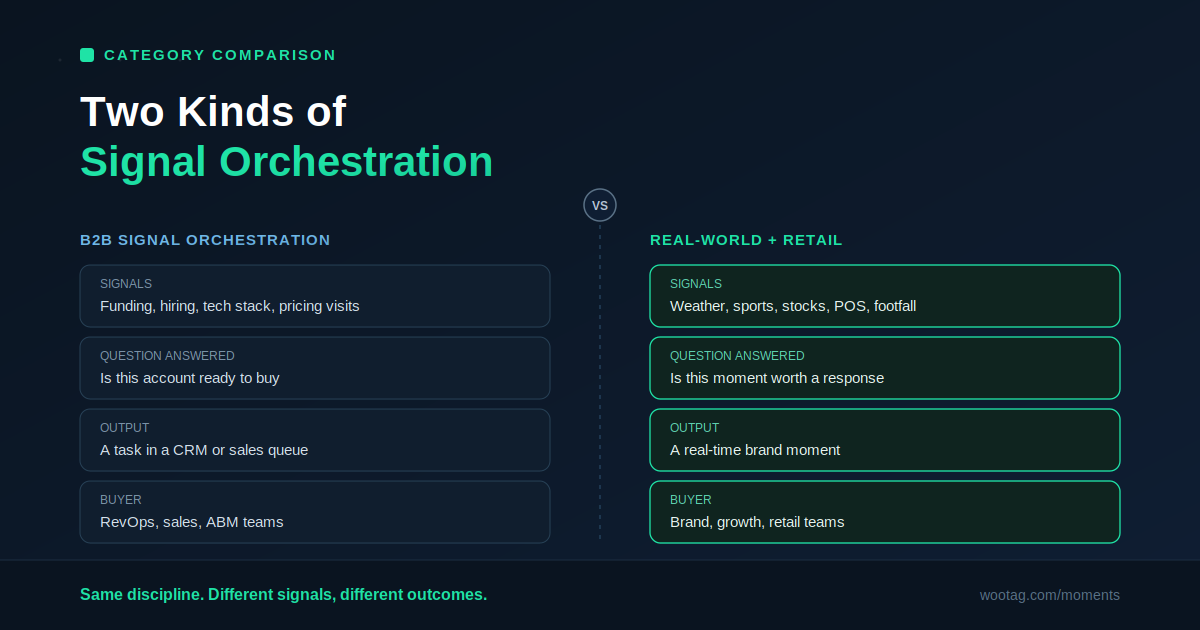
| B2B Signal Orchestration | Real-World and Retail Signal Orchestration | |
|---|---|---|
| What counts as a signal | Funding rounds, hiring activity, technographic changes, pricing page visits, competitor comparisons | Weather, live sports moments, stock and commodity movement, POS, footfall, inventory |
| Who or what the signal is about | An account or buying committee | A moment, an event, or a store |
| Primary question being answered | Is this account ready to buy | Is this the moment worth a brand response |
| Response window | Hours to a few days | Seconds to minutes |
| Where the response lands | A CRM, a sales engagement tool, an ABM platform | Social, CTV, programmatic, retail screens, owned channels |
| What the output looks like | A task, a score, a prioritized account list | A rendered brand moment, a creative, an activation |
| Primary buyer | RevOps, sales operations, ABM teams | Brand marketing, growth, retail and category teams |
| Underlying discipline | Listen, normalize, score, route | Listen, contextualize, adapt, activate |
Where the Two Actually Agree
Strip away the signals and the buyers, and both categories are built on the same structural idea. Neither is a dashboard that shows you something happened. Both are systems that decide what to do about it and act before the value of knowing has expired. That shared spine, listen to something live, decide if it is worth acting on, then coordinate a response across whatever system needs to receive it, is the real definition of orchestration, and it is broad enough to hold both applications without either one having to borrow legitimacy from the other.
Where they diverge is what counts as a signal worth listening to and what a good response looks like once one fires. A funding round and a heatwave are both live signals. Neither belongs in the other’s system, and neither needs to.
Which One a Team Actually Needs
A RevOps or sales operations team trying to stop good leads from going cold should be looking at B2B signal orchestration, this is exactly the problem that category was built to solve, and there are excellent platforms doing it well.
A brand or growth team trying to make marketing feel current, relevant, and alive to what is actually happening around its audience right now, whether that is a weather pattern, a market movement, a live sporting event, or its own store data, is looking for the second application, and this is where Wootag Moments operates.
Some organizations will eventually want both, a pipeline that knows which accounts are ready and a brand presence that knows which moments are worth showing up for. That is a reasonable future state. It does not need to be forced into one platform or one vendor conversation to be true today.
Why This Distinction Is Worth Making
The category is young enough that most of the content written about it assumes only one of these applications exists. That is an opportunity, not a problem, to describe the fuller shape of what signal orchestration can mean, rather than treating either version as the only correct one. A term with two legitimate applications is not diluted by having two applications. It is a sign the underlying idea, listen broadly and act fast, is bigger than any one category currently using it.
To see what the real-world and retail application looks like as a platform, start at wootag.com/moments.
Two Kinds of Signal Orchestration, and Why the Difference Matters
