

When the S&P moves half a percent before lunch, nobody on a trading floor waits for next month’s content calendar to catch up. The market has already moved on. Yet that is exactly what happens inside most large marketing organizations every day. A customer’s context changes in real time. The brand’s response arrives on a production schedule.
This gap was the real subject of a recent industry keynote from a senior Indian banking CMO, later covered by Campaign India. The headline point was simple and, for most marketing leaders, uncomfortable: you cannot automate your way out of a content problem. Before a CMO can hand decisions to machines, the organization needs content at a scale and speed that no manual process can produce. Automation without that foundation just automates the same bottleneck faster.
It is a fair diagnosis, and it is not unique to banking. Every industry with fragmented customer journeys, from retail to travel to telecom, is running into the same wall. Worth unpacking is not just what the problem is, but why most martech stacks cannot solve it on their own, and what actually closes the gap.
The gap is not creative output, it is decisioning
The keynote described an approach built around three moves: define the real business problem, build the data and infrastructure “rails,” then scale experiences on top of them. The example given was personalization that combined behavioral data, product history, and live context to generate well over a million content variations for a single product line. Manually, that volume is simply not achievable.
That number is easy to read as a content production challenge. It is actually a decisioning challenge. The hard part was never writing a million versions of an offer. The hard part is knowing, for each customer, at each moment, which version to serve, in which tone, on which channel, before the moment passes. A CRM or a CDP can store what is known about a customer. Neither one tells a brand that the customer just experienced a rate change, a weather event, a delayed flight, or a market swing that makes one message land and another fall flat.
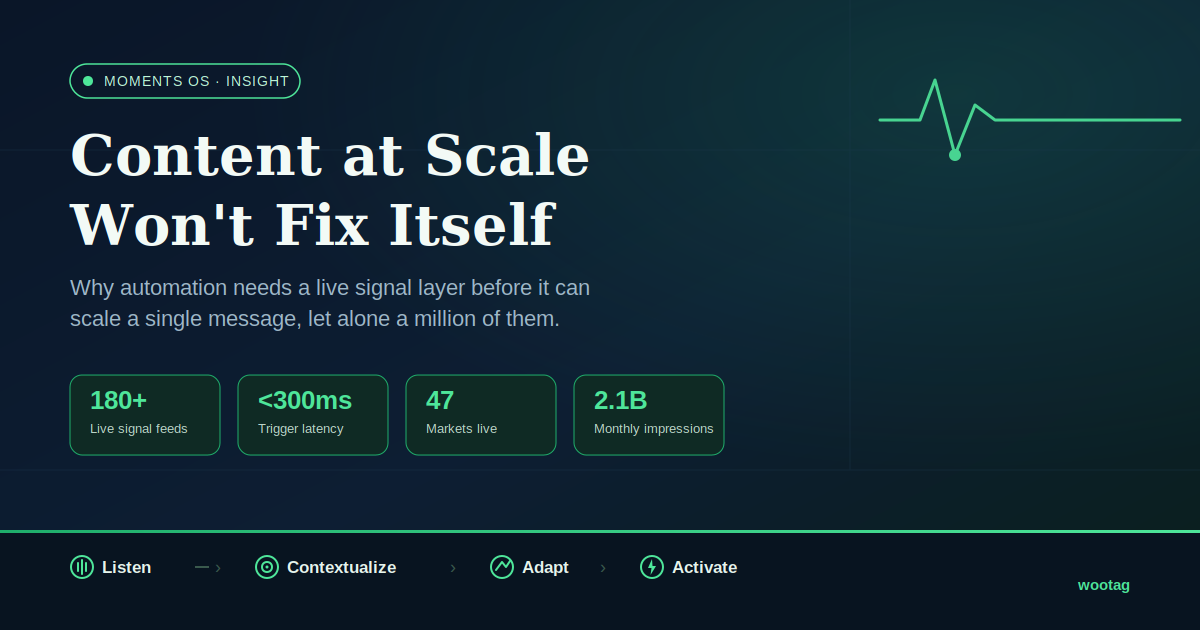
This is the layer most stacks are missing, and it is the layer a signal driven platform like Wootag Moments is built to sit on. Rather than treating personalization as a bigger content library, Wootag Moments treats it as a live decision made against the real world: Listen to what is actually happening, Contextualize it against brand rules and audience state, Adapt the message and format automatically, then Activate it across whatever channel the customer is on. Creative variation becomes an output of that decision, not a separate production line a content team has to keep feeding.
Rails before automation, not automation instead of rails
The keynote’s central caution, that clean data and infrastructure have to exist before AI can be trusted with decisions, is exactly right, and it is worth being specific about what “rails” means in practice.
For a brand trying to respond to the real world in real time, rails means a live signal layer: continuously ingesting what is happening (rates, weather, sports results, market movements, local events) with enough consistency and speed that a downstream system can trust it. Wootag Moments runs on 180 plus live signal feeds across 47 markets with sub 300ms trigger latency, which is the kind of infrastructure threshold this keynote was pointing at without naming it. Automation layered on top of a shaky or delayed signal source does not produce good decisions faster. It produces bad decisions faster, at scale, across every channel at once. The rails have to be trustworthy before the machine gets the keys.
From brand engine to experience engine
The keynote reframed the marketer’s job using a phrase worth sitting with: brand associations are not built by campaigns, they are built by every interaction a customer has with the brand, whether or not marketing planned it. That reframing, from brand engine to experience engine, is the same gap Wootag calls white space: the moments that happen between planned campaigns, when a customer is scrolling, checking a price, waiting on a delayed flight, or watching a weather alert, and the brand has nothing prepared to say.
Closing that white space only works if the response is channel independent. A signal that triggers a relevant message has to be able to reach the customer wherever they actually are in that moment, whether that is a social feed, a streaming ad break, a programmatic placement, a push notification, or a retail screen, and it has to say the same coherent thing everywhere. One signal layer activating consistently across channels is what makes “every interaction” something a brand can actually manage, rather than something that only gets attention when it goes wrong.
There is a frontline dimension to this too. The keynote described giving customers and relationship staff the same real time context at the same moment, so a QR scan surfaces relevant offers for the customer while the relationship manager sees the identical picture. That kind of synchronized front line enablement is a natural extension of a channel independent signal layer, since the same decision that fires a customer facing message can just as easily inform the person having the conversation next to them. Framed here as a direction the underlying infrastructure supports, not a shipped feature for any specific brand, it is one of the clearer signs that “content at scale” and “customer experience” are becoming the same problem.
Where this gap shows up
The pattern is generic across categories, even though the pressure looks different in each one.
| Industry | Where the white space appears | What “rails before automation” means here |
|---|---|---|
| Banking & Fintech | Rate moves, market volatility, life-stage triggers between planned campaigns | Real-time signal ingestion tied to compliant, pre-approved creative variants |
| Retail & E-commerce | Price changes, stock events, competitor moves, weather-driven demand | Live inventory and demand signals feeding channel-independent creative |
| Travel & Hospitality | Flight delays, weather disruption, destination demand spikes | Operational signals synced to customer-facing messaging in near real time |
| Telecom | Network events, plan usage thresholds, local outages | Usage and service signals triggering timely, relevant customer contact |
None of these are solved by adding another automation layer to an existing martech stack. They are solved by giving that stack something faster and more current to react to.
Sourcing transparency
The industry commentary referenced in this piece, including the framing of content scale as a precondition for automation, the “brand engine to experience engine” language, and the customer and relationship-manager journey example, draws on public reporting from Campaign India and Exchange4media covering a recent CMO keynote at an industry martech summit. Platform figures cited here, including the 180 plus live signal feeds, 47 live markets, sub 300ms trigger latency, and the Listen, Contextualize, Adapt, Activate framework, are Wootag’s own platform specifications and are kept distinct from the third-party reporting above. No client-specific claims are made in this piece, and the framing applies generically across industries rather than to any single organization named in the source reporting.
The takeaway
The keynote’s core point deserves to travel beyond banking: automation is not the fix for a content problem, and more content is not the fix for a decisioning problem. What closes the gap is a live signal layer that decides what to say, in what tone, on what channel, at the moment it actually matters, with creative as the output of that decision rather than the starting point. That is infrastructure work before it is campaign work, and it is the same rails question every CMO facing fragmented, real-time customer journeys will eventually have to answer.
If your team is further down this road already, thinking about content scale as an agentic, Context as a Service problem rather than a production problem, that is the next layer worth exploring.
