

A monsoon front rolls into a city. Humidity climbs past 80 percent, closets start smelling of damp fabric, and every household within twenty kilometers has the exact same small problem at the exact same time. Somewhere a supermarket aisle still has the laundry care shelf fully stocked. Somewhere a quick commerce app has a fifteen minute delivery slot open for the exact product that solves this. And somewhere a home care brand is running the same static ad it has been running since last quarter, completely unaware that the world just handed it a reason to be relevant.
That gap between what is happening in the real world and what a home care brand is actually saying to its audience is where the category is quietly losing consideration, sales and store visits every single day.
The gap is bigger in home care than almost anywhere else
Home care is one of the most habitual, low-attention categories a marketer can work in. Laundry detergent, surface cleaners, dishwashing liquid, air fresheners, insect control and disinfectants are bought out of routine, not desire. Nobody wakes up excited to buy floor cleaner. The global home care market was valued at roughly 109 billion dollars in 2025 and is projected to keep growing at a steady but unspectacular pace toward 154 billion dollars by 2035, reflecting a category that is durable and non discretionary rather than one driven by hype cycles or seasonal excitement.
That steadiness is exactly the problem. Because nothing about the category is naturally exciting, most home care marketing defaults to the safest possible creative: a clean kitchen, a happy family, a product shot, rotated every few weeks across Meta, TikTok and a push notification calendar that fires on a schedule rather than on a reason. The result is a category where the same message runs whether it is raining or dry, whether pollen counts are spiking or air quality is fine, whether a local store just restocked or just sold out.
And offline retail still dominates the category. Roughly 87 percent of home care value moves through physical retail, led by supermarkets, hypermarkets, discounters and small grocers, even as e-commerce has grown at a fast clip and now accounts for close to a third of category value in markets like the US. That split matters enormously for how a home care brand should think about Moments. This is not a category where digital activation alone drives the outcome. Every ad a home care brand runs is competing for two very different jobs at once: getting someone to add to cart online, and getting someone to actually walk down the cleaning aisle the next time they are at the store.
Why the gap persists
It is not a lack of data. Weather services publish humidity, rainfall, heat index and air quality in real time. Retail systems track stock levels and running promotions down to the SKU. The problem is that none of this signal ever reaches the creative. A brand’s weather data sits with its category insights team. Its stock and pricing data sits inside its retail or e-commerce operations stack. Its Meta account, TikTok account and push notification tool sit with growth or performance marketing. Nobody owns the pipe connecting them, so nobody activates on them, and the creative keeps running on a fixed calendar regardless of what the humidity gauge, the pollen count or the shelf actually says that morning.
This is a communication problem before it is a creative problem. The question is not what the ad looks like. It is what the brand says, to whom, in what tone, at what moment, and whether that moment is actually true right now for the person seeing it.
Moments as the signal layer underneath the stack you already run
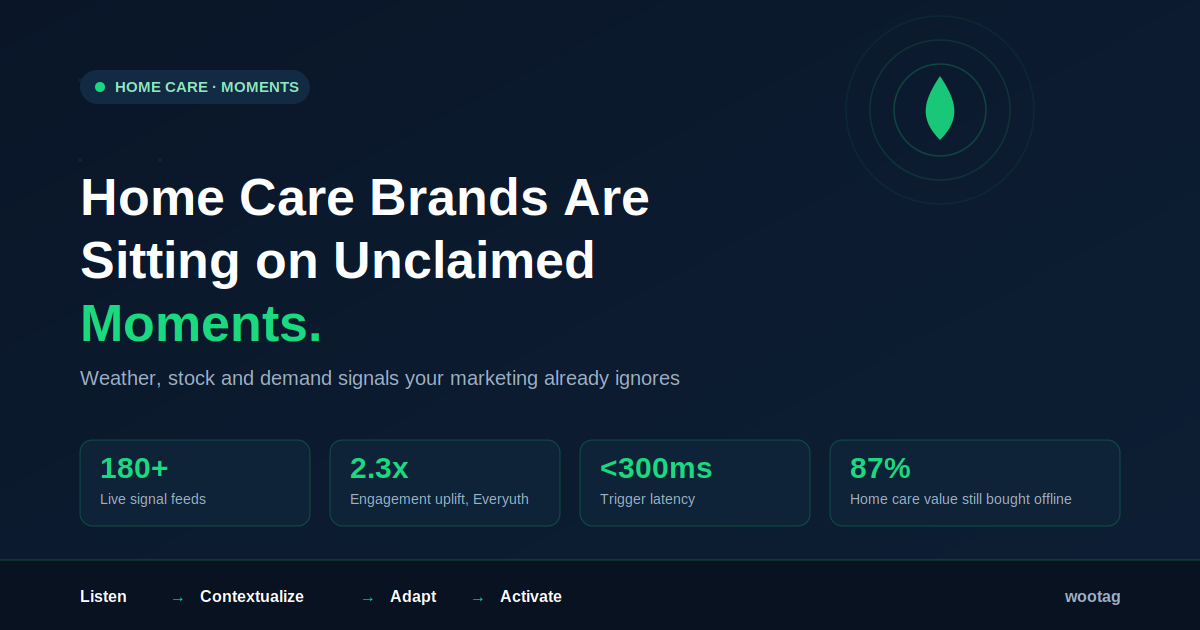
Wootag Moments does not ask a home care brand to rebuild its marketing stack or replace its agency. It sits underneath it as a signal orchestration layer, listening to over 180 live signal feeds spanning weather, air quality, sports, stocks and commodities, and sub 300 millisecond trigger latency turns any one of those signals into contextual creative the moment it goes true. The same signal fires across whichever channels a brand already uses, from paid social to CTV to push notifications to on site commerce, with each channel adapting the format automatically. A brand does not need every integration live to get value. Modular architecture means a home care marketer can start with just weather triggers into Meta, or just retail stock signals into push, and expand from there.
The four stage framework underneath all of it is simple. Listen to the signal. Contextualize it into a message, offer and tone. Adapt the format for wherever it will run. Activate it across every connected channel at once, live in under a second.
For a category where the same routine purchase happens week after week, this is what turns a habitual buy into a moment worth acting on now rather than next week.
What this actually looks like for a home care brand
Everyuth, a personal care brand under Zydus, is a useful proof point for exactly this kind of weather driven activation, run on the Wootag Moments Platform. Wootag identified each viewer’s city, pulled the live temperature, and dynamically assembled the matching creative in real time across Facebook and Instagram, swapping in a tan removal message the moment a city crossed into heatwave territory. The result was a 2.3x engagement uplift, 2.7x more video moments generated, and 41 percent cost efficiency compared to static creative, all from one activation connected once rather than a new campaign built for every city and every temperature band.
Sport carries similar weight for home care brands that already sponsor or advertise around live matches. Valvoline’s Connected TV activation detected live FIFA match events in real time, Goal, Halftime, Penalty and Team Win, and fired a matching spot for each, reaching a 99.03 percent average view completion rate and 37 percent cost efficiency. Budweiser ran the same principle across programmatic display during the FIFA World Cup, hitting 3.2x engagement uplift and 39 percent cost efficiency by matching creative to what was happening on the pitch rather than showing the same display banner on loop. A home care brand running a sports sponsorship or seasonal in-stadium partnership can apply this exact model to a laundry, disinfectant or floor care activation instead of leaving that sponsorship budget running on static creative.
Mapping the category to real signals
| Real world signal | What it means for the household | Home care activation | Where it fires | What it drives |
|---|---|---|---|---|
| Humidity crosses 80 percent, monsoon onset | Damp laundry, musty fabric smell, mold risk | Fabric conditioner and anti mildew detergent creative, dehumidifier bundle offer | Meta, TikTok In-Feed, push | Consideration and add to cart |
| Air quality index crosses an unhealthy threshold | Dust and pollutants building up indoors | Air purifier, surface disinfectant and air freshener creative pinned to top of feed | Push notifications, on site commerce carousel | Sales and category page visits |
| Heatwave, temperature spike | Sweat, odor, higher insect activity | Stronger fragrance dish and floor cleaner, insect repellent creative | Meta, TikTok, CTV | Consideration and retail walk in |
| Heavy rain, storm warning | Foot traffic drops, online demand rises | Shift CTA from store locator to quick commerce and D2C checkout | Meta, TikTok, push | Online sales |
| Local store stock running low | Shopper risks an empty shelf on arrival | Auto swap CTA from store locator to nearest marketplace or quick commerce app with live stock | Meta, TikTok In-Feed, on site | Third party sales, reduced drop off |
| Local store freshly restocked or promotion live | Shopper is close to a live deal | Location based creative pointing to nearest store with the exact deal live today | Push notifications, Meta location extensions | Retail walk in |
The last two rows matter as much as the weather driven ones. A home care brand’s own retail signal, stock level, running promotion, nearest store distance, can be wired into the same trigger logic as weather and sport. When a local store is low on stock, the same creative that would normally send someone to a store locator can automatically point them to whichever third party marketplace or quick commerce app has that SKU available nearest to them, so a stock out at one location does not cost the brand the sale entirely. When a store is freshly stocked with a live promotion, the reverse happens, and the creative pulls the shopper toward the physical aisle instead. This is the same modular logic TikTok’s own commerce moments already run on, where inventory and store proximity update the offer without a new creative build.
Separating what Wootag reports from what independent research shows
The platform figures in this piece, the 180 plus live signal feeds, sub 300 millisecond trigger latency, and the Everyuth, Valvoline and Budweiser results, are Wootag’s own platform specifications and self reported case study outcomes from wootag.com/moments/case-studies.
The independent research is separate. Euromonitor’s home care market data puts the US category at roughly 40.2 billion dollars in retail value with laundry care as the largest sub category, e-commerce accounting for around 31 percent of value, and offline retail still holding close to 87 percent of global category value even as e-commerce has grown at a 20 percent CAGR. The global market sizing of 109 billion dollars in 2025 growing toward 154 billion dollars by 2035 comes from Expert Market Research. Separately, retail research from NetChoice has observed that cleaning products and home repair items tend to sell better through the spring season, a seasonal pattern that lines up with exactly the kind of signal a brand can trigger creative against rather than discover after the season has passed. None of these third party figures are Wootag customer results. They are cited to show that the underlying demand pattern, real world conditions moving real category demand, is independently documented, not a claim unique to Wootag.
Where to start
A home care brand does not need every signal live on day one. The fastest path in is usually one weather trigger, humidity, heat or air quality, connected to the Meta and TikTok accounts already running paid activity, paired with one retail signal, stock level or active promotion, connected to push notifications. That is enough to see the shift from static, calendar based creative to creative that reacts to a real condition affecting a real household, right as it is happening.
If home care is the category, the world is already generating the reason to buy. The only question is whether the brand’s marketing stack is listening.
Book a demo to see a live moment built on your home care portfolio in 20 minutes.
Home Care Brands Are Sitting on Unclaimed Moments. Here Is How to Claim Them.
