

A heatwave breaks over a city and shorts and sandals start moving off the shelf within hours. A match goes to penalties and jersey searches spike the same night. A product runs low in three stores and a brand’s own app doesn’t know it. Apparel is one of the most signal-driven categories in retail. Weather decides what people wear. Sport decides what they want to be seen wearing. Trends move at the speed of a TikTok sound. Stock decides whether a sale is even possible.
And yet, walk through most apparel brands’ Meta feed, TikTok In-Feed, or push notification inbox on any given day, and the creative looks the same whether it’s raining or record heat, whether the derby just went to extra time or nothing happened at all, whether a product is flying off shelves or sitting untouched in a warehouse. The signal is there. The activation isn’t listening to it.
The gap: brands know signals move sales, but the creative doesn’t move with them
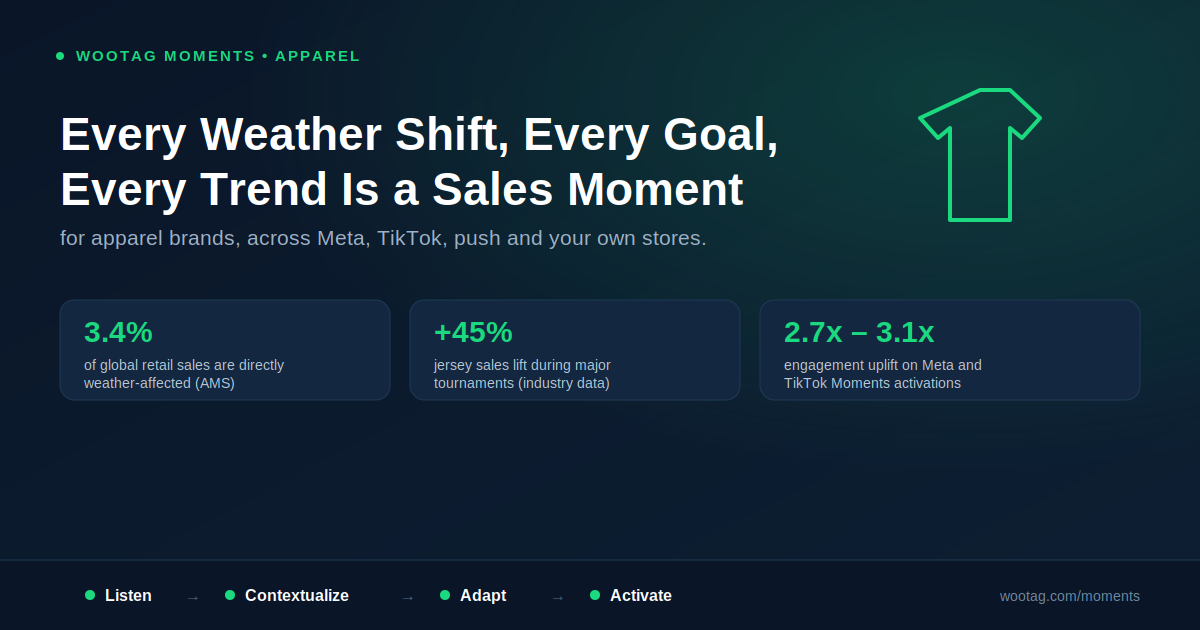
This isn’t a hunch. The American Meteorological Society estimates that weather directly affects 3.4% of retail sales, which works out to close to a trillion dollars of global retail revenue every year. Apparel sits at the center of that number. When a US apparel retailer featured by the National Retail Federation leaned into a warm-weather promotion at the right moment, the products they pushed saw a 267% sales lift. On the flip side, Gap, Target and Columbia Sportswear have all pointed to unseasonably warm weather as a drag on apparel sales in recent earnings commentary. The signal cuts both ways, and apparel brands already know it.
Sport tells the same story. Jersey sales climb by around 45% during major football tournaments, and industry data on team merchandise shows spikes of up to 400% after a big upset. It isn’t limited to sports fans anymore either. Search interest in jerseys styled as everyday fashion has jumped 167% as sportswear crosses over into streetwear, which means the moment for an apparel brand to show up isn’t just kickoff and full time, it’s whatever the culture is doing with the category right now.
The gap isn’t awareness. Apparel marketers already build activations around weather windows, tournament calendars and drop culture. The gap is that the creative, the offer and the channel it lands on are locked in days or weeks before the moment actually happens, while the signal that should be triggering all of it updates by the minute.
Why the gap persists
It isn’t for lack of effort. It’s structural. A weather-reactive or match-reactive variant means a new creative build for every scenario a signal could produce, and no creative team can brief, design and traffic a new asset every time the temperature shifts or a goal goes in. On top of that, the systems that hold the relevant data don’t talk to each other in real time. Regional weather sits with one team. Live match data sits with a media partner. Stock levels sit in a POS or inventory system. The Meta ad account, the TikTok Business Center and the push notification platform are three separate consoles with three separate creative libraries. Even when a brand has every piece of the signal, nothing wires it into what fires across channels the moment it changes.
A signal layer, not another platform to manage
This is where a real-time signal orchestration layer earns its place, sitting underneath the tools an apparel brand already runs rather than replacing any of them. The pattern is consistent: Listen, Contextualize, Adapt, Activate.
Listen means ingesting the signals that actually move apparel demand: regional temperature and weather shifts, live sports events down to the goal or the final over, stock and inventory levels, trending culture and sound data, and pricing or deal thresholds. Contextualize means mapping each of those signals to brand-safe creative, dynamic offers and the right product to surface, automatically. Adapt reshapes that decision into whatever format each channel needs, a Reel overlay, a Story swipe-up, a display banner, a push notification with a curated product carousel. Activate fires it the instant the signal goes true, across every connected channel at once, without a new creative build for every variant.
The connection itself doesn’t require an engineering project. Meta activates through Business Manager, Page and Ad Account connections in under five minutes. TikTok connects through Business Center and an ad account the same way. Push and in-app messaging plug into the CEP a brand already runs, MoEngage or Braze, through an app install from the dashboard rather than a code release. The apparel brand keeps its media buying team, its creative agency and its retention stack exactly as they are. What changes is that all of it now reacts to the same real-time signal at once.
Where this shows up for an apparel brand
| Signal | What fires | Where it lands | What it drives |
|---|---|---|---|
| Regional temperature or weather shift | Seasonal category swap (rainwear, cooling fabrics, layering) with matching offer | Meta, TikTok, push | Consideration and basket relevance |
| Live match event (goal, win, final over, penalty) | Team-linked or athlete-linked creative with a time-boxed offer | Meta, TikTok In-Feed, CTV | Engagement and urgency-driven sales |
| Trending culture or sound | Styled product pairing surfaced into the feed the hour it’s trending | TikTok In-Feed | Discovery and consideration |
| Stock or inventory threshold | “Limited stock” alert or restock notification tied to the real count | Push, Meta and TikTok retargeting | Urgency-driven conversion |
| Regional footfall or store proximity | Hyperlocal offer or “reserve in store” prompt | Push, display | Store walk-ins |
| Flash sale or price threshold | Dynamic discount overlay on the live creative | Meta, TikTok, owned site | Sales and cart completion |
None of these require a separate activation for every scenario. One trigger setup covers the range, and the signal decides which version fires.
Turning it into revenue: owned stores and third-party stores together
For an apparel brand, the signal layer is only half the value. The other half is where it routes demand.
Retail signal integrations, stock feeds, POS data, regional deal calendars, connect through API and are configured per brand rather than as a fixed, one-size template. That matters for apparel specifically, because it means a brand doesn’t need a full enterprise retail stack to get started. A brand with a handful of flagship stores can wire in real stock counts for those locations and let a “3 left in your size” push or a “back in stock” moment reflect what’s actually on the shelf, not a static promise.
The same signal layer can also decide where to send the customer. Apparel brands increasingly sell across their own D2C site and third-party marketplaces at once, and each channel carries a different margin, a different fee structure and a different stock picture. Recent analysis of the e-commerce apparel category found that rising marketplace fees are now the top challenge sellers cite, pushing brands to balance marketplace presence against investment in their own channel. A live signal can make that trade-off automatically. When owned-store inventory is healthy, the moment routes traffic and the offer to the brand’s own site, protecting margin. When a product is only in stock on a marketplace listing, the same moment can point there instead, so the sale still happens rather than being lost to an out-of-stock page. The brand keeps both channels working, and the signal decides which one is the right answer for that customer at that moment.
Where the numbers come from
The platform figures in this post, including 180+ live signal feeds, sub-300ms trigger latency, activation across 47 markets, and the case study outcomes for Everyuth (2.3x engagement uplift, 41% cost efficiency), along with the Meta activation benchmarks (2.7x engagement uplift, 4.3x relevance uplift, 37% cost efficiency) and TikTok activation benchmarks (3.1x engagement uplift, 4.6x relevance uplift, 34% cost efficiency), are Wootag’s own platform specifications and self-reported case study results.
The market context is drawn from independent, third-party research: the American Meteorological Society’s estimate that 3.4% of retail sales are directly weather-affected, the National Retail Federation’s reporting on a 267% apparel promotion lift and on Gap, Target and Columbia Sportswear citing weather in earnings commentary, industry market research on football jersey sales rising roughly 45% during major tournaments with spikes up to 400% after upsets, consumer search data showing a 167% rise in jersey-as-fashion search interest, and e-commerce apparel market research on rising marketplace fees pressuring seller economics. These are cited for context and are separate from Wootag’s own reported results.
The moment is already happening
Apparel brands don’t need to convince anyone that weather, sport and culture move sales. They already build entire calendars around it. The opportunity is closing the gap between when a signal happens and when the activation reacts to it, across Meta, TikTok, push and the brand’s own stores and marketplace listings, without rebuilding creative every time. Book a walkthrough and see a live moment built on your brand’s own signals in under 20 minutes.
