

TikTok spent most of 2026 proving it is no longer a discovery app that brands dip into for reach. At the IAB NewFronts in March, the platform introduced Logo Takeover, Prime Time, TopReach and new Pulse placements built for premium, brand safe inventory. By May, TikTok World had layered in AI powered ad formats, a creator collaboration tool called Branded Buzz designed to mobilize hundreds of creators around a single launch, and Search Hubs, a brand owned destination sitting at the top of TikTok’s own search results. Add a finalized US ownership structure under a new joint venture backed by Oracle, Silver Lake and MGX, and TikTok enters late 2026 as a platform with more institutional stability and more full funnel ad infrastructure than at any point in its history.
The numbers back up the shift in ambition. TikTok Shop is on pace to cross 20 billion dollars in sales this year, in feed checkout is converting at double digit rates, and industry analysis points to TikTok closing the gap between the awareness layer and the performance layer that used to define separate advertising disciplines. The platform is not asking brands to run a campaign anymore. It is asking them to be part of the feed’s ongoing conversation.
That is precisely the problem for most marketing organizations. The feed moves in minutes. The marketing org does not.
The Gap: TikTok’s Culture Speed vs. the Brand’s Production Speed
TikTok’s own advertising research is candid about this. TikTok for Business data shows a majority of users say they trust people to show up as themselves on the platform, which is exactly why polished, scripted, overtly branded creative underperforms the moment it feels out of step with what is actually trending. A sound, a match result, a weather event, a stock move, a cultural flashpoint, any of these can define what a feed rewards for a few hours and then move on entirely. Branded Buzz and Search Hubs are TikTok’s answer to distribution at that speed. They get more creators and more branded assets into the feed faster. What they do not solve is relevance at the moment a specific viewer sees a specific ad.
That is a different problem, and it sits upstream of any single platform’s toolset.
Why the Gap Persists
Most brand teams are still built around a campaign brief that gets locked weeks before it airs. Creative is produced in a batch, approved in a batch, and scheduled in a batch. Meanwhile the signal that would have made that creative land, a live score, a heatwave, a market swing, a trending sound, fires in real time and is gone by the time the next production cycle catches up. The result is a structural mismatch: TikTok’s feed is a live system, and most brand creative pipelines are not.
Platform native tools like Branded Buzz help brands move faster within TikTok. But they are still TikTok specific solutions to a problem that shows up on every channel a brand runs, from CTV to programmatic to Meta to TikTok itself. Solving it one platform at a time means rebuilding the same real time logic five times over, once per channel, with none of it talking to the others.
Why Channel Independence Is the Real Fix
This is where the conversation has to move beneath the platform layer entirely.
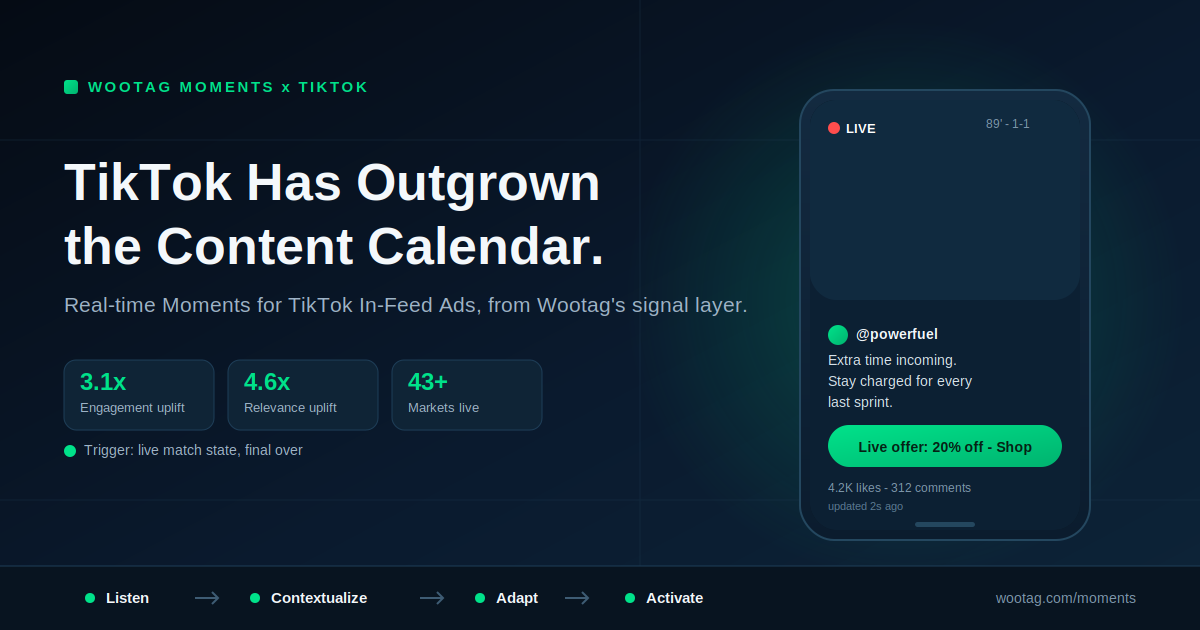
Wootag Moments is built as a signal layer, not a channel tool. It listens to 180 plus real time data feeds across sports, weather, markets and commodities, and now connects directly into TikTok In-Feed Ads through a native integration with TikTok Business Center. The same Listen, Contextualize, Adapt, Activate framework that powers a brand’s CTV spot or programmatic buy also rewrites the headline, offer and creative inside a TikTok In-Feed unit the instant a signal fires, without a separate production pipeline built just for TikTok.
Connect a TikTok Business Center account once, map the signals that matter to a brand, and Wootag’s engine takes over from there. A live football match entering its final minutes can rewrite an energy drink’s In-Feed copy from a generic call to action to “extra time incoming, stay charged for every last sprint.” A humidity spike in a specific city can flip a skincare brand’s featured product from moisturizer to a lighter gel texture, automatically, without an agency round trip. A stock threshold breaking can update a fintech brand’s offer language the same afternoon it happens. These are illustrative examples drawn from Wootag’s own TikTok integration showcase, built to demonstrate the mechanism rather than to represent specific client campaigns.
The important distinction is that none of this lives inside TikTok’s infrastructure. It lives in Wootag’s signal layer, which happens to activate on TikTok, on Meta, on CTV, on programmatic display and on retail screens using the exact same trigger logic. A brand is not building a TikTok strategy and a separate CTV strategy and a separate programmatic strategy. It is building one moment strategy that happens to show up wherever the audience already is.
Where This Maps Across Categories
| Industry | TikTok Moment Trigger | Wootag Response |
|---|---|---|
| FMCG / CPG | Heatwave or humidity spike in a launch city | Swap featured SKU and copy toward the relevant product variant |
| F&B / QSR | Live match state, halftime, final over | Time delivery offers to the exact minute attention peaks |
| Fintech | Index move, rate decision, market open or close | Update offer and messaging around live market sentiment |
| Mobility / Auto | Weather shift, commute pattern, event traffic | Trigger hyperlocal creative tied to road or transit conditions |
| Travel | Flight delay data, seasonal demand signal, destination weather | Adapt destination messaging to real conditions, not a fixed calendar |
| Retail | Inventory threshold, footfall pattern, local weather | Rotate offers and stock messaging without a manual creative rebuild |
| Telecom | Network event, sports broadcast tie in, data demand spike | Contextualize plan or bundle offers to live usage moments |
| Consumer Electronics | Product keynote, trending sound tied to launch, cultural event | Sync creative to the exact window a launch or trend is peaking |
Sourcing Transparency
Third party context on TikTok’s platform direction, including the NewFronts announcements, TikTok World’s AI ad formats and Branded Buzz, TikTok Shop’s growth trajectory, and the finalized US ownership structure, is drawn from TikTok’s own newsroom and independent trade coverage from Social Media Today and industry analysts, cited above where relevant. Engagement, relevance, cost efficiency and market coverage figures for the Wootag and TikTok integration (3.1x engagement uplift, 4.6x relevance uplift, 34 percent cost efficiency, and activation across 43 plus markets) are Wootag’s own self reported platform data drawn from its TikTok integration page. Brand examples referenced in this piece are illustrative demonstrations from Wootag’s product materials rather than confirmed client campaigns.
The Platform Has Matured. The Question Is Whether the Brand Has
TikTok in 2026 is no longer a bet on reach. It has institutional backing, a full funnel ad stack, and a feed that increasingly rewards brands for showing up inside the moment rather than around it. The brands that will win this cycle are not the ones producing the most creative. They are the ones whose creative already knows what is happening in the world before the next campaign brief gets written.
See how Wootag Moments connects to TikTok In-Feed Ads, explore how the same signal layer activates sports moments across every channel a brand runs, or book a demo to map the signals that matter most to your category.
