
Stop Chasing a Single Moment: What Customer Activations Are Teaching Us About Multi-Moment Marketing

A football match does not hand a brand one moment worth showing up for. It hands out dozens. The nervy kickoff. A shot that grazes the post. A penalty call. The goal itself. Halftime tension. The final whistle relief or heartbreak. A brand that plans around a single one of these, say the goal, is betting an entire campaign on a few seconds of attention that may or may not arrive on schedule. A brand that plans around all of them is building a relationship with the whole ninety minutes.
That distinction, single moment versus many moments, has turned out to be one of the clearest signals coming out of recent customer activations on the Moments platform. It was not something we set out to prove. It showed up in the results, campaign after campaign, until the pattern became too consistent to ignore.
The learning: one moment is a bet, many moments are a strategy
Most brands still plan contextual marketing the way they plan a product launch: pick the big moment, build one hero creative, and hope the timing lands. It is an understandable instinct. A single well-crafted asset feels safer to sign off on than a matrix of variations.
But a live event, a weather pattern, or a market swing rarely announces itself once. A match has a goal, a penalty, a halftime, a win. A heatwave has a first spike, a peak, a cooling trend. A stock index moves up, moves down, and sometimes goes nowhere at all. Each of these is a distinct emotional state in the audience, and each deserves its own message rather than one message stretched across all of them.
When we looked across activations that used multiple moments and rules, rather than a single triggered event, three things consistently showed up together:
Context adaptation across moments. The same brand, the same campaign, but the message shifted with what was actually happening. A goal moment talked about performance. A penalty moment talked about tension. A halftime moment talked about pace. None of it felt like the same ad recut five times. It felt like five different observations about the same game.
Multiple assets, not one asset stretched thin. Campaigns that paired several image and video variants against those moments consistently outperformed campaigns running a single hero asset on loop, regardless of how strong that single asset was on its own.
A real channel mix. Audiences for the same brand were not all sitting in the same feed. Some were on Instagram Stories, some on Facebook, some on connected TV, some on programmatic display. Campaigns that adapted format and tone for where the audience actually was, rather than pushing one channel’s version everywhere, saw meaningfully better engagement than single-channel structures.
None of these three things is new in isolation. What is new, or at least newly obvious, is how much better they work when they run together as one automated system rather than as three separate manual efforts.
Why this works: the moment, not the creative, is the unit of strategy
The instinct to build one great asset comes from a world where creative production was the bottleneck. If a video takes two weeks and a small fortune to produce, of course a brand wants one asset to do all the work. But when the underlying decision, what to say, to whom, in what tone, at what moment, is handled by a system rather than a production calendar, the calculus changes entirely.
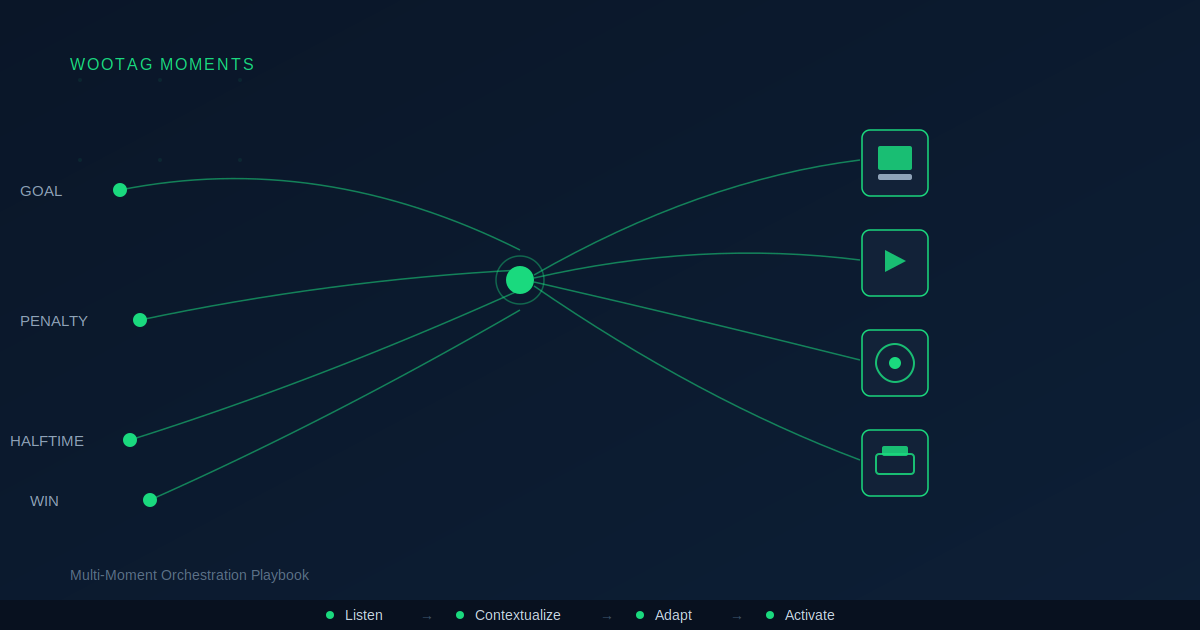
This is the logic behind how the Moments platform is built. Listen picks up the live signal. Contextualize maps that signal to the right creative treatment and message. Adapt reshapes the asset for the format and channel it needs to live in. Activate fires it the moment the trigger happens. Multiplying moments, assets, and channels is not extra work bolted onto that workflow. It is what the workflow was designed to do at scale, the same way a single trigger would fire a single asset.
That is the real unlock in the learning. Once the infrastructure treats “a moment” as the unit of strategy rather than “a creative” as the unit of strategy, running five moments with five contextual variants across three channels costs roughly the same operational effort as running one moment with one asset on one channel. The ceiling on how dynamic a campaign can be stops being a production constraint and starts being a strategic choice.
What the results actually looked like
Two activations from FIFA season illustrate the pattern well. Both are self-reported results from the brands’ own campaigns on the Moments platform, shared here as illustrations of what the multi-moment approach produced, not as claims about any other brand’s likely results.
Valvoline ran real-time creative against live FIFA match events on connected TV, with a separate treatment for Goal, Halftime, Penalty, and Team Win rather than one spot looping through the match. Penalty moments turned out to be the single highest-performing trigger of the set, something that would have been impossible to know, let alone act on, with a single fixed creative. The campaign posted a 99.03 percent average video completion rate and 37 percent cost efficiency against benchmark.
Budweiser ran a similar structure across programmatic display and DCO during the FIFA World Cup, with distinct creative for Kick-off, Goal, Halftime, Penalty, and Team Win, each pulling in the live scoreline. That campaign delivered a 3.2x engagement uplift and 39 percent cost efficiency, with the pre-match moment emerging as the strongest performer, a result the brand likely would not have anticipated going in with a single hero asset built around the goal alone.
A weather-triggered campaign for a personal care brand adds the channel and asset dimension to the picture. Rather than one static creative, the campaign dynamically assembled matching image and video assets by live city temperature, delivered in 9:16, 1:1, and 16:9 formats across Facebook and Instagram. That mix of formats and channels, tied to a mix of image and video assets, produced a 2.3x engagement uplift and 41 percent cost efficiency.
The common thread across all three is not the specific vertical or signal type. It is that the win came from range, multiple moments, multiple assets, multiple channels, working as one coordinated system, rather than from any single creative being cleverer than the last.
What the wider industry is seeing too
This pattern is not unique to what we are seeing on the Moments platform. It shows up in independent research on creative and channel strategy more broadly, and it is worth separating clearly from the platform-specific results above.
On the creative side, industry adoption of dynamic, multi-variant creative has climbed sharply, with reported advertiser usage of dynamic creative optimization rising from 60 percent in 2015 to 82 percent by 2024. A 2025 analysis of over a million video ad variations across app advertising found that creative optimization drove install lifts of up to 33 percent on ad networks and 65 percent on social channels compared to static, single-version creative. Separately, McKinsey research on personalization at scale has estimated revenue lifts in the 10 to 15 percent range from tailoring messaging to context, with some sectors seeing gains as high as 25 percent.
On the channel side, widely cited research on cross-channel campaigns found that marketers using three or more channels in a single campaign saw purchase rates roughly 287 percent higher than single-channel campaigns, with order rates nearly five times higher for multi-channel structures compared to single-channel ones.
Taken together, the independent research and the platform activations are pointing at the same conclusion from two different directions. Range, in moments, in assets, in channels, consistently beats depth on any single one of those dimensions alone.
Why this saves time and money rather than adding to the workload
The instinctive objection to any of this is production load. More moments, more assets, more channel variants sounds like more design hours and more budget, not less. In practice, the opposite held true across these activations, for one reason: none of the additional variants were built by hand.
The Contextualize and Adapt stages of the workflow handle the mapping from signal to message to format automatically, which means a brand’s design and media teams are not manually producing a Goal asset, a Penalty asset, a Halftime asset, a Story crop, a square crop, and a display banner for every campaign. They are approving a system that produces all of it against rules set once. That is where the time and cost savings actually come from, not from doing less work per asset, but from not having to touch most assets by hand at all.
It also changes how media spend gets allocated. Instead of a fixed budget split decided in advance, spend can shift toward whichever context is actually driving results, the way the Penalty moment did for Valvoline or the pre-match moment did for Budweiser, because the system is watching performance by moment in real time rather than reporting on it after the fact.
The takeaway for brands building their next activation
The question worth asking before the next campaign brief is not “what is our best creative for this moment.” It is “how many moments, assets, and channels can we responsibly put into motion at once, and what system lets us do that without burning out the creative team.” The evidence, both from what customers are seeing on the Moments platform and from the broader research on dynamic creative and cross-channel marketing, points the same way. Depth on one moment is a bet. Range across many, run through one coordinated system, is a strategy.
