
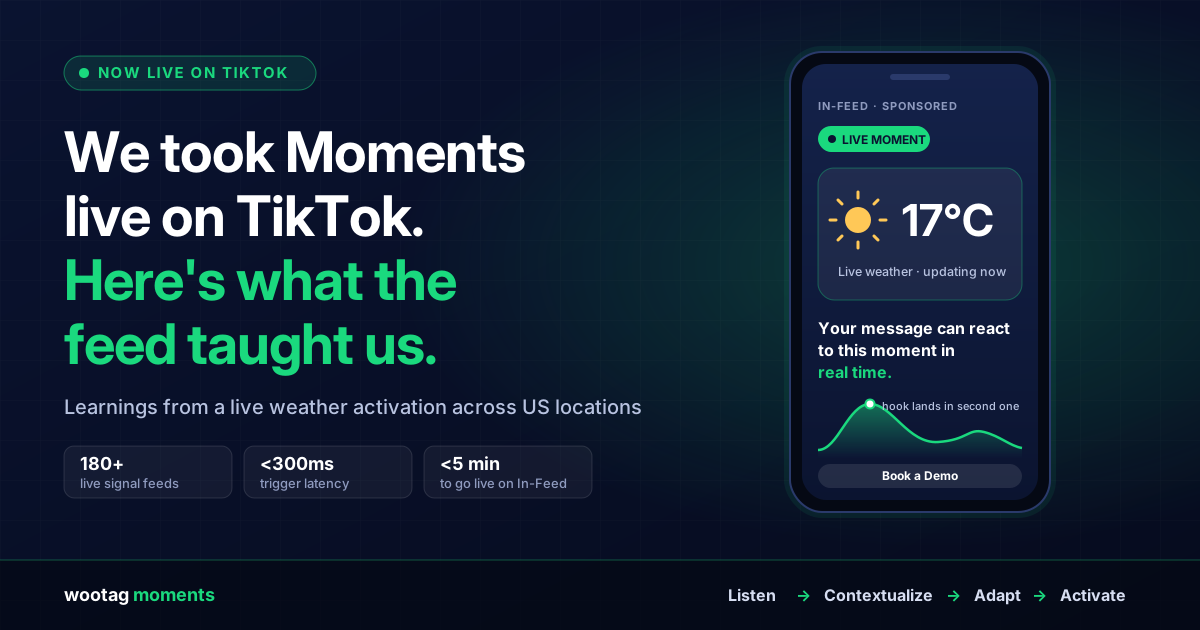

A temperature reading is not a creative idea. It is a number on a weather app. But put that number inside a TikTok In-Feed ad, updating live for the city the viewer is scrolling in, and something shifts. The ad stops feeling like something planned three weeks ago. It starts feeling like it knows what is happening outside the window.
That was the bet when Wootag Moments went live on TikTok. To see it work in the wild, we ran a test activation across a handful of US locations using the simplest live signal we have: local weather. The creative was a five second In-Feed spot telling marketers, in plain words, that their communication could react to this weather moment in real time on TikTok, with the live local temperature sitting right in the frame and a Book a Demo button at the end.
We are not sharing the raw numbers here. We are sharing what they told us, because the patterns matter more than the figures for any brand thinking about TikTok right now.
How brands advertise on TikTok today
Most TikTok advertising follows a familiar rhythm. A brand plans an activation, briefs a creator or an agency, shoots a few variants, and runs them as In-Feed ads or Spark Ads that boost organic posts. Bigger launches add TopView takeovers, branded effects or a TikTok Shop push. When the creative starts to tire, the team shoots a fresh batch and the cycle starts again.
Nothing about that rhythm is wrong. The problem is the clock it runs on. The message is decided by the media calendar, while the feed itself moves at the speed of the world. A heatwave rolls into a city on a Tuesday. A match goes to extra time. A sound starts trending at lunch. The ad that runs through all of it says exactly the same thing it said on launch day.
On most channels that mismatch is tolerable. On TikTok it is expensive, because TikTok punishes anything that feels out of step with the moment the viewer is in.
Why the TikTok audience is worth getting right
The US is TikTok’s single largest market, with roughly 136 million monthly users according to DataReportal figures. Scale alone is not the story, though. What makes the platform different is the mindset people bring to it.
TikTok users come to discover. Research TikTok commissioned from Material found that 61% of users discover new brands and products on the platform, and that they are 1.5 times more likely than users of other platforms to find something and go buy it immediately. More recent work from Deloitte Digital with TikTok found that 57% of users say they discover products passively, simply by scrolling.
That combination is powerful and unforgiving at the same time. People are paying attention, but they give you very little time. The swipe is always one thumb away. What earns the stop is relevance: the feeling that this piece of content belongs in the feed right now, for this person, in this place.
And as our own test showed, the TikTok audience is not only Gen Z teenagers. More on that below.
The gap: TikTok rewards relevance, most creative is built for the calendar
Brands already know relevance wins on TikTok. That is why so much effort goes into trend jacking, creator partnerships and reactive content. The trouble is that all of these depend on people noticing a moment, deciding it matters, producing something and getting it approved before the moment is over. By the time a reactive post clears legal, the weather has changed and the match has ended.
So the gap persists for structural reasons, not creative ones:
- Detection is manual. Someone has to spot the signal. Across dozens of cities and categories, nobody can watch everything.
- Production is slow. Each new message means a new creative build, a new upload and a new review.
- Targeting is static. Location and audience splits are set at launch and rarely move with what is happening on the ground.
- Expiry is ignored. Even when a team does react, the reactive ad keeps running long after the moment it was built for has passed.
This is not a TikTok problem. It is a communication infrastructure problem that TikTok happens to expose more sharply than any other channel.
Why signal orchestration is the missing layer
Signal orchestration is the layer that decides what a brand says, to whom, in what tone and at what moment, based on what is actually happening in the world. Creative becomes one output of that decision rather than the starting point.
Wootag Moments runs this as a four step loop:
- Listen. The platform ingests live feeds across sports, weather, markets, commodities, culture and commerce, and detects when a signal crosses a threshold that matters.
- Contextualize. Each signal is mapped to brand rules: which product, which offer, which message, which locations, and which guardrails apply.
- Adapt. The creative is reshaped for the format it lives in. On TikTok, that means the In-Feed headline, copy, offer and on-screen data update without a new build.
- Activate. The moment goes live in the ad account, and it pauses or rotates when the signal expires.
The important shift is that the brand stops publishing messages and starts publishing rules. One master creative can produce thousands of contextual variants, each one tied to a real condition in a real place, and each one retired the moment that condition no longer holds.
Finding the right moments for your brand
Not every signal is a moment. A good moment for TikTok usually passes five tests:
- It connects to the product. Humidity matters to a skincare brand. A stock index matters to a trading app. A football score matters to an energy drink. If the link needs explaining, it is not the right moment.
- It is local or personal. TikTok is a personal feed. Signals that change by city, by neighbourhood or by match are far stronger than national ones.
- It recurs. One off moments are fun, but signals that fire often (weather, match days, market sessions, stock levels) build a durable always on program.
- It carries emotion. Heat, rain, a last minute goal, a market spike. The best moments already have the viewer feeling something.
- It has an expiry. If you cannot say when the moment ends, you cannot stop the message from going stale.
On TikTok specifically, the four families that work best inside In-Feed today are sports, weather, culture and commerce. Live scores rewrite the headline mid match. Temperature and humidity flip the product per city. Trending sounds and events keep the copy on the day’s conversation. Inventory and pricing signals update the offer when stock runs low.
What our US TikTok activation taught us
Our test was deliberately small: a single five second weather creative, a few US locations, and a B2B message aimed at marketers. The goal was to see how a live signal behaves inside the TikTok feed, not to chase scale. Here is what stood out.
1. The live signal is the hook
TikTok’s key frame analysis showed clicks concentrated in the very first second of the video, right when the live temperature appeared on screen. Retention held through the opening beats and then picked up again a few seconds in, when the weather visuals cycled. The takeaway is simple. Put the live data point in frame one. If the viewer has to wait for the moment to arrive, they are already gone.
2. Relevance showed up in TikTok’s own benchmarks
TikTok Ads Manager ranks each video against the rest of the account’s creative. Our moment creative landed in the top quartile for click through rate and click volume. For a five second ad with a B2B message and no creator, no trending sound and no discount, that is a strong signal that contextual relevance does real work on the feed.
3. No single location won all week
When we looked at click through rate by day, the different locations peaked on different days. One market led early in the week, another took over midweek, and a third spiked near the end, broadly tracking how conditions shifted locally. A static budget split set at launch would have missed this completely. Relevance is local and it moves. Orchestration has to move with it.
4. The audience was older than the stereotype
Delivery concentrated in the 35 to 44 and 45 to 54 age brackets, with 35 to 44 responding most strongly, and it leaned male even though TikTok’s US user base skews female overall. For a message aimed at marketing decision makers, that is exactly the right cohort. The moment did the qualifying. TikTok’s delivery found the people for whom a live weather trigger actually meant something.
This matters for any brand that still treats TikTok as a Gen Z only channel. A well matched moment can reach professionals and household decision makers who are scrolling just like everyone else.
5. Short works when the moment carries the message
Five seconds is not much time to tell a story. It does not need to be when the signal is the story. A live temperature, a live score or a live stock count says “this is about right now” faster than any voiceover can.
6. Going live took minutes, not a sprint
The integration needed no code, no tags and no rebuild of the creative. We connected the TikTok Business Center, picked the ad account, mapped the weather signal and the locations, and the activation was live. That speed is what makes testing moments cheap enough to do often.
How brands can enable Moments on TikTok
The Wootag Moments TikTok integration is live for TikTok In-Feed Ads. Getting started takes three steps:
- Connect TikTok Business Center through a secure one click authentication.
- Connect your ad account and choose the activations you want Moments to run.
- Activate In-Feed moments by mapping the signals you care about to your creative.
Once connected, here is a practical way to run your first activation:
- Start with two or three signals that clearly connect to your product. Weather and live sport are the easiest places to begin.
- Write rules, not posts. Define the thresholds (above 30°C, humidity over 80%, final ten minutes of a match), the message for each, and the locations where each rule applies.
- Build one master creative with live slots for the headline, the data point, the offer and the call to action. Put the live signal in the first second.
- Set guardrails and expiry so every swap stays on brand and every message pauses when its moment ends.
- Test in a few locations first, as we did, then read trigger level reporting inside TikTok Ads Manager to see which moments earn attention.
- Scale what works across markets and ad accounts once a moment has proven itself.
Mapping moments to verticals on TikTok
| Vertical | Live signal | TikTok In-Feed moment | Outcome to watch |
|---|---|---|---|
| QSR and food delivery | Heat, rain, match time | Cold drinks on hot afternoons, comfort food on rainy evenings, combo offers at kickoff | Orders, app opens |
| Beauty and personal care | Humidity, UV, air quality | Product swaps by city as conditions change | Consideration, add to cart |
| Sportswear and energy drinks | Live match state | Messaging that reacts to goals, extra time and final whistles | Engagement, purchases |
| Fintech and trading apps | Market moves | Copy that updates when an index or asset moves sharply | Installs, sign ups |
| Retail and eCommerce | Stock levels, pricing | Low stock alerts and live offers per region | Conversions, store visits |
| Telecom and streaming | Live sports schedules | Data and streaming bundles timed to big matches | Plan upgrades |
| B2B and martech | Industry events, live demos of signals | Showing the product working on a real signal, as in our test | Site visits, demo bookings |
TikTok is one output, not the whole system
It is tempting to think of this as a TikTok tactic. It is not. The signal layer sits underneath every channel a brand already uses. The same weather trigger that updates a TikTok In-Feed ad can update a Meta ad, a push notification, a CTV spot or a retail screen. The orchestration layer decides once and every channel responds.
That is what makes the approach durable. Platforms change their formats, algorithms and policies regularly. The decision about what to say, to whom and when does not belong to any one of them. It belongs to the brand, and it should run on infrastructure the brand controls.
Sourcing and transparency
Wootag platform figures. Wootag reports 180+ live signal feeds and trigger latency under 300 milliseconds on its Moments platform page. The TikTok integration page reports 3.1x engagement uplift, 4.6x relevance uplift and 34% lower cost per action for Moments based TikTok activations versus static creative. These are platform reported figures.
Test learnings. The learnings in this post come from Wootag’s own small scale test activation in TikTok Ads Manager across a few US locations. They are directional observations from one creative and one signal. Absolute figures have been withheld, and results will vary by brand, category and market.
Third party research. US user figures are DataReportal estimates as reported by Vidico. Discovery and purchase behaviour figures come from TikTok Marketing Science research conducted by Material, which was commissioned by TikTok, and from Deloitte Digital research produced with TikTok.
See your first moment fire on TikTok
The feed already moves with the world. Your creative can too. If you want to see what a live sports, weather, culture or commerce moment looks like inside your own TikTok In-Feed ads, book a demo with the Wootag team and we will map the right signals to your brand.
We Took Wootag Moments Live on TikTok. Here's What the Feed Taught Us.
