
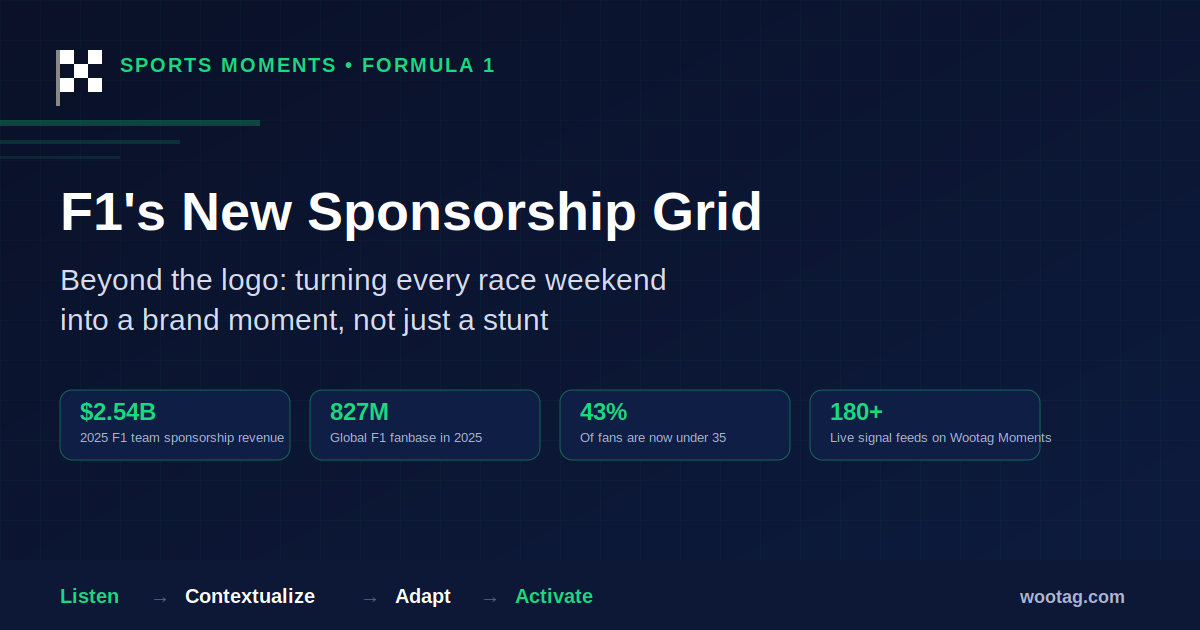

F1 team sponsorship revenue hit $2.54 billion in 2025. The names on the grid tell you why. PepsiCo brought Gatorade and Doritos in through McLaren. KitKat became the sport’s official chocolate bar and built a 350 kilogram chocolate replica car for it. Lego turned a licensing deal into full size buildable helmets worn by Ferrari drivers on a race weekend, and its CEO credited the F1 range as one of the drivers behind a 12 percent revenue jump in the first half of 2025. Mattel is in the paddock too, betting that a sport once defined by engine specs and lap times now sells toys and confectionery to a fanbase that looks nothing like it did a decade ago.
That audience shift is the real story behind the money. F1’s global fanbase reached 827 million people in 2025, up 12 percent year on year and 63 percent since 2018. Under 35s now make up 43 percent of that base, and 57 percent of everyone who became a fan this year was under 35. Women account for 42 percent of the audience, up from 37 percent in 2018, with 43 million new female fans added in a single year. This is no longer a niche motorsport audience. It is a young, global, gender balanced crowd that confectionery, toy, and beverage brands would ordinarily have to fight for through kids’ TV or gaming, and F1 is delivering it to them race weekend after race weekend.
The gap: spectacle is doing the work that a system should be doing
Look closely at how these brands are actually activating, and a pattern shows up. KitKat’s chocolate car is a genuine piece of craft, and it worked as intended. It generated press coverage, social sharing, and a physical centerpiece that made the sponsorship feel real to people who will never see a race in person. Lego’s life size helmets did the same job in the paddock. These are strong ideas, and they prove the audience is there and paying attention.
But a stunt is built for one moment on the calendar. A 24 race season generates thousands of moments that never get a chocolate car: a podium finish, a safety car that flips the strategy, an overtake in the final laps, a rookie’s first points, a championship point sealed at the wire. Right now, the sponsorship spend covers the trackside branding and the broadcast exposure for all of it, but the brand’s own activation, the thing that actually shows up in a fan’s feed or a shopper’s path to purchase, is still built around a handful of planned hero moments rather than the moments the race itself produces in real time.
That is the gap. Sponsorship rights buy visibility across every session. Activation, in most of these plans, still only shows up for the sessions the creative team planned around in advance.
Why the gap persists
It is not a budget problem for brands writing checks this size. It persists because sponsorship and activation are usually planned as two separate disciplines on two separate timelines. The sponsorship deal is negotiated months out and locks in trackside inventory, hospitality, and a handful of marquee content moments like a livery reveal or a stunt in a host city. The activation plan, the social posts, the in-store promotion, the push notification, gets built against that fixed calendar of planned moments.
What does not get planned for, because it cannot be, is what actually happens on track. Nobody knows in October which of next season’s 24 races will have a last lap overtake for the win, or which driver will have a breakout drive that sends search volume and shirt sales up in one afternoon. Brands that only activate around what they scheduled in advance are, by definition, going to miss the moments the sport itself creates. And those are usually the moments fans are talking about the most.
Moments infrastructure does not require a sponsorship
This is where the model needs to change, and it changes the same way regardless of category. A brand does not need broadcast rights or trackside signage to build around a live moment. What it needs is a way to listen for the signal, a podium finish, a fastest lap, a safety car, a title clinched, and turn it into a brand response before the moment has passed.
That is a signal orchestration problem, not a sponsorship problem, and the same underlying discipline applies whether the live signal is a race result, a goal, a wicket, a heatwave, or a stock move. Listen for the signal as it happens. Contextualize it against brand safe rules, audience sentiment, and the offer that fits that specific moment. Adapt the creative and the offer to the channel and the audience. Activate it across the channels the audience is actually on, in the window while the moment is still live.
Wootag’s own case study work shows what this looks like when it is not tied to any single sport. Valvoline ran a real time moments campaign across an entire FIFA season on Connected TV, swapping in a matching creative the instant a goal, halftime, penalty, or team win happened instead of running one static ad for the whole match. That campaign averaged a 99.03 percent video completion rate with a 37 percent cost efficiency gain. Budweiser ran a comparable model during a FIFA World Cup window across programmatic display, triggering a contextual creative off kickoff, goal, halftime, penalty, and team win, and saw a 3.2x engagement uplift with 39 percent cost efficiency. Neither of those results depended on a stunt. They came from infrastructure that was listening throughout the match, not just at the moments planned for in the media plan.
Applied to F1, the same infrastructure means a confectionery or toy brand is not choosing between “build the chocolate car” and “activate every race weekend.” The stunt still earns its media coverage. The moments infrastructure sits underneath it, catching the podium finish, the overtake, the safety car restart, and the championship point across every one of the 24 weekends the stunt cannot cover.
Where this shows up by category
| Category | F1 live moment to trigger on | Activation | Sales trigger |
|---|---|---|---|
| Confectionery & snacks | Podium finish, fastest lap, race win | Push notification and social creative swapped to the winning driver or team colors | Limited edition pack promo pushed to nearest retail or quick commerce partner |
| Toys & collectibles | Pole position, driver of the day, championship point clinched | Dynamic product creative on social and display featuring that driver’s set or livery | Direct link to in stock inventory at nearest retailer, own store, or marketplace |
| Beverage & QSR | Safety car, overtake for the lead, final lap restart | Contextual CTV and display creative matched to race tension | Store locator overlay with a time bound offer tied to the moment |
| Apparel & lifestyle | Race win, title clinched, rookie milestone | Dynamic creative featuring that driver’s merchandise | Shoppable overlay routing to own store stock, with marketplace fallback if local stock is low |
| Fintech & payments | Championship standings shift, qualifying result | Contextual messaging on owned app and paid social tied to the moment | Awareness and consideration content driving app opens or card sign ups |
The mechanism does not change across rows. What changes is which signal matters to that audience and what the brand does the moment it fires.
Sourcing and transparency
The F1 audience and revenue figures referenced above, the $2.54 billion in 2025 team sponsorship revenue, the 827 million global fanbase, the 43 percent under 35 composition, and the 42 percent female audience share, are third party figures reported by Campaign, Formula 1’s own 2025 season review, and RacingNews365, not Wootag data. The KitKat and Lego activation details are drawn from public reporting on those campaigns, not from any confirmed Wootag client relationship, and are used here as illustrative examples of how sponsorship activation is currently built.
The Valvoline and Budweiser figures, a 99.03 percent average video completion rate and 37 percent cost efficiency for Valvoline, and a 3.2x engagement uplift with 39 percent cost efficiency for Budweiser, are self-reported case study results published by Wootag on its own case studies page, not independently audited numbers. Platform specifications referenced, including 180 plus live signal feeds, sub-300ms trigger latency, and coverage across 47 markets, come from Wootag’s own product documentation. They are shared as proof points of what real time moment activation can look like, not as a benchmark that every brand or category will match.
Where this goes from here
F1’s sponsorship grid is only going to get more crowded, and more categories will keep discovering an audience that is younger, more global, and more female than the sport’s reputation suggests. The brands that win the next few seasons will not be the ones with the biggest stunt. They will be the ones with a system that turns every race weekend, not just the planned ones, into a brand moment. If a chocolate car or a full size Lego helmet can earn a brand this much attention once a season, imagine what the same brand does with a system that shows up for every podium, every overtake, and every safety car in between.
If you want to see how Wootag’s signal orchestration engine turns live sports moments like these into measurable activation across CTV, social, and retail channels, book a demo with our team.
