

Nobody wakes up and decides to buy a portable fan. They type “why is my room so hot” first. A few searches later they are comparing models, and a few after that they are checking who has stock nearby. By the time a purchase happens, the decision has already been shaped by a trail of queries.
Search is one of the few places where people tell you what they want, in their own words, at the exact moment they want it. Most brands read that signal in one corner of the business and ignore it everywhere else.
Why search trends matter for purchase decisions
Research habits have settled around search. Search engines dominate product research for 65% of shoppers, and most shoppers (68%) spend an hour or less on research. In a separate study, 36% of consumers who recently made a major purchase said they began the journey with a search engine. At the scale of Google alone, people shop on Google more than 1 billion times per day, and 80% of Gen Z use it somewhere in their shopping journey. 2025 Consumer Research Meet Every Shopper, Every Channel, Every Moment +2
Even as AI assistants enter the picture, the research stage stays where influence lives. Among consumers who use AI to research, 69% want AI involved in research while keeping the final say on the purchase. People are still doing the thinking before they buy. razorfish
Here is the part that matters for marketers. A rising search query is a demand signal that shows up days or weeks before it appears in a sales report. Sales data tells you what already happened. Search trends tell you what is about to.
The gap: trends live in one team, communication lives in another
In most organisations, search trend data is used by the SEO and paid search team. It informs keywords and landing pages. That is useful, but it is a small slice of what the signal can do.
Meanwhile, social, push notifications, display and CTV run on a content calendar planned weeks ago. So a person who spent the morning searching for a trending product category sees an unrelated message on Instagram in the afternoon. The brand knew what the market was asking for. The communication did not.
Why the gap persists
Three reasons keep it open.
First, ownership. The trend dashboard belongs to one team and the creative briefs belong to another.
Second, speed. A search trend can peak and fade in a day or two, while creative production and approvals run on weekly cycles.
Third, scale. Even a team that spots the trend cannot manually adapt messages, products and offers for every channel and every audience fast enough.
The result is that brands watch trends instead of acting on them.
Three kinds of search signal worth listening to
A useful trend layer mixes three sources.
Your own keywords. Searches for your brand and product names, and the problems your products solve. A spike here means interest is building around something you already sell.
Competitor keywords. Rising searches for rival brands, “versus” queries and “alternative to” phrases. These tell you when attention is moving and where a comparison or an offer could win the next click.
Category and cultural trends. Rising queries around a need, a season, an event or a behaviour that your category serves. This is where you meet demand you did not create.
One caution from the research side: not every trending topic is something people buy, and switching Google Trends to its Shopping filter helps separate casual curiosity from purchase intent. Filtering for intent matters before any activation goes live. shopify
Building the contextual layer: message, product, offer
A trend alone is not a communication. It becomes one when you attach context to it. Think of the context layer as three decisions made in advance, so they can fire the moment a trend does.
Messaging. What do you say when this trend is rising? The tone for a heatwave search spike is different from the tone for a competitor comparison spike.
Product. Which product or product line answers this trend best, and is it in stock where the demand is?
Offer. Is there a deal, a bundle or a first order incentive that fits this moment? Or is the right move to inform and not to discount?
Pair each trend with a threshold as well. A trend that clears the bar triggers the activation. One that does not triggers nothing. Staying quiet is a design choice. Franklin Templeton’s Moments setup, which paused automatically when the market move was too small, saved 24% of budget and served zero wasted impressions, and the same logic applies to search trends.
How Wootag turns a search trend into a live activation
This is where the Moments Platform comes in. The framework is the same one that runs every Wootag activation.
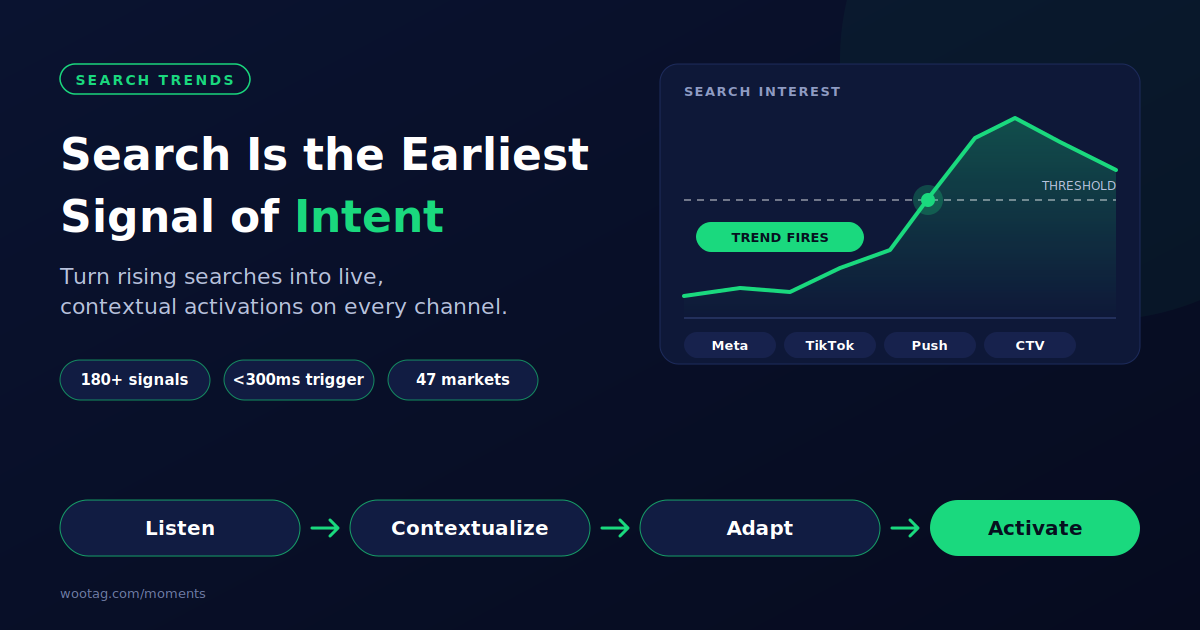
Listen. Wootag tracks the search trends you care about: your own keywords, competitor terms and category trends, alongside its 180+ live signal feeds.
Contextualize. Each trend is mapped to the message, product and offer you defined for that moment.
Adapt. Creative is reshaped for where it will live, whether that is a feed, a story, a banner, a push notification or a shoppable tile.
Activate. When the trend clears its threshold, the activation fires across your channels, with trigger latency under 300 milliseconds.
The trend sets off the whole chain. Nobody has to brief a new asset, wait for approval and book media while the moment passes.
The channel is not the point
A search trend is a trigger, not a channel. The same rule can fire on Meta, TikTok, LinkedIn, push notifications, programmatic display, CTV and shoppable surfaces. The rule lives in one place and the channels simply carry it. This is the difference between running activations channel by channel and running them from a single signal layer. When your trends, thresholds and context sit in the platform, adding a channel does not mean rebuilding the logic.
The mechanic is proven on other signals. Everyuth’s weather moments on Meta delivered a 2.3x engagement uplift and 41% cost efficiency. Valvoline’s live FIFA moments on CTV reached a 99.03% average view completion rate with 37% cost efficiency, and Budweiser’s FIFA moments on display delivered 3.2x engagement uplift with 39% cost efficiency. In each case, the signal decided what was said and when.
The insights layer: what trends teach you back
Every activation also writes data back. Which trend fired, which message ran, which offer was shown, on which channel, and how people responded. Over time this becomes an insights layer that answers questions your search dashboard alone cannot:
- Which trends convert into engagement, and which are only noise?
- Which competitor spikes are worth responding to?
- Which offers lift response for which category trend?
- Which channel reacts fastest to which kind of trend?
Those answers feed straight back into the keyword set and the context layer. The loop tightens with every activation.
What this looks like across verticals
| Vertical | Example search trend | Context layer (message, product, offer) | Where it activates |
|---|---|---|---|
| Apparel and Fashion | Rising queries for a seasonal style, or “alternative to” a rival label | Style led message, trending product in stock, size or bundle offer, routing to a marketplace if local stock is low | Meta, TikTok, push |
| Personal Care and FMCG | Rising searches for a skin or hair concern | Hero product for that concern, a how to use tip, a trial size offer | Meta, TikTok, shoppable tiles |
| Travel | Surge in searches for a destination or “flights to” | Destination creative, matching fare or package, limited time offer | Social, push, display, search |
| Consumer Electronics | “Best phone under a budget” or a rival model spike | Comparison message, matching model, trade in offer | Meta, YouTube, programmatic |
| Fintech and Investing | Queries on a rate change, an asset or a tax deadline | Educational message, relevant product, sign up prompt | Meta, LinkedIn, display |
| QSR and F&B | A trending dish or craving search | Trending menu item, combo offer, nearest outlet | Push, social, CTV |
| B2B and SaaS | Rising searches for a problem or a competitor alternative | Problem led message, relevant solution page, demo offer. Outcomes are leads, demo bookings and site visits | LinkedIn, display, push |
Sourcing and transparency
Wootag platform information. The platform specs (180+ live signal feeds, trigger latency under 300 milliseconds, live in 47 markets) and the Everyuth, Valvoline, Budweiser and Franklin Templeton results come from wootag.com/moments and wootag.com/moments/case-studies. They are self-reported by Wootag. None of these published case studies uses search trends as its signal. They show the signal to context to activation mechanic on weather, sports and stock signals.
Third-party research. The statistics on search and purchase behaviour come from Salsify’s 2025 Consumer Research Report, Razorfish’s research on consumer discovery, Think with Google APAC, and Shopify’s guidance on Google Trends. Search trend tools show relative interest and not absolute volume, so they should be paired with your own sales and analytics data.
Your next trend is already rising
Somewhere right now, a query in your category is climbing. The question is whether your communication will answer it while it still matters. Book a demo and the Wootag team will help you map the search trends, signals and channels that fit your brand.
Search Is the Earliest Signal of Intent. Your Communication Should Listen to It.
