
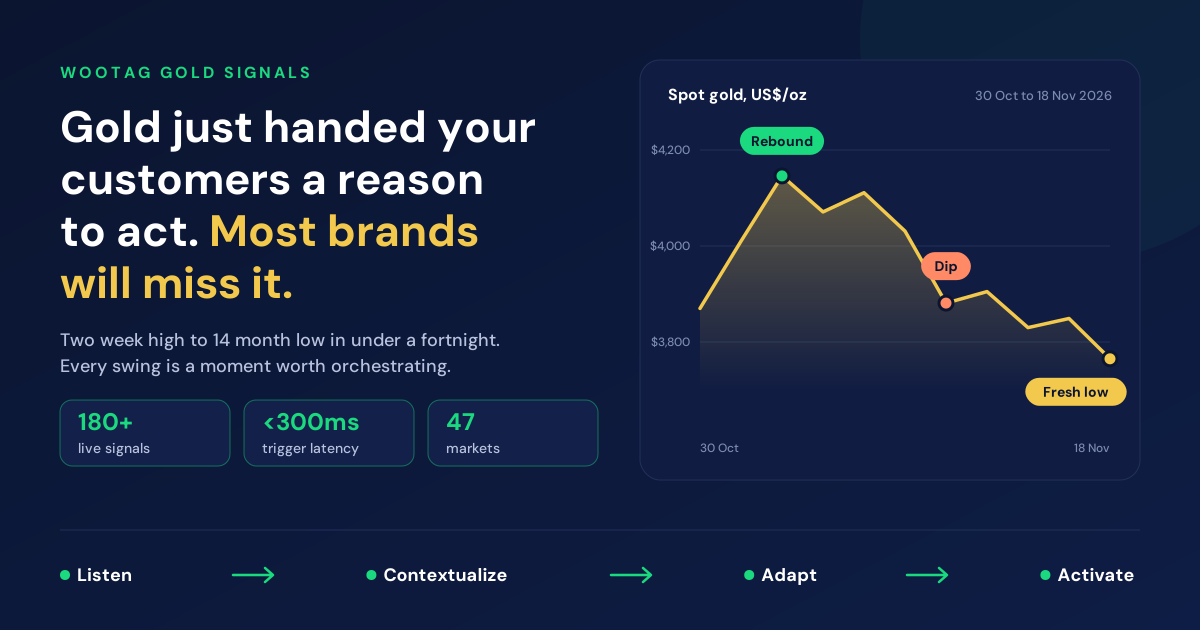

In under two weeks gold has gone from a two week high to a 14 month low. Here is how jewellers, wealth platforms, lenders and gifting brands can turn every swing into a moment with Wootag Gold Signals.
In short
- Gold touched $4,146 an ounce on 5 November and slid below $3,750 by 18 November, its lowest level since September 2025 and roughly a third below January’s record.
- Retail buyers spent Q3 on the sidelines waiting for a clearer price trend. The last fortnight is that trend showing up, and the brands that speak in step with it will pick up the demand that has been held back.
- Wootag Gold Signals turns live gold prices, computed across time windows and local currencies, into moments that change what a brand says, to whom and on which channel, with compliance guardrails built in.
Four gold stories in fourteen days
If you only checked the gold price once this month, you saw one number. Your customers saw four different stories.
On 4 November gold jumped close to 3.4%, its biggest single day gain since August, and the next day it reached $4,146, more than $250 above the one year low it had set only a week earlier. That was a rebound story.
By 12 November the mood had flipped. Rising oil revived inflation worries and gold dropped about 3% in a single session. The week to 13 November closed down 4.6%. That was a sell off story.
On 16 November gold hit $3,830 on a strong dollar and climbing bond yields. On 18 November it fell another 2% to around $3,765 after hawkish signals from the Federal Reserve, with markets now pricing a near certain December rate hike and US 10 year yields hovering around 5%. That is a fresh low story.
And sitting behind all of it is the January peak of roughly $5,600. Against that number, gold today is a discount story.
Rebound, sell off, fresh low, discount. Each of those stories puts a different thought in a different customer’s head. A first time buyer thinks “is this my chance?” An existing investor thinks “should I be worried?” A family planning a wedding thinks “do we buy the jewellery now or wait?” A gold loan borrower thinks “what does this mean for my loan?”
Now look at what most gold related brands are saying this week. In most cases it is the same message they were saying three weeks ago.
The demand is waiting, not gone
The World Gold Council’s Q3 2026 numbers explain why this matters so much right now.
Global bar and coin demand fell 19% year on year to 268 tonnes, a four year low, and the Council’s own read is that individual investors stayed on the sidelines because the price lacked a clear direction. Jewellery volumes fell 17% to 313 tonnes, the weakest third quarter on record, even as the value of jewellery bought rose 2% to $43 billion. India’s bar and coin demand dropped 40%. The US dropped 40%. China was the outlier, up 7%.
Read that carefully and it is not a story about people losing interest in gold. Year to date bar and coin investment is still the strongest first nine months since 2013. It is a story about people waiting for a signal.
The price is the signal. It arrives every second of every trading day. The gap is that very few brands have a way to hear it, make sense of it, and change what they say before the moment passes.
Why the gap keeps showing up
It would be easy to blame slow creative teams. The real reasons are structural.
The price lives in the wrong building. Gold prices sit with treasury, trading desks and finance apps. Marketing calendars sit somewhere else entirely. The two rarely talk in real time, so communication gets planned around Dhanteras, Akshaya Tritiya, Chinese New Year, wedding season and Christmas gifting rather than around what the metal is actually doing.
Gold is not one number. The headline price is in US dollars per ounce. Your customer in Mumbai, Dubai, Singapore, Jakarta or Shanghai sees a local rate per gram, by karat, with making charges on top. When the dollar sits near a 19 month high, a sharp fall in dollar gold can look much milder in rupees or rupiah. A brand reacting to the global headline can end up telling a local customer something that is not true for them.
A single reading is not a moment. Gold down 0.4% today means very little on its own. Gold down for five straight sessions and now at a one year low means something quite different. So does a 3% jump the morning after a fresh low. Moments come from computing the signal over different time windows, not from reading a ticker once.
Compliance makes teams freeze. Anything that touches investment invites legal review. Faced with a fast moving price and slow approvals, most teams pick the safest option, which is to keep running the same evergreen line and say nothing about the market at all.
Manual reaction is always late. By the time someone spots the dip, briefs a creative, gets it approved and pushes it live, gold has often bounced. The window closes before the communication opens.
How Wootag Gold Signals turns price into moments
Wootag Moments runs on the same four steps across every signal it handles: Listen, Contextualize, Adapt, Activate. Gold is a natural fit for all four.
Listen. Wootag ingests live gold prices from verified sources, alongside silver and other metals, and can track them in the local currency and unit each market actually buys in. Gold sits inside the commodities layer of the Moments Marketplace next to 180+ other live signal feeds, so a brand does not have to stitch providers together.
Contextualize. This is where the compute framework earns its place. Instead of asking “what is the price?”, it asks better questions. How has gold moved over the last hour, the last day, the last week? Is the move positive or negative across each window? How far is it from its 52 week high and low? Is the market calm or choppy right now? Each answer can create a moment a single reading would never reveal.
A typical gold moments setup might look like this:
| Moment | What triggers it | What it tells the brand |
|---|---|---|
| Dip | Local gold price down beyond a set threshold on the day | Value window is open; lead with access and affordability |
| Fresh low | Price at a new 52 week or multi month low | Strongest “considered buy” context; speak to people who have been waiting |
| Rebound | Sharp rise after a recent low | Momentum is back; urgency without hype |
| Rally | Sustained gains across day and week | Speak to existing holders and to the value of what they already own |
| Choppy | High volatility with no clear direction | Pause or switch to steady, education led communication |
| Stable | Small moves inside a narrow band | Run the evergreen message; no market framing needed |
Adapt. Each moment maps to its own approved message, offer and creative. A jeweller might show “today’s 22K rate” with a making charge waiver on a dip day and a rate lock offer on a rebound day. A digital gold app might lead with “start with as little as one gram” on a fresh low and with a portfolio check in on a rally. Gold moments can also be layered with other signals: an occasion like the wedding season, Christmas gifting or Lunar New Year, and Retail Signals such as store level stock of coins or a particular collection, so the communication never pushes something a nearby store cannot deliver.
Activate. The moment goes live across the channels the brand already uses, in under 300 milliseconds from the trigger, without anyone having to wake up and rewrite a brief.
Compliance built into the moment, not bolted on later
For financial brands, the honest question is not “can we react to gold?” but “can we react to gold without creating a compliance problem?” That is exactly where moments based communication is stronger than improvised reaction.
On Wootag Moments, the brand stays in control of every layer. Signals come from verified sources. Brands decide which moments they want to speak to and which ones they want to avoid. Messages and creatives are written and approved by the brand in advance, then paired automatically with the moment they belong to, so nothing is generated on the fly. Guardrails can restrict activation to exchange hours, to end of day prices, or to specific value ranges. And outcomes are measured by signal, by moment, by creative and by channel, so the team can see exactly what worked.
Franklin Templeton’s mutual fund activation on Wootag shows how this plays out in practice. The rules were simple: if the Sensex closed up 0.3% or more, a growth led film ran. If it closed down 0.3% or more, a stability led film ran. Anything in between, the activation paused. The result, as reported in the case study, was an 8.3x CTR uplift, 24% of budget saved and zero wasted impressions.
That pause matters as much as the messages. Swap the Sensex for gold and the same logic holds. On a choppy day with no clear direction, the right move for an investment brand is often to say nothing market related at all. Silence becomes a designed outcome rather than an accident.
One more point on tone. Gold moments should give context, not calls. “Gold is at its lowest in over a year” is a fact the customer can act on. “Gold will go up from here” is a prediction no brand should be making. Building the rules this way keeps the communication useful and keeps it defensible.
Your channels, every channel
The moment is the decision. The channel is just where it shows up.
A gold moment that fires at 10am should be able to change what a customer sees in a social feed, in a push notification from an app they already use, on a CTV screen in the evening, in a programmatic placement on a finance news site, on a digital screen inside a store, and in a WhatsApp or messaging update to an existing customer. If each of those channels needs its own manual workflow, the brand will only ever react on one or two of them, and usually too late.
Signal orchestration flips that. The signal is heard once, contextualized once, and the right version of the message is activated everywhere the brand has a presence. Teams stop asking “which channel should we react on?” and start asking “what should we say in this moment?”, which was the right question all along.
Who should be listening to gold right now
| Vertical | Gold moments that matter | How the communication changes | Outcome to measure |
|---|---|---|---|
| Jewellery retailers | Dip, Fresh low, Rebound, plus wedding season and gifting occasions | Show today’s local rate per gram, making charge offers on dip days, rate lock or advance booking on rebound days, routed to stores with stock | Store visits, bookings, online orders |
| Digital gold and savings apps | Dip, Fresh low, Choppy | Small ticket entry (“start with one gram”), recurring savings plans on low days, calm education on choppy days | New sign ups, first purchases, plan starts |
| Gold ETF and fund houses | Fresh low, Rally, Choppy (pause) | Long term allocation messaging on lows, portfolio context on rallies, pause market framing in volatile bands | Account opens, SIP or plan starts, cost per qualified lead |
| Banks and gold loan lenders | Rally, Fresh low | On rallies, “your gold is worth more today” eligibility messaging; on sharp falls, pause acquisition and send reassurance and top up guidance to existing borrowers | Loan applications, retention, service queries resolved |
| Bullion dealers and mints | Dip, Fresh low, plus Retail Signals stock levels | Coins and bars in stock near the customer, delivery promises, availability led messaging | Orders, average order value |
| Brokerages and trading apps | Dip, Rebound, Rally | Gold and silver market context, product discovery for commodities and metals funds, within exchange hour guardrails | Trades, new commodity accounts |
| Gifting, festive and luxury retail | Dip, Fresh low, plus occasions like Christmas and Lunar New Year | “Better value this season” for gold gifts, pairing price context with the occasion | Gift orders, basket size |
Notice that none of these require the brand to have a trading desk, and only some require physical stores. Public signals like gold work on their own. Retail Signals are an optional layer for brands that want each moment to reflect local stock and pricing.
The real opportunity in a falling market
It is tempting to treat a falling gold price as bad news for anyone selling gold. The Q3 data says the opposite. Millions of buyers have been waiting for a clearer trend, and the market is now giving them one, day by day, in their own currency.
The brands that win the next few months will not be the ones with the biggest budgets. They will be the ones whose communication moves when gold moves: a better offer on the dip, a confident message on the rebound, a reassuring note when it gets choppy, and silence when silence is the smarter move.
That is what Wootag Gold Signals is built to do.
Sourcing and transparency
Wootag platform : 180+ live signal feeds, sub 300ms trigger latency and live in 47 markets are taken from wootag.com/moments. The Franklin Templeton rules and results (8.3x CTR uplift, 24% budget saved, zero wasted impressions) are as reported on wootag.com/moments/case-studies. The gold moments table and vertical mapping are illustrative setups, not results from a specific client deployment.
Third party data: Gold price movements through 13 November are drawn from Reuters and Trading Economics reporting via The Nation Thailand and Admiral Markets. The 16 November low of $3,830 is from The Nation Thailand. The 18 November move to around $3,765 and the lowest level since September 2025 are from Reuters via Business Recorder. Fed hike pricing and US 10 year yields are from Shanghai Metals Market. Q3 2026 demand figures (bar and coin, jewellery, India, US and China) are from the World Gold Council’s Gold Demand Trends Q3 2026 report and its 3 November press release.
Gold prices move every second. Figures above reflect reporting up to 18 November 2026. Nothing in this post is investment advice.
Want to hear what gold is telling your customers?
Wootag can map gold, silver and other commodity signals to the markets, currencies and channels you already run, and show you which moments your brand has been missing.
Gold Just Handed Your Customers a Reason to Act. Most Brands Will Miss It.
