

How brands can use real-world Moments to turn festive and big shopping days into sales across social, push and beyond.
It is 8:47pm on a Thursday in late November. Someone is on the couch with a match on, scrolling with one thumb. Her feed shows a winter coat ad, the same creative she saw yesterday, the same 20% off, from a brand that has no idea the temperature just dropped to 4 degrees outside or that her team scored two minutes ago.
She keeps scrolling.
Now multiply that scene by every brand, every platform and every festive weekend. That is the quiet leak in festive marketing, and it is bigger than most teams realise.
The gap: festive plans follow dates, festive demand follows moments
Festive and big shopping days are the most carefully planned weeks of the year. Calendars are locked by September, hero films are approved, discounts are set. The effort makes sense. Adobe expects US online holiday spend to reach a record $275.1 billion in 2026, with Cyber Week alone at $47.5 billion. October is already carrying $95.8 billion as the season starts earlier every year, and a record 63% of Cyber Week spend is expected to come through mobile.
But a date only tells you when people shop. It does not tell you why this hour, why this city, why this product. That comes from what is happening around the shopper right now: the temperature, the match on screen, the air quality reading, the stock sitting in the nearest store.
Most festive plans listen to none of it. One creative runs across five days, with one offer, to everyone.
There is a second problem. Everyone is discounting. Adobe expects offers of up to 30% off during Cyber Week. When the whole shelf is on sale, the discount stops being a reason to pick you. Relevance is what separates the brand that gets the tap from the brand that gets the scroll.
Why the gap persists
It is not for lack of intent. It persists for practical reasons.
The plan is built around the calendar. Dates are certain, so planning anchors to them. Live conditions are uncertain, so they get left out.
Creative is the bottleneck. A hero film and a handful of cutdowns cannot cover every city, weather pattern and match result across a festive fortnight.
Manual triggers arrive late. By the time someone spots the cold snap, briefs the team and gets approvals, the moment has passed. The shopper has already bought from someone else.
Channels run in silos. The social team, the CRM team and the programmatic team each see a slice. None of them sees the moment as a whole.
Offers and stock live somewhere else. So ads promote products a nearby store has run out of, while the item that is in stock goes unmentioned.
A moment is a decision, not a channel
This is the idea that changes how festive activations get built.
A real-world signal, such as a temperature drop, a goal, a pollution spike or a gold rally, is not tied to any one platform. It happens once. What matters is the decision that follows: what should the brand say, to whom, in what tone, at what moment.
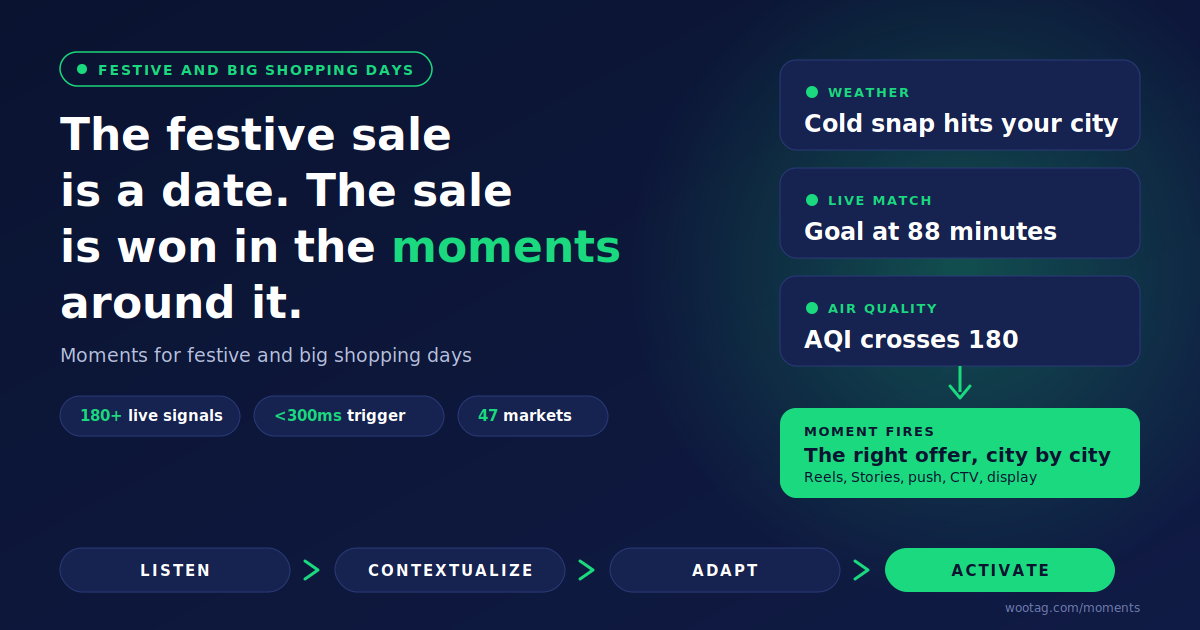
Wootag Moments works as the layer that makes that decision. It listens to live signals (180+ feeds today, with sub-300ms trigger latency, live in 47 markets), contextualizes each one against your brand, products and offers, adapts the creative to the format it will land in, and activates it across the channels where your audience already is. Listen, Contextualize, Adapt, Activate.
Because the decision sits beneath the channels, the same moment can show up as an Instagram Story, a Facebook video ad, a push notification with a curated product list, a Connected TV spot and a programmatic banner, all in step with each other. It does not replace your CDP, CRM or customer engagement platform. It gives them something they usually lack: a live reason to speak.
How a festive Moments plan gets built
Think of it in four layers.
1. A default for every impression. Every rule set starts with a default or fallback creative, so no impression ever goes out unplanned. Your core festive message and offer live here.
2. Calendar moments. The festival, the sale day, the gifting weekend. These are the moments you already know about. Treat them as the frame, not the whole picture.
3. Live signal moments. The signals that fire inside the calendar: weather by city, live match events, air quality, commodity moves. This is where relevance is won.
4. Store and stock moments. Where retail signals such as inventory and deals are connected by API, the activation can reflect what is actually available nearby, and route demand to a marketplace or quick-commerce partner when local stock runs low. These integrations are set up per enterprise customer and are optional. You can start with public signals alone and add retail signals later.
One more principle matters during festive peaks: silence can be a designed outcome. If a moment does not fit your brand or your stock, the right rule is to hold back rather than push a generic message into a crowded feed.
Vertical approaches
The scenarios below are illustrative examples of how Moments can be configured for each vertical. They are not confirmed client work, except where a named Wootag case study is cited.
Personal Care
Personal care is a festive gifting and grooming category, and it is also one of the most weather and environment sensitive categories there is. Skin reacts to temperature, humidity and air quality, and shoppers know it.
Everyuth, a personal care brand from Zydus, ran an activation where Wootag Moments identified each viewer’s city, fetched the live temperature and assembled matching image and video creatives across Facebook and Instagram. Per the case study, it delivered 2.3x engagement uplift, 2.7x on video moments and 41% cost efficiency.
Festive version (illustrative):
- A cold front hits a city the week before a gifting weekend. Lip care, body butters and winter gift sets lead the creative for that city only.
- Air quality crosses a threshold in a metro. Cleansing and skin recovery routines move up the feed, with a push notification pointing to same-day delivery.
- The evening before a major festival, a “glow kit, ready in time” message fires, and routes to quick-commerce where your own stock is thin.
Adobe also expects Cyber Week online sales of personal hygiene products to run 150% above average September levels, so the demand is there for brands ready to meet it.
Fashion and Apparel
For fashion, the weather is the merchandising team. The same festive weekend can be a coat day in one city and a linen day in another.
Festive version (illustrative):
- First cold snap in a city triggers outerwear and layering creative. First rain triggers water-resistant jackets and footwear.
- Festival calendar moments drive occasion wear and gifting edits, while live weather decides which pieces in the edit lead for each city.
- Reels and Stories carry the lookbook feel, and a push notification opens a product list already filtered for the weather outside.
- With store stock connected, an ad can promote what a nearby store has in your size, or send the shopper to a marketplace listing when it does not.
Apparel is a tentpole category in the season. Adobe projects $51.3 billion in apparel spend, and Cyber Week sales of clothing basics at 210% above average September levels. Basics are exactly where timely, relevant nudges beat a generic discount.
Sports Goods
Sports goods have a built-in advantage: the signal and the product are the same thing. A goal, a final whistle or a title decider is the moment a fan feels most connected to the game, and most open to gear that says so.
Wootag has proof for this mechanic in sport. For Valvoline, every live FIFA match event (goal, halftime, penalty, team win) triggered its own matching creative on Connected TV, delivering a 99.03% average VCR and 37% cost efficiency, with Penalty the top moment. For Budweiser 0.0, FIFA events fired matching display creatives, delivering 3.2x engagement uplift and 39% cost efficiency, with Pre-Match as the top moment.
Festive version (illustrative):
- A big derby ends. Within seconds, winning-side fans see jerseys and match balls, while the other side sees a tone-adjusted “back next week” kit message.
- Pre-match is a strong window, as the Budweiser result suggests. Boots, kits and fan gear fire in the hour before kick-off.
- Weather moments support running, cycling and winter training gear, with shoppable overlays so the path from moment to basket stays short.
Adobe’s 2025 forecast pointed to premium units rising sharply in sporting goods (up 56% in share of units sold), so festive sports moments are also a chance to lead with the trade-up product, not only the entry level.
Electronics
Electronics is the largest category in the season. Adobe projects $63.3 billion in online holiday electronics spend. It is also the category where shoppers compare the most and where price transparency is the highest, which makes relevance and timing even more valuable.
Festive version (illustrative):
- Big match night approaches. TVs, soundbars and streaming devices lead the creative in the hours before kick-off, with a financing or exchange offer attached.
- Air quality spikes, and purifiers move to the top of the app feed. Wootag’s own push notification examples show this pattern, with an air care category pinned to the top of the feed after an AQI alert.
- Heatwave or cold front in a city triggers the matching appliance, whether cooling or heating, with local delivery windows.
- Gifting moments around the festive calendar lead with accessories and bundles, which carry higher basket value.
Adobe’s 2025 forecast also pointed to premium electronics gaining share of units sold (up 52%), another reason to let the moment decide which tier of product leads.
Other verticals worth planning for
Home appliances and home care. Weather and air quality decide the buying reason: cooling, heating, purifying, drying. The signal is the brief.
Food, grocery and QSR. Rain, match nights and festive hosting all drive orders. A match-night snack bundle that fires at halftime, or a comfort food push when it starts pouring, turns a quiet evening into an order.
Jewellery and gold-linked retail. Commodities are a Wootag signal category. A gold rally, a festival buying day or a wedding season weekend can each carry its own message and tone.
Travel. Long weekends, year-end breaks and shifts in weather at home or at the destination create natural moments for offers.
Where it lands: social first, everywhere else too
Social is where festive discovery now happens, and it is where moments are easiest to switch on. Adobe’s data shows social’s share of Cyber Monday revenue rose 56.5% year on year in 2025, and its 2026 data shows social networks and affiliates driving the strongest revenue share growth.
On Meta, a single trigger can update Facebook posts and display ads, Facebook video ads, Instagram Stories and Reels. Setup means connecting Business Manager, Page and Ad Account, which takes under five minutes with no code. TikTok and LinkedIn integrations are also available. For retention and growth teams, push notifications can fire through MoEngage and Braze inside the activations you already run, with creative and product listings attached to the moment. And for reach beyond social, the same moments extend to Connected TV, programmatic display and shoppable surfaces.
Vertical mapping at a glance
| Vertical | Signals that matter in the festive window | Illustrative moment | Where it lands |
|---|---|---|---|
| Personal Care | City temperature, air quality, festival calendar | Cold front in a city leads with winter care gift sets | Instagram, Facebook, push |
| Fashion and Apparel | Weather by city, festival calendar, live sports | First cold snap leads with outerwear for that city only | Reels, Stories, push, display |
| Sports Goods | Live match events, pre-match windows, weather | Final whistle triggers fan gear for each side | Meta, CTV, display, push |
| Electronics | Big match nights, air quality, weather | Pre-match hour leads with TVs and soundbars | Meta, push, programmatic |
| Home Appliances | Weather, air quality | AQI alert pins air care to the top of the feed | Push, Meta, display |
| Food and Grocery | Rain, match nights, festive hosting | Halftime snack bundle with delivery window | Push, Meta |
| Jewellery | Commodities, festival and wedding calendar | Gold rally message on a buying day | Meta, display |
| Travel | Long weekends, weather, forex | Long weekend forecast triggers a getaway offer | Meta, push, display |
A rhythm for the season
Now to early November: warm up. Pre-season spend is rising earlier every year. Switch on your default creative and your first weather and calendar rules while competitors are still waiting for the main event.
Festival and singles-style sale days: lead with the calendar, personalise with the signal. Keep the festive frame, and let city weather, match events and stock decide which product leads.
Cyber Week: widen the rules. Add match-day triggers, store stock and marketplace routing, and watch which moments move the numbers.
Year end: shift to gifting and returns. Gift sets, gift cards, travel and the post-festive reset all have their own signals.
What is Wootag’s data and what is third party
This post draws on two kinds of sources, and we want to be clear about which is which.
Wootag platform information and self-reported case study results (from wootag.com/moments, wootag.com/moments/case-studies, wootag.com/moments/meta and wootag.com/moments/push-notifications):
- 180+ live signals, sub-300ms trigger latency, 47 markets live
- Everyuth (Zydus): 2.3x engagement uplift, 2.7x video moments, 41% cost efficiency
- Valvoline: 99.03% average VCR, 37% cost efficiency, Penalty as top moment
- Budweiser 0.0: 3.2x engagement uplift, 39% cost efficiency, Pre-Match as top moment
- Meta activation: setup in under five minutes with no code, formats and integrations as described on the Meta page
- Push notification integrations with MoEngage and Braze, including the AQI example
Third-party research (US online data, used as a directional indicator of festive intensity rather than a market-specific benchmark):
- Adobe, 2026 holiday forecast (September 2026): $275.1 billion online season, Cyber Week at $47.5 billion, October at $95.8 billion, 63% mobile share of Cyber Week spend, up to 30% off during Cyber Week, electronics at $63.3 billion and apparel at $51.3 billion. Source: news.adobe.com/news/2026/09/adobe-us-holiday-shopping-season-to-hit-record
- Adobe via Retail TouchPoints: Cyber Week clothing basics at 210% and personal hygiene at 150% above average September levels. Source: retailtouchpoints.com
- Adobe, 2025 Cyber Monday results: social’s share of revenue up 56.5% year on year. Source: news.adobe.com/news/2025/12/adobe-cyber-monday-hits-record
- Adobe, 2025 holiday forecast (as reported by CFOtech): premium share of units sold up 56% in sporting goods and 52% in electronics. Source: cfotech.news
The vertical scenarios in this post are illustrative and not confirmed client work.
Your next festive moment is already on the calendar
The shopping days are fixed. The moments inside them are not, and that is where the sale is won or lost. Tell us the signal that matters to your category, and we will show you a live moment built on your brand in 20 minutes.
