

An index moves 1.2 percent in the first ten minutes of trading. A penalty is missed in stoppage time. A heatwave alert fires across three cities at once. Somewhere, right now, a brand’s marketing team is watching all three happen and doing nothing about any of them, because nobody built the plumbing to turn a live signal into a live decision.
That plumbing problem is not new. What is new is who is expected to solve it. For the last two years, marketing has been trying to bolt real time context onto human workflows: a strategist sees the signal, briefs the creative team, someone approves the copy, media buying pushes it live. By the time the moment reaches a customer, the moment has usually passed.
Now the workflow itself is changing hands. Agentic AI is moving from pilot to production across the martech stack, and the industry’s own research shows it. Scott Brinker and Frans Riemersma’s Martech for 2026 research found that 90.3 percent of marketing organizations already use AI agents in some capacity, though only 23.3 percent have put them into full production. The gap between those two numbers is not a talent gap or a tooling gap. It is a context gap, and it is the same gap Google Cloud’s engineering community recently gave a name to: Context as a Service.
What Context as a Service is actually proposing
Context as a Service, or CaaS, is an architecture pattern for building and maintaining large numbers of AI agents without every agent reinventing its own model choice, tool access, memory and instructions from scratch. The core idea, laid out in a widely read Google Cloud community piece by Ezekias Bokove, is to treat each reusable unit of agent capability, a “Block,” as a declarative, versioned component built from five parts: a model reference, a set of tools, a memory scope, a logic or prompt layer, and an evaluation suite that defines what good behavior looks like. Build the block once, version it, and any agent in the organization can assemble it into a working system without touching code.
The reason this framing matters for marketing has nothing to do with agent orchestration syntax. It matters because CaaS assumes something martech has never actually had at scale: a context layer that is trustworthy enough, live enough and structured enough to hand to a machine that will act on it without a human checking every output first. Most martech stacks were built to help humans decide faster. Agentic systems need infrastructure built to let machines decide correctly, and those are not the same requirement.
Why the martech stack is not agent ready yet
Ask most CMOs what “context” means in their stack today and they will point to a customer data platform. That is fair. It is also incomplete. A CDP tells an agent who the customer is: purchase history, browsing behavior, lifecycle stage. It rarely tells the agent what is happening in the world around that customer right now, and it is that second layer, live, external, world state, that determines whether a message lands as relevant or as noise.
Industry researchers are converging on this exact point. Data architecture readiness for AI agents depends on what one recent analysis called context engineering, where the data foundation provides the real time signals necessary for agentic action. Boston Consulting Group’s work on agentic marketing transformation reaches a similar conclusion from a different angle, describing a brand intelligence layer that encodes rules and operating context so that probabilistic agents can interpret data effectively, sitting alongside data governance as one of the load bearing layers of an agent ready stack.
This is the gap that persists even in organizations that have invested heavily in AI tooling. They have agents. They have models. What most of them do not have is a governed, reusable, always on feed of the real world signals those agents need to act on, packaged in a form an agent can actually consume without a human translating it first.
The Moments OS was already built for this job
This is where the repositioning Wootag has been making across its own content, from creative refresh tool to Moments OS, stops being a branding exercise and starts looking like an architectural head start.
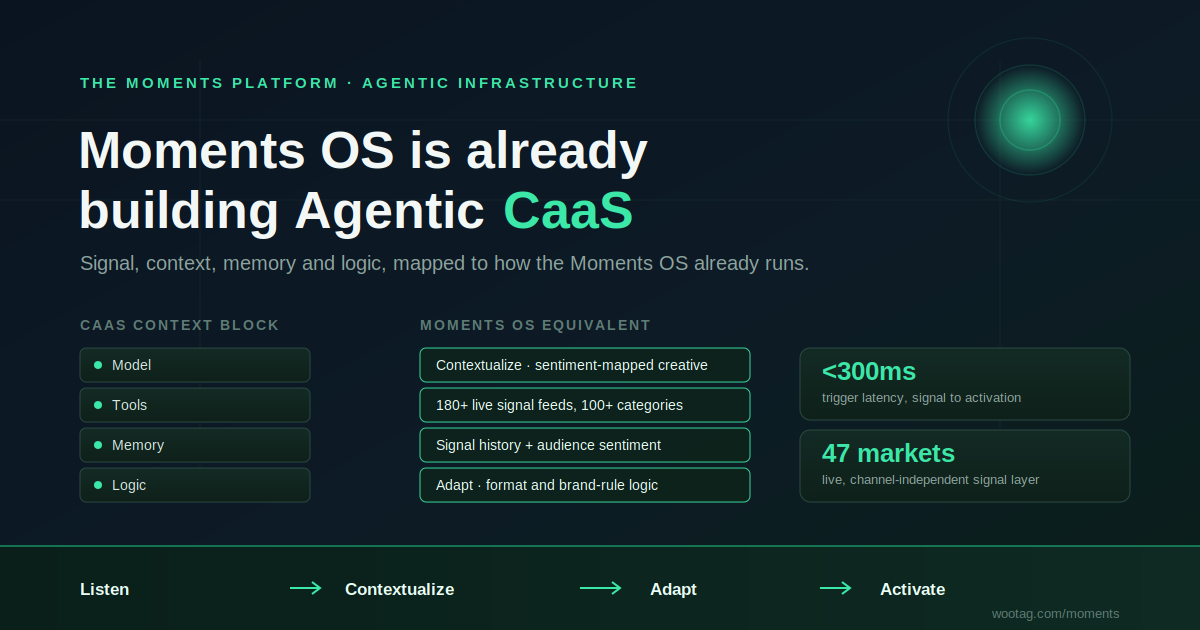
Look at what the Moments OS already does, structurally, before a single agent framework enters the picture. It listens to over 180 live signal feeds across more than 100 categories, sports, weather, stocks, commodities, and turns each one into a structured, brand-ready object in under 300 milliseconds. It contextualizes that signal against brand safe rules and audience sentiment. It adapts the resulting message into the right format for the channel it will land on. And it activates that message across the surfaces where the audience already is.
Strip the marketing language away and that four step Listen, Contextualize, Adapt, Activate framework maps almost one to one onto the anatomy of a CaaS Block.
| CaaS Block element | What it requires | Wootag Moments OS equivalent |
|---|---|---|
| Model | A defined reasoning layer with clear parameters | The Contextualize stage, where signals are mapped to brand safe creative and dynamic offers using AI tuned to sentiment |
| Tools | Defined access to external systems and data | 180+ live signal feeds across sports, weather, stocks, commodities and 100+ categories, functioning as the platform’s tool layer |
| Memory | A scoped record of state and prior context | Signal history and audience sentiment data that inform how a moment is contextualized, not just whether it fires |
| Logic | The instructions that define objective and constraints | The Adapt stage, where format, tone and message are reshaped to brand rules for each destination |
| Evaluation suite | A way to test and govern behavior before it ships | Trigger latency, market coverage and outcome tracking built into the platform’s own reporting, at under 300ms and across 47 markets |
Read that table the way an agent architect would read it, not the way a media planner would. What you are looking at is not a campaign tool with a context feature bolted on. It is a context supply layer with a marketing use case sitting on top of it. The signal ingestion, the sentiment mapping, the brand safe adaptation logic, all of it already exists as governed, reusable infrastructure, independent of any single campaign or channel. That is precisely the property CaaS architecture is trying to formalize for agentic systems generally: build the context once, let any downstream agent assemble it.
Why this only works if the signal layer stays channel independent
There is a trap every martech vendor eventually walks into, and it is worth naming directly. It is tempting to build the signal layer and the activation channel as one tightly coupled system, because it ships faster and demos better. It is also the fastest way to make that signal layer worthless to an agentic future.
An agent ecosystem does not have one consumer. A brand’s media buying agent, its customer support agent, its lifecycle marketing agent and its retail media agent will all eventually want to know that a heatwave just hit a specific city or that a match just went to penalties. If the context that answers that question only exists wired into one ad format on one channel, every other agent has to go build its own version of the same signal detection from scratch, which is the exact fragmentation CaaS architecture was designed to eliminate in the first place.
This is why a signal and context layer has to be channel agnostic by design, structured so that the same moment can be assembled into a CTV spot, a shoppable social overlay, a programmatic bid adjustment, or a support agent’s response tone, without the underlying context needing to be rebuilt for each one. The value is not in any single activation. The value is in the fact that one governed context object can be reused everywhere an agent needs it, which is the entire economic argument behind treating context as a service rather than a feature of any one tool.
What a reusable moments context block looks like by vertical
The clearest way to see this is to look at what a single, reusable Moments context block could serve, if handed to different agents across different industries, without anyone rebuilding the signal detection underneath it.
| Vertical | Live signal the block ingests | Agent that consumes it | What the agent does with it |
|---|---|---|---|
| FMCG and CPG | Heatwave or festival calendar signal | Retail media bidding agent | Shifts spend and creative toward high-velocity SKUs before demand peaks |
| F&B and QSR | Live match or weather signal | Local offer and delivery agent | Triggers hyperlocal promotions timed to spikes in foot traffic or delivery demand |
| Fintech and banking | Market index movement | Advisory or lead-gen agent | Surfaces relevant product messaging and demo bookings at moments of financial attention |
| Mobility and auto | Fuel price or weather signal | Dealer and lead qualification agent | Adjusts messaging tone and offer urgency based on real-world driving conditions |
| Travel and hospitality | Flight delay or destination weather signal | Booking assistance agent | Reprices or reframes offers in the moment a traveler’s plans are disrupted |
| Retail and e-commerce | Stock rally or commodity shift | Merchandising agent | Reprioritizes category pages and shoppable placements tied to spending sentiment |
| Telecom | Sports or event signal | Customer engagement agent | Times upsell and retention messaging to peak network usage moments |
| Consumer electronics | Product launch or market signal | Consideration and comparison agent | Surfaces relevant specs and offers when a competitor moment shifts attention |
None of these agents need to know how the signal was detected. They just need to be able to call it, the same way the CaaS model describes an application invoking a versioned block without touching the logic underneath. That separation, definition on the platform, invocation in the agent’s workflow, is the same separation of concerns CaaS proposes for AI agents generally, applied here to the specific problem of real world marketing context.
Where this is not yet finished, and why that matters
It would be inaccurate to claim the Moments OS is a complete CaaS implementation today. It is not versioned in the strict semantic sense CaaS architecture describes, and it does not yet expose the kind of formal evaluation suite or promotion workflow, dev to staging to production, that CaaS treats as a governance requirement. Those are genuine gaps, not marketing gaps to smooth over.
What does exist, and what most martech vendors chasing the agentic narrative do not have, is the harder half of the problem already solved: a live, governed, channel independent signal layer running across 47 markets with sub 300ms latency, feeding structured context rather than raw data. Building the versioning and orchestration layer on top of a working signal supply is a materially smaller engineering problem than building the signal supply itself from a standing start, which is what most agentic marketing platforms are currently attempting.
Where this leaves brand and growth teams
The organizations that win the next phase of agentic marketing will not be the ones with the most agents. They will be the ones whose agents are working off context that is live, governed and reusable rather than stale, siloed or rebuilt from scratch for every new use case. That is the infrastructure question underneath the agent question, and it is the one most vendors are still avoiding because it is harder to demo than a chatbot.
Wootag’s Moments OS was not built to answer the CaaS question. It was built to answer a simpler one: how do you connect a real world signal to a brand experience fast enough for it to still matter. It turns out those are closer to the same question than they first appear.
If you are mapping what an agent-ready context layer needs to look like for your stack, book time with the Wootag team to see how the Moments OS signal layer plugs into your existing martech and AI investments.
