
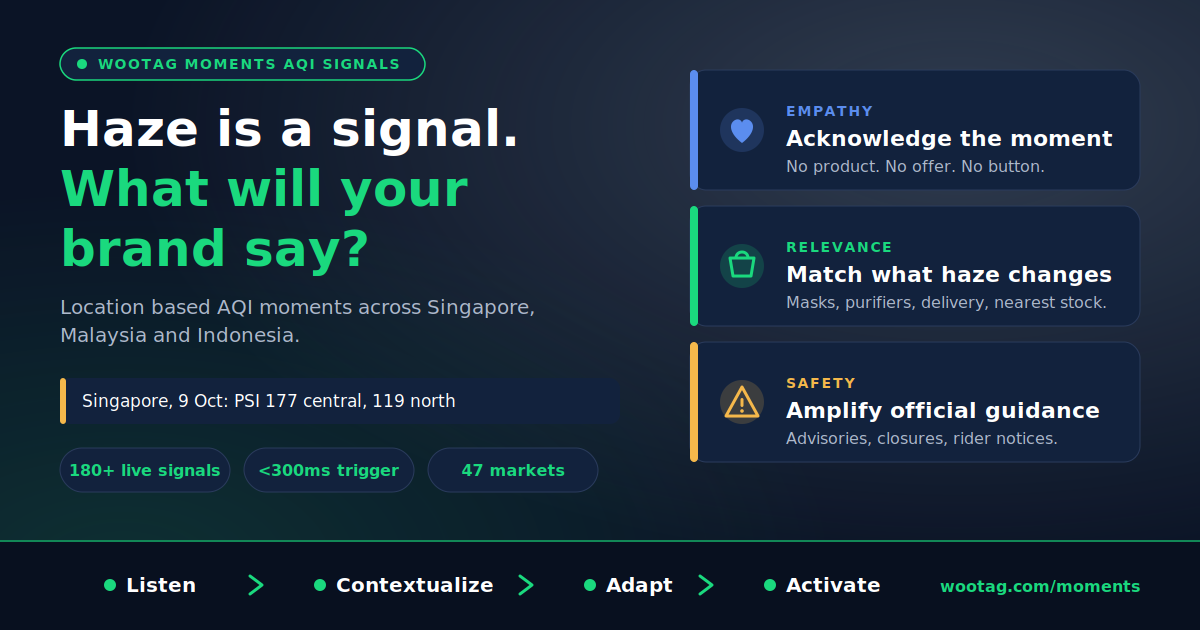

Haze is not a weather story. It is a communication story, and most brands in Southeast Asia are still telling the wrong one.
It is 6:40 on a school morning in Kuala Lumpur. A parent checks their phone. The first notification is a school closure. The second is the air quality reading. Then they open Instagram, and the first thing in the feed is a sponsored post for a weekend outdoor family run.
Nobody at that brand meant any harm. The activation was scheduled three weeks ago. It just had no idea what kind of morning it was landing on.
That is the gap this post is about.
What is happening across the region right now
Singapore’s air quality crossed into the unhealthy range on 4 September, the first time haze had done that since October 2023. The 2026 peak so far came on 9 October, when the central region reached a PSI of 192. The same day, Malaysia closed schools in Kuala Lumpur and other states, with the King saying schools should shut once the API reaches 150. Across the border, around 1.4 million students in six Indonesian provinces moved to remote learning in early September.
And it may not be over. Singapore’s weather service expects the dry season to retreat later than usual this year, with a transition only in late October or early November, and forecasters have linked the longer season to a strong El Nino.
For anyone running marketing in Singapore, Malaysia or Indonesia, that is millions of people changing how they live, move, shop and feel, hour by hour.
The gap: brands treat haze as one event. It is thousands of small ones.
Look at a single morning. On 9 October, Singapore’s 24-hour PSI read 177 in the central region and 168 in the west. In the north it read 119. Same island, same day, a gap of nearly 60 points. In one neighbourhood people are cancelling outdoor plans. In another, they are still deciding.
Most brands respond to haze in one of three ways:
- They keep the planned calendar running and hope nobody notices the mismatch.
- They go quiet everywhere, which protects the brand but abandons customers at a moment they need help.
- They rush out a one-off mask or purifier post that is already stale by the time it is approved.
All three treat haze as a single, regional headline. It is not. It is a hyperlocal, hourly signal, and it can be listened to.
Why the gap persists
It is not because marketers do not care. It is structural.
The signal lives in the wrong place. Air quality data sits in weather apps and government dashboards. Your marketing stack was never wired to hear it.
There is no single scale. Singapore reports PSI. Malaysia reports API. Indonesia has its own index. The bands look similar on paper, with unhealthy starting at 101 and hazardous above 300, but each market reads its numbers differently, and a brand running across all three needs one logic that respects each.
Approval cycles move in days. Air moves in hours. By the time a thoughtful message clears review, the reading has changed.
The fear of looking opportunistic. This is the honest one. Selling during a health event feels risky, so teams default to silence. But the answer to a tone risk is better tone logic, not no communication at all.
Three kinds of moments, one signal
A haze reading should not trigger one message. It should trigger the right kind of message for the person and the place. We think about it as three families of moments.
1. Empathy moments
No product. No offer. No button.
These acknowledge what people are going through. A short, warm line on a story or a short video that says the air is rough this week and the brand is thinking of its customers. They fire when a location crosses into the unhealthy band, or when schools close in a city.
Empathy moments do quiet work. They earn the right to be present for the next two types.
2. Relevance moments
This is where product enters, and where precision matters most. Haze changes what people need within a single day: masks, air purifiers, air conditioner servicing, eye drops and throat remedies, indoor entertainment, groceries and meals delivered rather than collected, a ride instead of a walk.
Wootag’s weather moments already list AQI and pollen spikes as a trigger, built to reach health-conscious audiences with masks, purifiers and remedies the moment air quality dips. The signal decides who sees what, where, and when.
For brands with their own stores, this can go one step further. Connect local stock and deals through an API integration, and the moment can point to the nearest store that has the product. If it is out of stock, route the demand to a marketplace or quick-commerce partner instead of losing it. Retail integrations are modular and built per enterprise customer, so brands without physical retail can run relevance moments on the public signal alone.
3. Safety moments
For some brands, the most valuable thing to say during haze has nothing to sell. Delivery platforms and ride services can brief riders and customers. Event organisers can announce changes early. Employers, schools, clinics and insurers can pass along practical guidance.
The rule here is simple: the brand amplifies official guidance, it does not replace it. Point people to the national agency advisories. Be useful, be short, be accurate.
The escalation ladder: when to speak, and when to stop
The three families are not equal at every reading. As air quality worsens, the mix should shift.
| Air quality band | What people feel | What leads | What recedes |
|---|---|---|---|
| Moderate (51 to 100) | Mild concern, checking the app | Light relevance | Nothing yet |
| Unhealthy (101 to 200) | Plans change, families stay in | Empathy plus relevance, safety where the brand has a role | Outdoor and energetic product messaging |
| Very unhealthy (201 to 300) | Real disruption, school and work impact | Safety leads, empathy supports | Promotional offers, outdoor use cases |
| Hazardous (above 300) | A health event | Safety only | Everything else is suppressed |
Each brand should set its own thresholds against its own category. A gym chain and a pharmacy should not share a ladder.
The bottom rows matter most. The strongest haze activation a brand can run may be the one that quietly switches off the outdoor promotion it had planned. Wootag’s own Franklin Templeton activation shows the mechanism: when the Sensex stayed inside a defined band, the activation paused on its own, so no impression was served and no budget wasted. Flip that logic for haze and you get a brand that knows when to stay out of the feed.
The signal does not care which channel you use
This part is the same for every brand and every signal. A reading is a reading. What changes is how the decision shows up on each surface.
The same air quality change can become a Stories frame on Instagram, a 9:16 video on TikTok, a feed unit on Facebook, a push notification on a customer’s phone, a programmatic banner, or a CTV spot. Different formats, one decision about what to say, to whom, in what tone, and at what moment.
That is the whole logic of Wootag Moments: Listen to the signal, Contextualize it, Adapt the creative to the channel, and Activate. The creative is one output of the decision, not the decision itself.
A real example of the mechanics, from a different signal: Everyuth, a personal care brand, used live city temperature as the trigger. The activation identified each viewer’s city, fetched the live temperature, and assembled matching image and video creative across Facebook and Instagram in 9:16, 1:1 and 16:9. One activation, hundreds of weather aware moments. Swap temperature for air quality and the mechanics carry over: a location, a live reading, and creative that reshapes itself to match.
Who can use this, and how
| Vertical | Empathy moment | Relevance moment | Safety moment |
|---|---|---|---|
| Pharmacy and health retail | “Breathing feels heavy this week. We are here.” | Masks, eye drops, throat care, routed to the nearest store with stock | Link to official health advisory |
| Home appliances and home care | A calm note for families staying in | Air purifiers, filters, AC servicing | Indoor air tips from official sources |
| Food delivery and quick commerce | “Stay in. We will bring the day to you.” | Meals and essentials delivered to the doorstep | Rider wellbeing and delivery time notices |
| Ride-hailing and mobility | A short check-in message | A ride instead of a walk, in the worst hit areas | Driver and passenger advisories |
| Travel and hospitality | Understanding for changed plans | Flexible bookings, indoor stays and experiences | Updated policy on haze related changes |
| Insurance and healthcare | Reassurance for families | Cover and clinic information, timed to the reading | Where to get care and what official bodies say |
| Education and family services | Support for parents juggling school closures | Learning at home resources | Closure and reopening notices |
| Fitness, outdoor events and sports | A message of patience | Indoor alternatives | Postponement and refund information |
The outcomes you measure will depend on the brand: shoppable product clicks, store visits, bookings, app opens, or simply attention that was earned at the right time.
How we sourced this
We keep our platform claims and third party facts apart on purpose.
From Wootag: The platform listing AQI and pollen spikes as a weather trigger, the Listen, Contextualize, Adapt, Activate framework, 180+ live signal feeds, sub 300ms trigger latency and 47 live markets, all from wootag.com/moments and wootag.com/moments/weather. The Everyuth and Franklin Templeton activations are from wootag.com/moments/case-studies and the results are self reported by Wootag and its clients. We are not claiming any result from a haze specific activation here.
From third parties: Air quality readings, school closures and forecast timing come from reporting by The Straits Times (via The Star), Bernama, Malay Mail, Reuters (via New Straits Times), AFP, and The Associated Press, plus the Meteorological Service Singapore’s outlook as reported by The Straits Times. Readings change by the hour, so check the National Environment Agency and your local authority for current numbers.
Where to start
You do not need a full regional programme to begin. Pick one city, one signal threshold and one channel. Build a single empathy moment, a single relevance moment and a single safety moment, and add an escalation rule that knows when to stop. Then let the reading do the rest.
Haze will return next season, and the one after. The brands that earn trust in these weeks will be the ones that were ready before the air turned.
Tell us the signal that matters to your category, and we will show you a live moment built on your brand in 20 minutes.
When the Sky Turns Grey, Your Brand Has a Choice to Make
