

Few industries generate as much live, quantifiable signal as financial services. A volatility spike, a gold price surge, a payday, a rate decision, a match your bank happens to sponsor — each one is a documented, measurable shift in what a customer needs from their bank, broker or lender right now. And yet most financial marketing is still built the way it was a decade ago: quarterly campaign calendars, static lifecycle emails, and CRM segments refreshed on a monthly cycle. The signals in this category are unusually rich and unusually fast. The marketing built to respond to them mostly isn’t.
The gap: financial behaviour is signal-driven in ways the industry already tracks — just not in real time, across channels
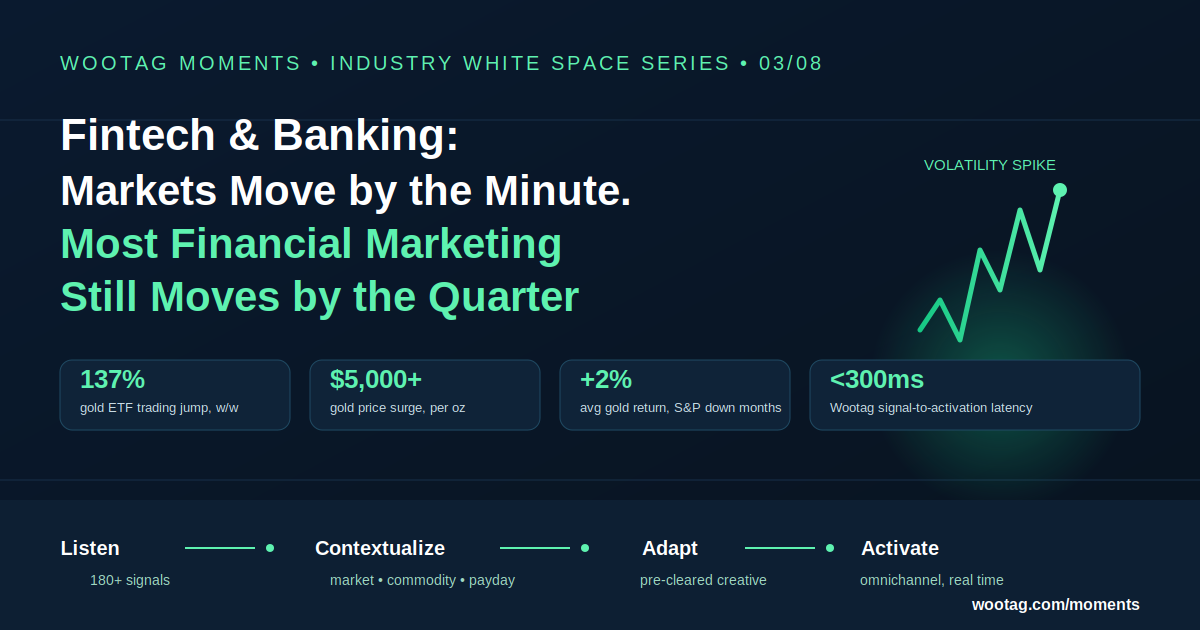
Start with market volatility, because it’s the cleanest example of a live signal financial brands already monitor obsessively for risk purposes but rarely activate for marketing. Gold trading volumes have surged to record levels during recent sell-offs — daily volumes across major venues reaching levels never before recorded, gold ETF trading jumping over 130% week-on-week, and exchange volumes climbing over 45% in the same stretch. Gold itself surged past $5,000 an ounce for the first time this year, and since 2020, months when the S&P 500 has fallen more than 5% have seen gold deliver a positive average return while other assets fell. This is a well-documented, near-instant “flight to safety” behaviour pattern — precisely the moment a bank, broker or wealth platform could be putting a relevant savings, gold-linked or hedging product in front of an anxious customer. Most aren’t, because the volatility signal lives in a trading or risk system, not in the marketing stack.
Fintech’s own industry data confirms the appetite for this kind of response is already there in principle. Industry guides describe 2026 marketing shifting from generic audience segments toward hyper-personalized, real-time engagement built on behavioural and contextual signals like transaction history, geolocation and lifestyle events, and note that lifecycle marketing is increasingly built on real financial events rather than scheduled campaigns — a funding round, a missed payment, a large deposit. But the same research is candid about the gap: most fintechs have this data scattered across six or more disconnected platforms, and even leading players are still building triggered sequences one lifecycle event at a time rather than orchestrating a shared, always-on signal layer across channels.
Then there’s the calendar-predictable signal hiding in plain sight: payday. It’s one of the most reliable, recurring financial behaviour triggers there is — spend, saving and borrowing intent all shift measurably around it — yet most banking and lending marketing still treats it as a segment attribute rather than a live trigger that should be firing coordinated messaging the moment the date arrives for each customer’s specific pay cycle.
And, as with other categories in this series, there’s the tentpole sponsorship gap. Banks and fintechs are prominent sponsors of major sporting events — a natural fit, since these are trust-building, high-visibility platforms — but that sponsorship spend is typically locked to the tournament’s official calendar and creative assets, with no live layer connecting it to the everyday financial moments (a paycheck, a rate move, a gold price spike) that happen every other day of the year.
Why the white space persists — and why finance has an extra reason
Financial services carries the same structural issues as other categories in this series — quarterly planning cycles, channel-siloed data, disconnected vendors — plus one that’s unique to the industry: compliance review speed. Every piece of financial marketing creative typically has to clear a compliance and legal review before it goes live, which is a reasonable safeguard but one that’s fundamentally at odds with a signal that changes by the hour. The result is that even when a bank’s risk team spots a volatility spike in real time, there’s often no pre-approved, compliance-cleared creative template ready to deploy against it — so the moment passes before marketing can legally respond.
Why the layer needs to be independent of any one channel
Most of the tools that already exist to catch real-world signals — weather-ad networks, retail media platforms, DSP-side contextual targeting — are built inside a single channel. A weather-triggered DOOH vendor can only activate DOOH. A retail media network’s real-time bidding logic only fires inside that retailer’s own inventory. A DSP’s contextual layer only reaches programmatic display. Each one is genuinely useful, and each one is also a silo: the same volatility spike, the same payday date, the same sponsorship moment has to be re-detected, re-briefed and re-created separately for every channel team that wants to react to it.
This is the structural reason most real-time campaigns stay confined to the channel they were built for. A campaign designed around broadcast, a single retail media network, or a single DSP’s contextual layer has no natural mechanism to also re-trigger a brand’s other programmatic buys, social feeds and retail media placements the moment the same signal recurs somewhere else. Each of those channels sits with a different team, a different vendor and a different creative pipeline.
An independent moments platform solves this by sitting above the channel layer rather than inside it. Wootag listens to signals once, contextualizes them once, and then adapts and activates that single decision across every channel a brand already buys — social feeds, publisher content, programmatic and retail media, CTV/streaming, and shoppable/commerce surfaces — whether that media is owned (a brand’s own app, site or CRM) or paid (a DSP, a retail media network, a social platform’s ad stack). Because the detection and decisioning layer isn’t married to any one channel’s ad server, it doesn’t matter whether the next signal-triggered moment needs to land as a push notification, a DV360 line item, a retail media placement, or an email send — the same signal drives all of them from one place.
For financial marketing and growth teams specifically, that channel-agnosticism does something else important: it gives compliance one shared decisioning layer to review and pre-approve, instead of five separate channel teams each building their own version of “what a volatility spike should say.” A pre-cleared creative template tied to a defined signal threshold can be approved once and then fire consistently everywhere the signal is relevant — which is what actually makes real-time financial marketing operationally and legally viable, not just technically possible.
Mapping the white space across financial services
| Segment | Live signal white space today | What “moment-activated” looks like |
|---|---|---|
| Retail banking | Payday and salary-credit dates are known but treated as static segments, not live triggers | Real-time, payday-synced messaging for savings nudges, overdraft protection or credit offers the day funds land |
| Wealth & trading platforms | Volatility and commodity price spikes (gold, equities) drive documented flight-to-safety behaviour, largely unmonetized in marketing | Live volatility- or price-threshold triggers surfacing relevant products (gold-linked funds, hedges, safe-haven savings) the moment a signal crosses a defined level |
| Lending & credit / BNPL | Commodity and cost-of-living signals shift borrowing intent, but campaigns are mostly evergreen | Contextual offers tied to live cost signals (fuel, essentials pricing) timed to when affordability pressure is visible |
| Insurance | Weather and climate signals (storms, heatwaves, floods) are directly relevant to claims and coverage products but rarely activated pre-event | Pre-emptive, weather-triggered messaging on relevant coverage as a live weather event approaches a region |
| Payments & digital wallets | Sports and cultural tentpoles drive spend spikes around sponsorships, but activation stops at the official campaign window | Signal-triggered cashback, rewards or spend nudges tied to live match or cultural moments, beyond the sponsored tournament dates alone |
A closer look: taking the signal layer to the field — contextual pitches for agents and RMs
Everything above has been about marketing channels — social, push, CTV, retail media. But banking and insurance are unusual among the industries in this series in how much high-value selling still happens through a human: a bancassurance advisor, a wealth relationship manager, an insurance agent, a gold-loan officer, a DSA on a door-to-door route. That channel deserves the same signal layer the rest of this post argues for — and today, it’s usually the last channel to get it.
A field agent typically walks into a client conversation with a lead list, a product brochure and whatever they remember from the morning’s news — not with a live view of what’s actually relevant to that specific customer, in that specific location, today. That’s a real gap, because the same signals this post has already covered — a volatility spike, a gold price move, a payday date, a storm forecast — are exactly the kind of context that turns a generic pitch into a timely, credible one.
The architecture doesn’t need to change to close this gap — only the destination for the signal does. The same Listen → Contextualize decisioning that feeds a push notification or a social placement can just as naturally feed whatever tool an agent already carries: a CRM, a sales-enablement platform, an agent-facing mobile app, or a WhatsApp Business account. In practice, that could look like:
- A gold-loan or wealth officer opening their agent app before a client visit and seeing that gold has just crossed a notable price threshold, with a pre-approved talking point about loan-to-value or portfolio rebalancing ready to use.
- An insurance agent covering a territory getting a prompt ahead of a forecasted storm or heatwave, flagging which existing policyholders in that area have coverage gaps worth raising proactively, rather than a generic renewal script.
- A bancassurance or retail RM seeing that a payday cycle has just landed for a cluster of customers in their book, with a same-day, pre-approved savings or protection-product conversation starter.
The reason this belongs in the same architecture as the marketing use cases above — rather than as a separate tool — is the compliance point already raised in this post: agents in regulated selling need pre-approved language just as much as an ad creative does. A signal-triggered talking point is only useful if it’s been cleared in advance, the same way a signal-triggered push or display ad would be. Treating the field agent as one more “channel” the moments layer activates into, rather than a manual, judgment-based process layered on top, is what would make this consistent, scalable and auditable rather than one more thing compliance has to review ad hoc.
To be clear, this is a natural extension of the channel-agnostic architecture described earlier in this post, not a confirmed, shipped Wootag capability at the time of writing — worth raising directly with your Wootag contact if agent and RM enablement is a priority for your organisation.
What’s ours, and what’s independently sourced
For transparency: the gold and market-volatility figures (record gold trading volumes during sell-offs, the 130%+ week-on-week jump in gold ETF trading, gold’s surge past $5,000/oz, and the average 2% gold return in months of S&P 500 declines over 5%) come from independently published third-party sources — the World Gold Council, Bloomberg and BlackRock — not from Wootag’s own client data. The fintech marketing-behaviour research (the shift toward event-based lifecycle marketing, the data-fragmentation challenge across platforms) is drawn from independent fintech marketing industry analyses. Wootag’s own platform specifications (180+ signal categories, 47 markets, sub-300ms signal-to-activation latency) are the company’s stated figures. Any financial-services-specific Wootag pilot data will be labelled separately from this research as it becomes available.
Where this leaves financial marketers
Financial services already tracks its live signals more precisely than almost any other industry — volatility, commodity prices, payday cycles, spend patterns are all measured constantly, just by risk and product teams rather than marketing ones. The white space isn’t a data problem. It’s the absence of a shared, pre-approved, cross-channel layer that can take a signal risk teams already see, turn it into compliant creative once, and activate it everywhere a customer might be — before the moment that made it relevant has passed.
Ready to map your institution’s live signals — market, commodity, calendar or sponsorship-driven — to a compliant, always-on activation layer? Book a demo with Wootag to see how the Listen → Contextualize → Adapt → Activate framework applies to your specific product portfolio.
