

The problem isn’t visibility. It’s relevance.
The average person is exposed to somewhere between 4,000 and 10,000 ads a day — yet consciously registers fewer than 100 of them, and remembers barely 1–10% of what they saw just 24 hours later. Global ad spend has crossed $1 trillion, but attention hasn’t grown an inch to match it. More messages are chasing the same finite pool of human focus, and the result is not stronger brand recall — it’s noise.
This is the paradox every marketer is quietly wrestling with: volume is up, signal is down. Programmatic buying, AI-generated creative, and always-on campaigns have made it cheaper than ever to produce more ads — but producing more has never been the same as being heard. When everything is shouting, nothing is a signal. It’s just static.
Wootag’s answer is to stop treating marketing as a volume problem and start treating it as a timing and relevance problem. That’s the premise behind the Moments Platform — and it’s worth unpacking why it matters so much right now.
What “signal-to-noise” actually means for a brand
Signal-to-noise ratio is a simple idea borrowed from engineering: it’s the strength of a meaningful message relative to the background clutter surrounding it. In marketing terms, the “signal” is anything that genuinely resonates — an offer, a message, a creative moment that lands because it’s relevant to what a person is feeling or doing right now. The “noise” is everything else: generic banners, mistimed retargeting, templated copy, ads that could have run on any day for any audience.
A high signal-to-noise environment doesn’t require more media spend. It requires better timing and context — delivering the right message at the exact moment a consumer’s attention and emotion are already engaged, rather than interrupting them and hoping something sticks.
This is precisely the gap Wootag Moments is built to close.
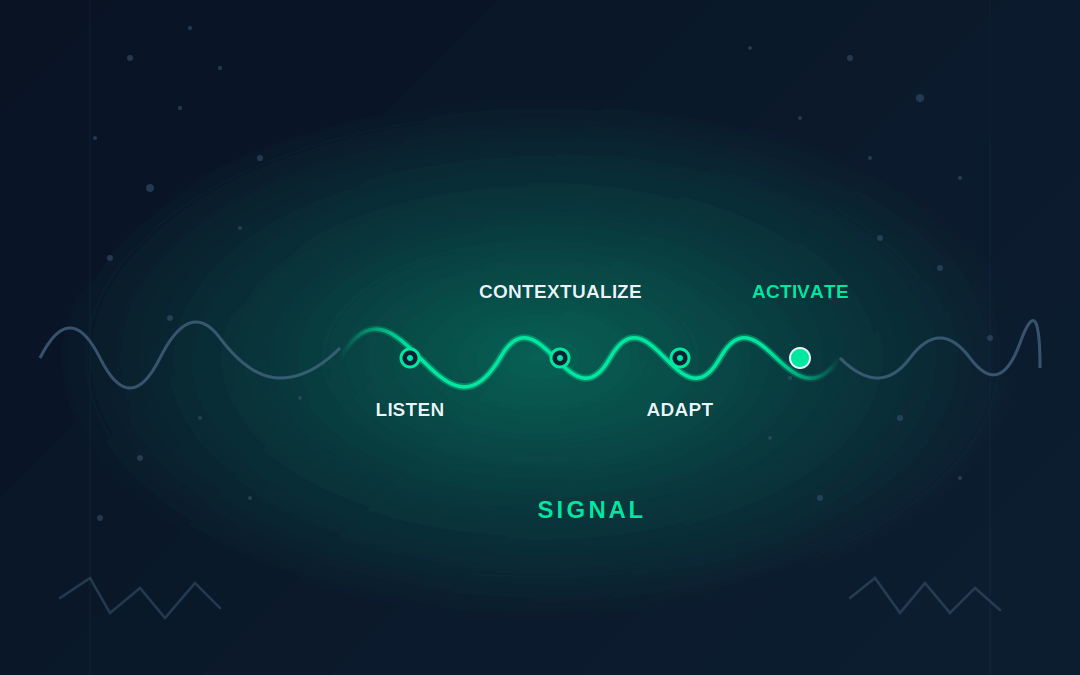
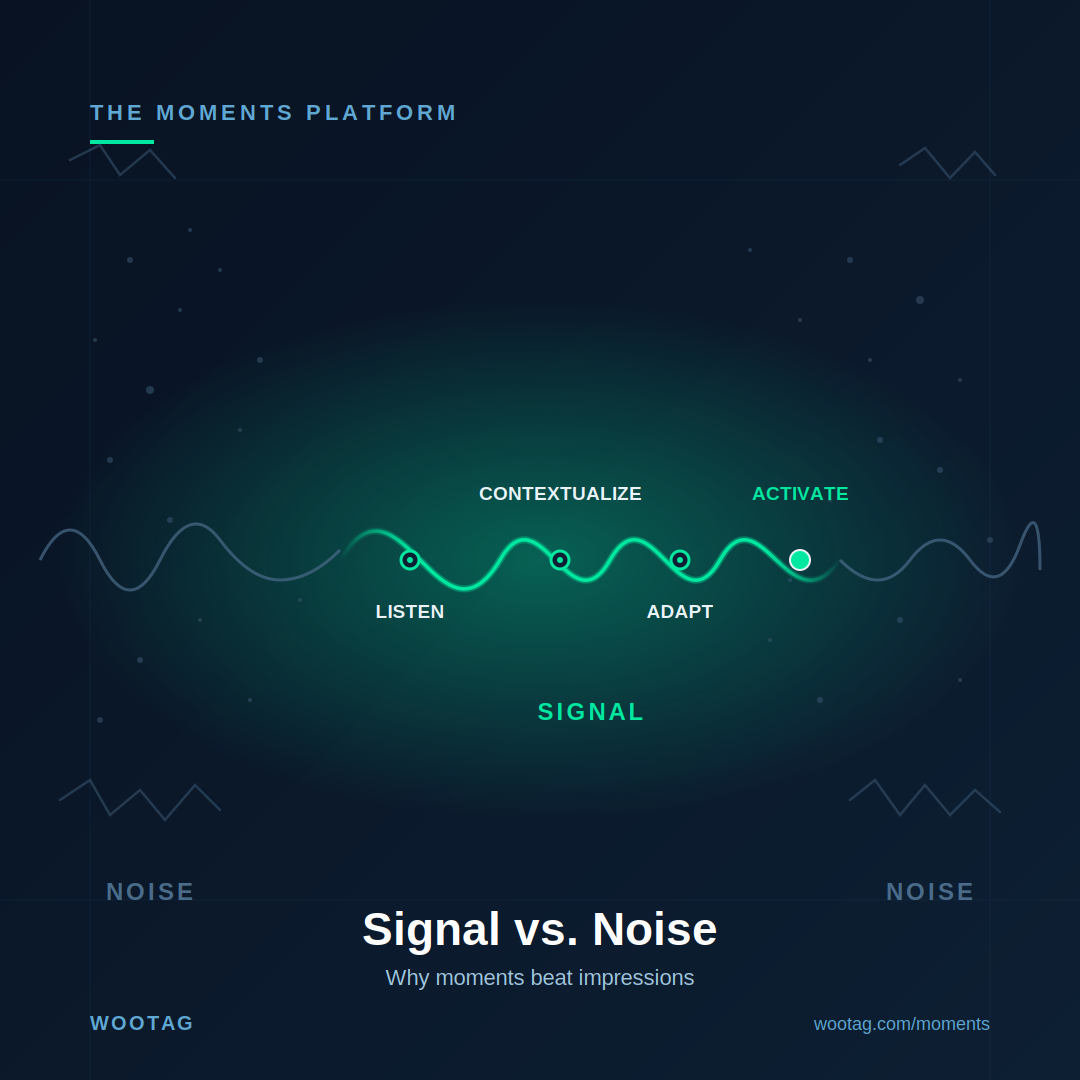
Listen → Contextualize → Adapt → Activate: turning real-world signal into brand signal
Wootag describes itself as connecting every real-world signal — a falling wicket, a market spike, a heatwave, a crude oil rally — to a brand experience, in real time, across every digital touch point. The Moments Platform runs on a four-step framework:
1. Listen. Wootag ingests 180+ live data feeds spanning sports, weather, markets and commodities, and detects high-impact moments as they happen — with under 300ms trigger latency, live across 47 markets. This is the noise-filtering step: instead of guessing when audiences might be receptive, the platform listens for the moments when they demonstrably are.
2. Contextualize. An AI layer maps each live signal to brand-safe creative, dynamic offers and hyperlocal triggers tailored to audience sentiment — so a heatwave alert in Mumbai and a market breakout on the Nifty don’t get the same generic treatment. Each signal is contextualized to what it actually means for a specific brand and audience.
3. Adapt. Creative is smart-adapted in format, framing and message for wherever it will live — social, sites, ads — reshaping one signal into the right asset for each destination rather than force-fitting a single creative everywhere.
4. Activate. The moment fires across CTV, social, programmatic, retail screens and shoppable overlays — instantly, while the emotional window is still open.
The platform frames it well: a signal isn’t a moment until it reaches a human in the right state of mind. That’s the entire thesis of signal-to-noise reduction — it’s not about shouting louder, it’s about arriving exactly when the audience’s attention, emotion and intent all peak together.
Why “moments” outperform “impressions”
Look at how this plays out in sports, one of Wootag’s highest-signal categories. A cricket wicket falling, a football match’s last-minute winner, an F1 overtake, an unseeded tennis player upsetting a giant — these are seconds where hundreds of millions of people are simultaneously locked into the same emotional state. Wootag’s sports moments product is built to trigger brand messaging, shoppable overlays and hyperlocal walk-in prompts at exactly that instant, rather than scheduling a generic spot to run sometime during the broadcast window.
The difference matters enormously when you think about signal-to-noise mathematically. A banner ad served at a random scroll point competes with everything else on the page and in the person’s head — low signal, high noise. A brand message triggered the second a goal is scored, timed to the crowd’s shared adrenaline spike, has almost no competing noise in that instant — the audience’s attention is already fully allocated to that single event. Wootag isn’t creating attention; it’s borrowing a sliver of attention that already exists at maximum intensity and putting a brand inside it.
The same logic extends across weather, stocks and commodities — a heatwave alert, an IPO listing, a gold rally are all instances where a real-world event has already done the hard work of capturing attention. The brand’s job is simply to show up inside that window with something contextually useful, not to manufacture attention from scratch.
The business case: why this matters beyond “cool tech”
For brands and marketers, three consequences follow directly from this shift:
1. Efficiency of spend. If attention is finite and mostly filtered out (people register under 100 of the thousands of ads they see daily), then spend aimed at moments of genuinely elevated attention should, in principle, convert more efficiently per dollar than spend spread evenly across low-attention inventory. You’re not paying for reach you can’t convert — you’re paying for reach at the instant it’s most convertible.
2. Recall and differentiation. With ad fatigue and banner blindness well documented, repetition alone no longer builds recall the way it once did — familiarity built through consistent, contextually sharp moments increasingly beats familiarity built through frequency. A brand that shows up at a wicket, a heatwave, or match point becomes part of the memory of the event itself, rather than another interchangeable interruption competing with it.
3. Trust through relevance, not intrusion. Consumers already say they’ll tolerate advertising that feels non-intrusive and contextually appropriate; what erodes trust is irrelevance and repetition. A message tied to a real, live, shared moment reads as responsive rather than interruptive — which is a meaningfully different relationship for a brand to have with its audience.
An honest caveat
It’s worth being clear-eyed about what moment-based activation can and can’t do. Tying creative to a live signal doesn’t automatically guarantee resonance — the contextual link between the moment and the brand message still has to make sense (a heatwave-triggered offer from a beverage brand reads naturally; a heatwave-triggered offer from an unrelated category can feel forced). Latency and signal accuracy also matter enormously: a “real-time” trigger that fires ten minutes after the wicket falls, or misreads sentiment, becomes noise itself. And not every brand has a natural moment to plug into — the framework works best for categories where a real-world trigger (weather, price movement, live sport) has an intuitive link to consumer behavior (comfort, spending confidence, celebration). Brands evaluating a platform like this should ask for real trigger-latency data and post-campaign attribution, not just the promise of “real time.”
The takeaway
The advertising industry’s default response to attention scarcity has been to produce more — more creative variants, more channels, more frequency. But when the entire ecosystem does that simultaneously, the noise floor rises for everyone, and signal-to-noise gets worse, not better. Real-time moments marketing takes the opposite approach: instead of adding volume, it finds the instants where a large, real audience is already emotionally locked in, and it puts a relevant, well-timed message inside that window. That’s a fundamentally different strategy for cutting through noise — not louder, but better timed.
For any brand deciding where to put its next marketing dollar, that’s the real question worth asking: are you buying more impressions, or are you buying a moment that was already going to matter to someone?
Explore Wootag’s Moments Platform → · See how it works in Sports →
