
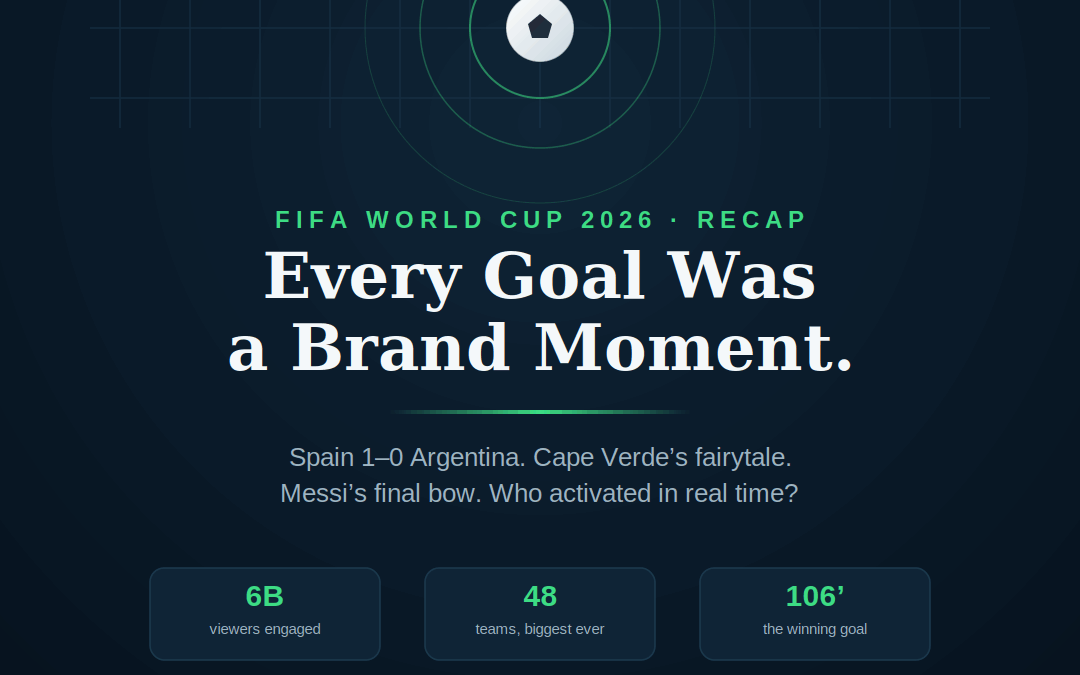

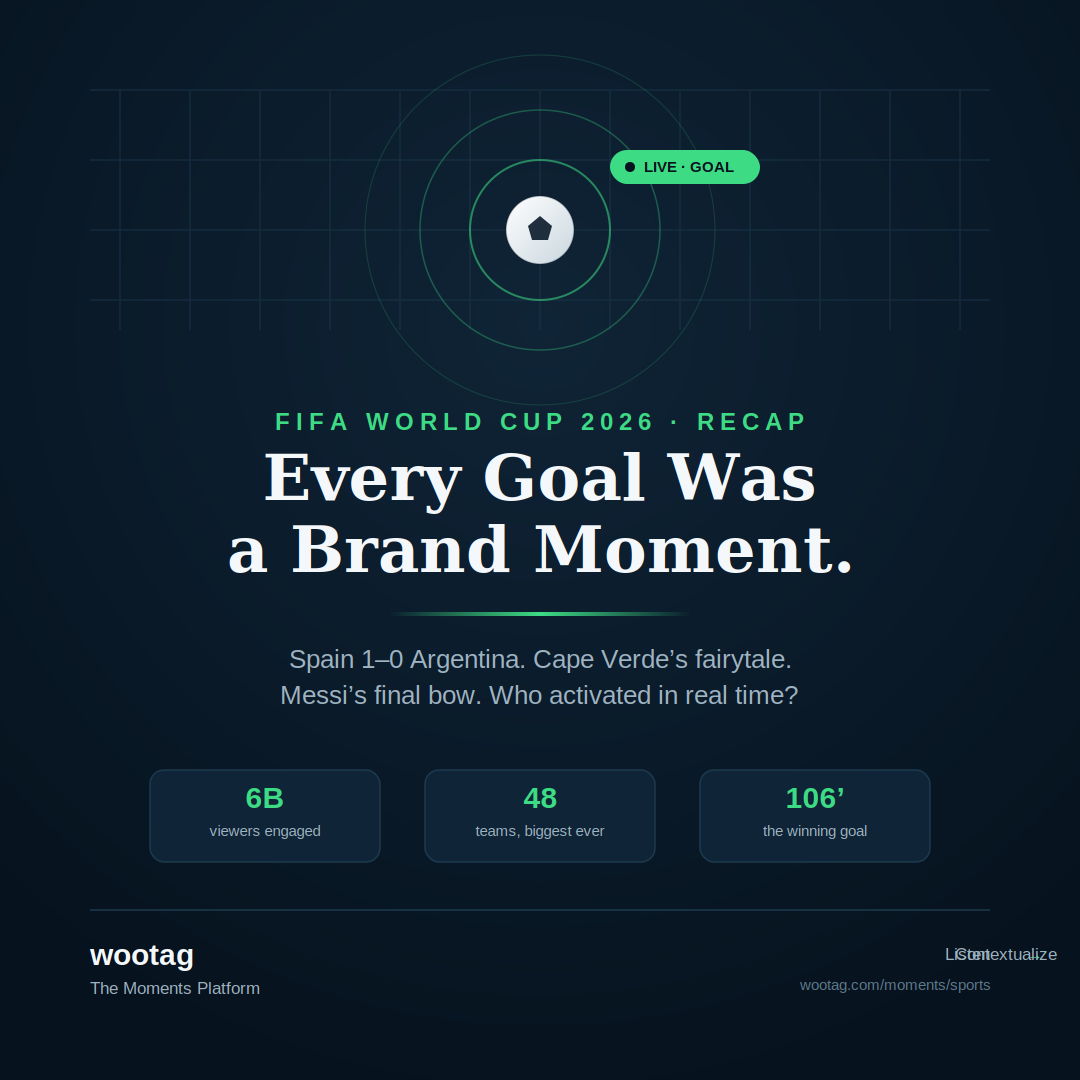
On July 19, 2026, Ferran Torres rose off the Spanish bench and, in the 106th minute of extra time at New York New Jersey Stadium, buried the goal that denied Lionel Messi and Argentina back-to-back World Cup titles. Spain 1, Argentina 0. A second star for La Roja, their first since 2010 — and the closing scene of the biggest, longest, and most-watched FIFA World Cup in history.
Forty-eight teams. Sixteen host cities across the United States, Mexico and Canada. 104 matches over 39 days. And, by FIFA’s own projections, roughly 6 billion people engaging across broadcast, streaming and social — with an estimated 1.5 billion tuning into the final alone. It was, by every measure, a marketer’s Everest.
And yet, according to WARC Media’s Global Ad Trends report, the $10.5 billion the tournament pumped into global ad markets landed softer than 2018’s $12.6 billion Russia bump — a sign that attention is no longer concentrated in one broadcast feed. Fans splintered across TikTok, YouTube, Netflix and a dozen regional streaming apps, watching goals as clips before they watched them as broadcasts. The brands that broke through weren’t necessarily the ones with the biggest sponsorship checks — they were the ones fastest to the moment.
This is exactly the gap Wootag’s Moments Platform is built to close: turning a live signal — a wicket, a goal, a last-minute winner — into a brand experience before the crowd has finished celebrating.
A tournament built for real-time marketing
The structural story of World Cup 2026 was expansion. Bigger bracket, more matches, more storylines running in parallel — which meant more discrete, high-emotion spikes for brands to either catch or miss. A few numbers set the scene:
- Nielsen reported US viewers logged nearly 80 billion minutes watching football in the year before the tournament even began, with interest projected to climb 62% among existing fans because of the World Cup.
- Nexxen research found 43% of expected viewers planned to watch primarily via streaming rather than linear TV — a fundamentally more fragmented, moment-driven audience.
- On Fox’s broadcast networks, iSpot data cited by The Social Juice showed World Cup advertisers running an average attention index of 121 — 21% above baseline — with Coca-Cola, McDonald’s and Adidas leading sponsor engagement, and Nike, LEGO and Levi’s dominating the non-sponsor conversation.
That last stat is the tell. Official sponsorship bought reach. It didn’t buy the internet’s attention on its own — the brands that won the conversation were the ones reacting to what was actually happening on the pitch, in real time, not just running pre-baked creative during ad breaks.
This is precisely the kind of window Wootag’s Sports Moments product is built around — goals, buzzer-beaters and upsets treated as scheduled brand-activation windows rather than background noise.
The moments brands should have been building around
Every major tournament produces a handful of scenes that outlive the scoreline. World Cup 2026 delivered several — each one, in Wootag terms, a signal that should have triggered a brand response within seconds, not hours.
1. Ferran Torres’ extra-time final winner. The peak moment of the entire tournament — only the second substitute in World Cup final history to score the winning goal — landed at minute 106, well past the point most brands’ pre-planned creative calendars had anything left to say. A platform listening to the live match state could have fired celebratory, Spain-flagged creative into feeds within the latency window Wootag advertises for its live triggers — while the goal was still replaying, not the next morning.
2. Cape Verde’s fairytale run. A nation of under 600,000 people went unbeaten through the group stage against former champions Spain and Uruguay, with goalkeeper Vozinha becoming an overnight global storyline after a string of stunning group-stage saves. This is the archetypal “signal-vs-noise” moment Wootag talks about — a low-probability, high-emotion underdog story that a static campaign calendar would never have scheduled for, but that a signal-listening platform would have flagged the instant Cape Verde held Spain to a scoreless draw.
3. Messi’s final World Cup bow. Messi entered the tournament as the defending champion chasing history and left it, at 39, confirming this was his last World Cup — with Kylian Mbappé edging past him in the Golden Boot race. Legacy moments like this carry an emotional half-life that outlasts the final whistle; brands with tribute or thank-you creative ready to adapt within the hour, rather than the week, captured a wave that others simply watched pass.
4. Enzo Fernández’s red card and Argentina’s backs-to-the-wall final. Down to ten men from the 90th minute, Argentina somehow dragged a goalless, chanceless first 90 into extra time — a tension spike that had nothing to do with a goal at all. It’s a reminder that “the moment” isn’t always a scoreline change; card decisions, momentum swings and VAR reviews are equally activatable signals, which is why Wootag’s sports triggers extend beyond goals to wickets, milestones, pole positions and match points across sports generically, not just the scoreboard.
5. Fan culture moments — England’s Wonderwall chant. England’s run to the semi-finals produced one of the tournament’s most-replayed off-pitch moments: thousands of fans singing Oasis’s “Wonderwall” in unison after wins, a clip that traveled across social far beyond football audiences. Culturally resonant, non-match moments like this are exactly what Wootag’s resonance layer is designed to catch — adapting tone and creative to the emotion a signal produces, not just the final score.
6. Controversy as a real-time signal. The USA’s Folarin Balogun had a red-card suspension controversially overturned ahead of the round of 16 following reported political intervention, instantly becoming one of the tournament’s most-discussed storylines. Not every brand wants to touch a controversy directly — but knowing a signal is trending, and having the option to lean in or deliberately stay silent with adjacent, feel-good creative, is itself a real-time decision that only a live-listening system can support.
Mapping the moments to Wootag’s framework
Every one of the moments above follows the same four-step arc Wootag is built around:
| Step | What happens | World Cup 2026 example |
|---|---|---|
| Listen | Ingest live match data and social sentiment in real time | Detecting Torres’ 106th-minute strike the instant the net ripples |
| Contextualize | Map the signal to brand-safe creative and audience sentiment | Recognizing a Cape Verde shock result as an underdog-story trigger, not just a scoreline update |
| Adapt | Reshape creative for the format and platform it will live on | Turning a Messi tribute into a vertical Story, a CTV spot and a shoppable feed tile simultaneously |
| Activate | Fire the experience across CTV, social, programmatic and retail screens | Pushing Spain-branded shoppable overlays into feeds mid-celebration, not the next news cycle |
For a tournament this fragmented — 43% of viewers streaming rather than watching linear TV — that Listen-to-Activate loop matters more than the size of a sponsorship deal. A brand that owns official partnership rights but reacts a day late to Cape Verde’s story, or to the Wonderwall clip, cedes the conversation to whoever gets there first — sponsor or not, as Nike, LEGO and Levi’s proved against paying sponsors on social.
A note on how this comparison was built
This piece draws on two categories of information, and we want to be transparent about the difference. Tournament facts, scorelines, viewership figures and ad-spend estimates are sourced from third-party reporting and industry research — FIFA’s own match data, NBC News, Fox Sports, WARC Media, Nielsen and Nexxen data as cited by The Gutenberg, and iSpot data via The Social Juice. None of these organizations are affiliated with Wootag, and none of the brand examples referenced (Coca-Cola, Nike, Adidas, LEGO, Levi’s, and others) reflect confirmed Wootag clients or campaigns — the mapping between World Cup moments and the Listen–Contextualize–Adapt–Activate framework is illustrative of how the platform’s published capabilities apply to this tournament, not a case study of executed work. Platform capabilities and trigger latency figures referenced are drawn from Wootag’s own product pages.
The next World Cup moment is already four years away — but the pattern isn’t
Whatever the event — a wicket, a monsoon, a crude oil spike, a World Cup final — the lesson from summer 2026 is the same: fragmented, streaming-first audiences reward whoever reaches the moment first, not whoever has the biggest logo on the shirt. Wootag’s Moments Platform exists to make sure the next real-time signal — sporting or otherwise — doesn’t pass a brand by.
