
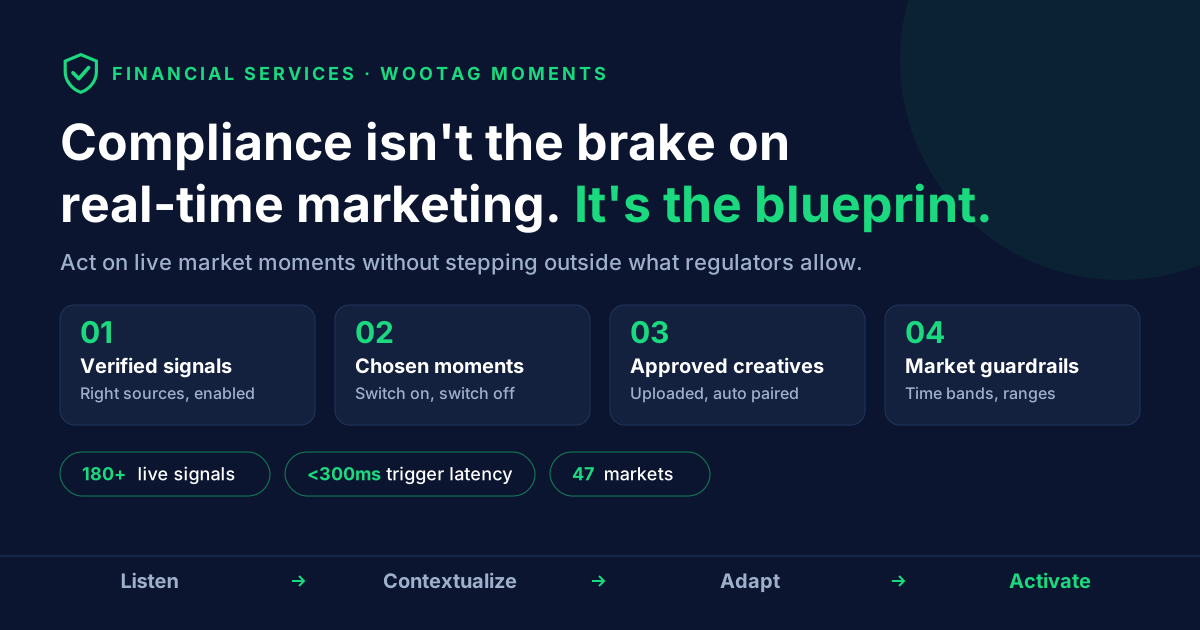

How Wootag Moments lets banks, asset managers, brokerages, insurers and fintechs act on live market moments without stepping outside what their regulators allow.
In short
- Financial brands can’t guess at data or let AI write their messaging. Every signal, moment, message and activation has to stand up to a compliance review.
- Wootag Moments is built around four control points: signals from verified sources, moments you switch on or off, creatives your team has already approved and uploads by moment, and activation guardrails tied to market hours and value ranges.
- Outcomes can be measured by signal, moment, creative, channel and every combination of them, so marketing and compliance work from the same picture.
The S&P 500 closes up 1.8%. A few minutes later, a consumer investing app sends a push: “Markets are flying. Don’t miss the next run.”
It’s timely. It’s relevant. And to anyone who has sat in a financial promotions review, it reads like a problem. It implies future performance, says nothing about risk, and nobody signed off on that exact wording before it went out.
That one message sums up why so many financial brands stay out of real-time marketing, even though markets are literally their category.
The gap: financial brands own the moments but rarely use them
Every day the market hands financial brands moments that no other category can claim as naturally. Index breakouts, rate decisions, IPO listings, gold rallies, currency swings, the closing bell. These are the moments their customers are already paying attention to.
Yet banks, asset managers and brokerages tend to be the slowest to act on them. Not because they lack the intent, but because of how their communications are governed.
In the US, FINRA Rule 2210 requires a qualified registered principal to approve each retail communication before it is used. In the UK, the FCA requires every financial promotion to be fair, clear and not misleading, across every medium including social. And regulators are actively enforcing this. The FCA reported that nearly 20,000 financial promotions were withdrawn or amended in 2024 after its intervention, close to double the year before.
Every market has its own version of these rules, and a brand operating across five countries is answering to five different rulebooks. So “real time” sounds less like an opportunity and more like a way to create unapproved communications at speed.
Why the gap persists
Most real-time and AI creative tools were built for speed first. They read a trigger and write fresh copy or generate a new visual on the spot.
For a consumer brand, that can work. For a regulated financial brand, it creates exactly the kind of communication compliance teams can’t sign off on, because it didn’t exist until the moment it went live.
Regulators have been clear that the technology doesn’t change the obligation. FINRA’s Regulatory Notice 24-09 reminded firms that the content standards of Rule 2210 apply whether a communication is written by a person or produced by a technology tool. An AI-generated line about the market is held to the same standard as one written by your team, and it still needs supervision.
So the answer isn’t to slow down. It’s to move the compliance work upstream, so the live moment only ever triggers things that were already checked, approved and allowed.
That’s the way Wootag Moments is designed for financial organizations.
Four control points, built in from the start
1. Signals you can rely on
Everything starts with the signal, and in financial marketing accuracy isn’t optional. A message that says “the index is up today” when it isn’t is a misleading communication, however well it was approved.
That’s why we have integrated and enabled financial signals from the right sources rather than scraped or estimated readings. Index levels, stock and IPO moments, commodities like gold and crude, currencies and more come into the platform through the Moments Marketplace, which brings fragmented providers into one place.
For a financial brand, this means the moment your activation responds to is a moment that actually happened, read from a source your team can name if anyone asks.
2. Moments you choose to talk about, and the ones you don’t
Not every market moment is a moment a financial brand should speak in. Knowing when to stay silent is part of compliance.
On Moments, brands configure which moments are switched on and which are switched off, by product and by market. A few examples of how that plays out:
- An asset manager may choose to speak during index recoveries with a message about long-term discipline, and stay silent on a sharp single-day fall.
- A bank may allow rate-related messaging only after the official central bank announcement, never on speculation ahead of it.
- A product that is approved for marketing in one country may be switched off entirely in another where the rules are different.
Silence becomes a configured decision rather than something left to whoever happens to be watching the screen that day.
3. Messages and creatives you approved, paired automatically by moment
This is the part that matters most to compliance teams.
Instead of letting AI generate creatives that may not hold up under local regulations or current market conditions, Moments lets financial organizations upload their own messages and creatives. These have already been through the brand’s legal and compliance review, with the right risk warnings, disclaimers and product language in place.
Brands upload creatives against each moment they have switched on. When that moment occurs, the platform automatically pairs it with the approved creative for that moment. It picks from what you gave it. It doesn’t write new claims.
The practical benefit is simple. The approval records your compliance team already keeps match one to one with what can go live. There is no surprise wording to explain later.
4. Activation with guardrails that respect the market
Getting the signal, moment and message right still isn’t enough if the timing is wrong. So activation on Moments carries additional guardrails built for financial markets:
- Exchange time bands. Activations can be restricted to a specific exchange’s trading hours, or kept outside them, depending on what your rules require.
- End-of-day conditions. Brands can choose to act on closing values rather than intraday noise, so a message reflects where the market actually settled.
- Value ranges. Activations fire only when a signal falls within the range you define. For example, respond to an index move between 0.3% and 2%, but not to an extreme swing where any communication could look like it’s reacting to panic or euphoria.
Franklin Templeton used this kind of threshold logic with Wootag, activating only when the Sensex moved past a ±0.3% threshold. The result was an 8.3x CTR uplift, 24% of budget saved and zero wasted impressions, because nothing ran when the condition wasn’t met.
Measurement that both teams can read
Once activations are live, brands can measure outcomes by signal, by moment, by creative, by channel, and by any combination of these.
For marketing, that shows which market conditions and which approved messages actually drive outcomes like account openings, app installs, investment registrations or site visits. For compliance, it gives a clear record of what ran, where, when, and in response to which signal. It’s the same data, just answering two different questions.
The channel shouldn’t decide your compliance
Most brands run communications across several channels at once: social platforms, programmatic, connected TV, push notifications, their own apps and sites. When the rules for what can run sit inside each channel separately, every new channel becomes a new place for something to slip.
The stronger approach is to hold the decision logic in one layer above the channels. Which signal counts, which moment is allowed, which approved message goes with it, and when it can run are decided once. Each channel then receives the same governed decision. Adding a new channel adds reach, not risk.
How this maps across financial services
| Segment | Signals to listen to | Moments to switch on | Guardrails to apply | Example of an approved message angle |
|---|---|---|---|---|
| Asset managers and mutual funds | Index levels, sector moves | Recoveries, milestone closes | End-of-day values, value ranges, silent on sharp falls | Staying invested through cycles, with risk disclosure |
| Brokerages and trading apps | Market open and close, IPO listings, volatility | IPO listing day, session open | Exchange time bands, no performance implications | How to access a new listing, with risk warnings |
| Banks | Central bank rate decisions, FX | Post-announcement rate moments | Activate only after official announcement | Updated deposit or loan rates, as published |
| Gold and commodity products | Gold, silver, crude prices | Gold price milestones | Value ranges, per-market switch on and off | Diversification messaging, with price risk notes |
| Insurers | Weather, travel disruption | Seasonal risk moments | Switched off during disaster events | Coverage reminders, sensitively worded |
| Payments and cards | Sports, festivals, travel | Match days, festive periods | Per-market offer rules | Approved offers and rewards terms |
The table is illustrative. Which moments a brand switches on, and what messages it approves, will always be set by its own compliance team and local regulators.
Sourcing and transparency
From Wootag (platform claims and self-reported results): 180+ live signal feeds, sub-300ms trigger latency and availability in 47 markets are Wootag’s published platform specifications. The Franklin Templeton results (8.3x CTR uplift, 24% budget saved, zero wasted impressions, Sensex ±0.3% threshold) come from Wootag’s own case study at wootag.com/moments/case-studies. The capabilities described in the four control points reflect how Wootag Moments is built for financial organizations.
From regulators and independent sources:
- FINRA Rule 2210 (Communications with the Public), including the requirement for principal approval of retail communications before use. finra.org
- FINRA Regulatory Notice 24-09 (June 2024), on generative AI and large language models, confirming Rule 2210 content standards apply to technology-generated communications. finra.org
- FCA Handbook, COBS 4.2, the fair, clear and not misleading rule for financial promotions. handbook.fca.org.uk
- FCA data on nearly 20,000 financial promotions withdrawn or amended in 2024 following FCA intervention, as reported by Actuarial Post.
Wootag Moments supports a financial brand’s compliance process. It doesn’t replace the brand’s own legal and compliance review, which stays in control of what is approved and where it can run.
Speak in the market’s moments, on your terms
Financial brands don’t need to choose between being relevant and being compliant. When the signals are verified, the moments are chosen, the messages are already approved and the activation knows when to hold back, real time stops being a risk and starts becoming a capability.
If your team wants to see how this would work for your products and markets, talk to us at wootag.com
Compliance Isn't the Brake on Real-Time Marketing for Financial Brands. It's the Blueprint.
