
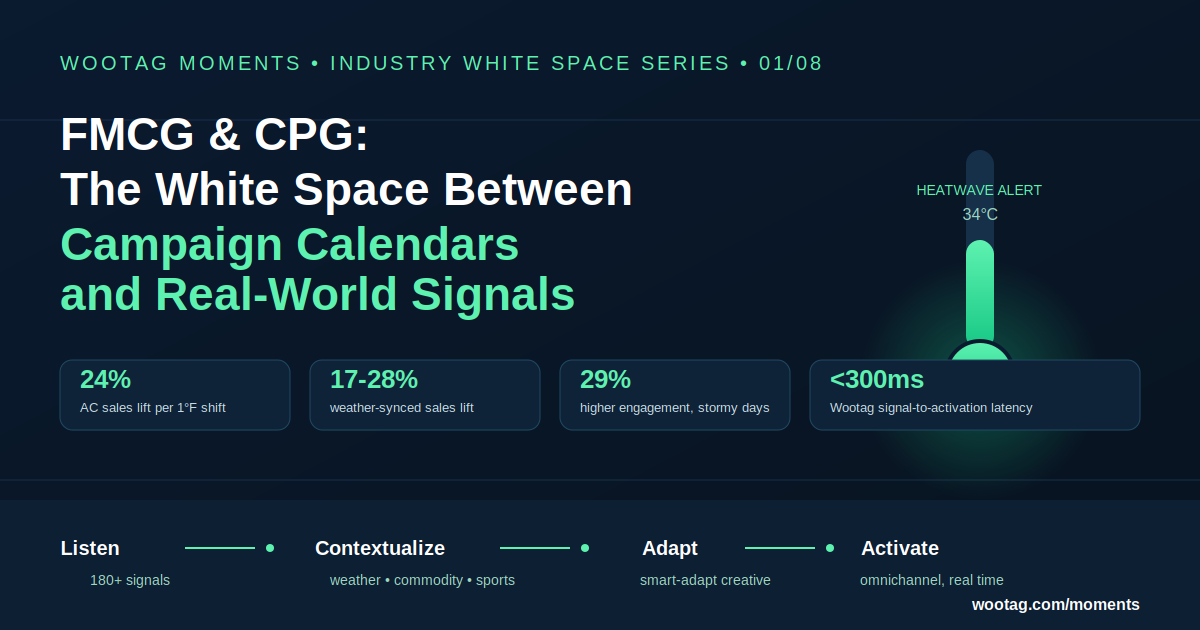

FMCG marketing has never had more data, more automation, or more channels. AI is rewriting creative in minutes, retail media networks are absorbing an ever-larger share of budget, and “always-on” has become a boardroom mantra. And yet the industry’s actual media planning is still built around a small number of pre-scheduled windows — a festive push, a summer campaign, a monsoon relaunch — while the moments that genuinely move FMCG demand happen almost every day, unplanned, and mostly unmonetized.
That gap is the white space this post is about: the distance between an FMCG category calendar and the real-world signal calendar the category actually responds to.
The gap: FMCG is weather-sensitive, event-sensitive, and price-sensitive — but its media isn’t
Start with weather. It is one of the most-documented — and most under-used — demand drivers in the FMCG playbook. A one-degree shift in temperature has been shown to swing air conditioner sales by as much as 24%, nudge soft drink purchases by 2%, and lift infant apparel by 4% in the same week. Campaigns timed to sunny conditions have driven a 10% lift in purchase intent, while stormy, “cocooning” weather has been linked to nearly 29% higher emotional engagement with advertising. Retailers like Sainsbury’s have found that the same BBQ range needs a 68°F trigger in Scotland but 75°F in London to sell through — proof that the “moment” isn’t a season, it’s a specific, local, live threshold.
Brands that have moved early on this are seeing it directly in sales, not just engagement: sales-lift campaigns tied to weather triggers for named FMCG advertisers such as La Redoute and Pantene have been reported in the 17–28% range, and QSR chains syncing warm-food promotions to cold snaps have documented double-digit sales gains. None of this is speculative — it’s published case data. What’s missing is scale. Most FMCG marketers still treat weather as a seasonal creative theme (a “monsoon campaign,” a “summer range”) rather than a live signal that should be re-triggering media, pricing and creative hour by hour.
The same gap shows up around commodity and cost signals. FMCG margins are under constant pressure from input-cost swings — edible oil, packaging resin, freight — and a growing share of manufacturers are now using AI to flag when a price rise crosses a “fairness threshold” so PR can get ahead of backlash. That’s a defensive, internal use of real-time signal detection. Almost none of it is being turned outward into brand-building moments — explaining value, reframing a price point, or rewarding loyalty right when the pressure is visible to the shopper.
And it shows up around cultural and sporting moments too. Big tentpole events such as the 2026 FIFA World Cup are pulling brand budgets toward full-funnel, real-time activation — retailers are explicitly being pushed to leverage live signals like scores and match outcomes to dynamically optimise campaigns. But that real-time capability is concentrated at the retail-media layer and around one or two marquee events a year. The other 363 days — a heatwave in Chennai, a surprise monsoon delay in Maharashtra, a cricket chase going down to the last over, a payday weekend — pass without a coordinated brand response, even though the underlying behavioural triggers (impulse purchase, comfort-seeking, treat-buying) are just as real.
Case in point: Unilever’s World Cup activation had the product fit, but not the signal
No CPG portfolio illustrates this white space better than Unilever’s own FIFA World Cup 2026 personal care sponsorship — and Wootag has covered this specific case before, in No Sweat, But No Signal Either: The Moments Unilever’s World Cup Campaign Left on the Table.
The short version: Unilever’s personal care division — Dove, Degree, Rexona and Axe — became the tournament’s official personal care sponsor, built around a genuinely sharp insight. A World Cup played through the North American summer is a tournament played in heat, and deodorant is arguably the single most contextually relevant product you can hand a sweating fan in a stadium concourse. Unilever leaned into that fit hard, running stadium activations that paired misting showerheads with free product sampling, and mobilizing more than 50,000 creators across markets to carry the “context premium” argument into social feeds. It’s a smart, structurally sound campaign, and by several industry accounts one of the standout CPG plays of the tournament.
But the fit that made the campaign work at the stadium — heat plus the right product, in the same place, at the same time — was locked to physical activations and a pre-planned creator and broadcast calendar. It wasn’t extended into a live signal layer that could have carried the same logic to every fan who wasn’t in the concourse: a heatwave spiking in a host city on a non-match day, a humidity surge in a market watching on TV, a temperature threshold crossed in a region where Rexona or Axe media was already running. The product argument — “you need this right now” — is exactly the kind of message a weather-signal trigger is built to deliver at scale, hour by hour, across every city Unilever’s brands are sold in, not just the ones hosting a match.
That’s the gap this post is describing, made concrete: even a CPG leader with a best-in-class, contextually-perfect campaign concept left the always-on, signal-triggered layer of that same idea untapped. (Note: this reading of Unilever’s campaign design draws on public reporting and Wootag’s own published analysis — it is illustrative commentary, not confirmed Unilever-Wootag client work.)
Why the white space persists
Three structural reasons keep this opportunity untapped even as the data on its effectiveness gets stronger every year:
- Planning cycles are quarterly; moments are hourly. FMCG media plans, creative sign-off and trade calendars are built months in advance. A live signal — a heat spike, a price swing, a match twist — has no natural slot in that process.
- Retail media and weather-triggered advertising are treated as separate disciplines. One team owns retail media, another owns programmatic, a third (if it exists at all) owns “always-on.” None of them own the cross-channel, cross-signal orchestration that would let one heatwave trigger a coordinated response across social, CTV, DOOH and retail screens simultaneously.
- Silos between digital, trade and supply chain teams. Even where the demand signal is detected, most FMCG organisations aren’t structured to convert it into a same-day creative and media response across channels — the operational bottleneck, not the data, is usually what kills the moment.
The framework: turning FMCG’s white space into a live media layer
This is precisely the gap Wootag’s Moments Platform is built to close. Rather than treating weather, commodities, sports and cultural signals as separate one-off campaigns, Wootag runs them through a single, continuous loop:
- Listen — 180+ live signal categories, including weather, commodities, sports and cultural events, ingested in real time across 47 markets.
- Contextualize — AI maps each signal to brand-safe creative, dynamic offers and hyperlocal triggers, so a heatwave in Chennai and a cold snap in Delhi can carry two entirely different messages for the same SKU on the same day.
- Adapt — Smart-adapt reshapes one creative asset into the right format for social, sites, CTV, DOOH or shoppable — automatically, not through a fresh production cycle.
- Activate — The experience fires across every channel the shopper actually inhabits, in under 300ms from signal to activation.
That sub-300ms trigger latency is the structural fix for the planning-cycle problem above: it turns a live signal into a live media event, not a delayed campaign refresh.
Why the layer needs to be independent of any one channel
Most of the tools that already exist to catch real-world signals — weather-ad networks, retail media platforms, DSP-side contextual targeting — are built inside a single channel. A weather-triggered DOOH vendor can only activate DOOH. A retail media network’s real-time bidding logic only fires inside that retailer’s own inventory. A DSP’s contextual layer only reaches programmatic display. Each one is genuinely useful, and each one is also a silo: the same heatwave, the same commodity spike, the same World Cup moment has to be re-detected, re-briefed and re-created separately for every channel team that wants to react to it.
This is the structural reason most real-time campaigns stay confined to the channel they were built for. A campaign designed around broadcast, a single retail media network, or a single DSP’s contextual layer has no natural mechanism to also re-trigger a brand’s other programmatic buys, social feeds and retail media placements the moment the same signal recurs somewhere else. Each of those channels sits with a different team, a different vendor and a different creative pipeline.
An independent moments platform solves this by sitting above the channel layer rather than inside it. Wootag listens to signals once, contextualizes them once, and then adapts and activates that single decision across every channel a brand already buys — social feeds, publisher content, programmatic and retail media, CTV/streaming, and shoppable/commerce surfaces — whether that media is owned (a brand’s own app, site or CRM) or paid (a DSP, a retail media network, a social platform’s ad stack). Because the detection and decisioning layer isn’t married to any one channel’s ad server, it doesn’t matter whether the next signal-triggered moment needs to land as a TikTok creative brief, a DV360 line item, a retail media placement on a grocer’s app, or an email send — the same signal drives all of them from one place.
For marketing and growth teams, that channel-agnosticism is what actually makes automation possible, for three concrete reasons:
- One integration, not N integrations. A growth team doesn’t need to build (and maintain) a separate real-time pipeline for every DSP, retail media network and social ad account it uses. The signal-to-decision logic is built once and orchestrates everywhere, which is what turns “real-time marketing” from a bespoke, engineering-heavy project into a repeatable, always-on capability.
- Consistent creative logic across every buy. Because Smart-adapt reshapes one contextualized decision into the right format for each surface, a brand’s messaging, offer and tone stay coherent across feed, story, banner, CTV and shoppable — instead of drifting apart because five channel teams each built their own version of “what a heatwave should say.”
- Media-neutral measurement. An activation layer that isn’t owned by a specific DSP or retail network has no incentive to over-credit its own inventory. That makes it easier for growth teams to compare true incrementality of a moment-triggered creative across owned and paid channels side by side, rather than trusting each channel’s walled-garden reporting.
The practical effect is that channel strategy and moment strategy stop being the same decision. A brand can keep its existing media mix — its DSP, its retail media partnerships, its owned app and CRM — and still get one coordinated, real-time response to a live signal across all of it, rather than having to pick a single channel vendor’s version of “real-time” and live inside that walled garden.
Mapping the white space across FMCG categories
| FMCG category | Live signal white space today | What “moment-activated” looks like |
|---|---|---|
| Beverages & refreshment | Temperature/heatwave spikes are known sales drivers but rarely retriggered same-day | Dynamic creative + shoppable overlay firing the moment local temperature crosses the category’s known threshold |
| Home & personal care (skin, hair) | Humidity, UV index and pollen signals are documented triggers, mostly unused outside search | Contextual creative on social/content feeds tied to live humidity or UV data by city |
| Packaged food & snacks | Sports moments (wickets, goals, match points) drive impulse and social snacking behaviour | Brand messaging and shoppable product triggered at the instant of peak match emotion, via sports moments |
| Baby & infant care | Weather-linked apparel/comfort purchases documented but not activated at brand level | Hyperlocal, weather-triggered messaging timed to seasonal comfort needs |
| Home & fabric care | Monsoon onset, humidity and heatwave alerts affect usage occasions (odour, mould, static) | Weather-triggered dynamic creative synced to regional monsoon/heatwave data |
What’s ours, and what’s independently sourced
In the interest of transparency: the effectiveness figures above (temperature-linked sales swings for air conditioners, soft drinks and infant apparel; the La Redoute and Pantene sales-lift ranges; the purchase-intent and emotional-engagement lifts from weather-mindset research; the Sainsbury’s BBQ threshold example) come from third-party industry sources — WeatherAds, The Weather Company/Neuro-Insight, Celtra and related published case studies — not from Wootag’s own client data. Wootag’s platform figures (180+ signal categories, 47 markets, sub-300ms latency) are the company’s own stated platform specifications. Any FMCG-specific pilot results Wootag shares in future case studies will be labelled separately from this independently sourced research.
Where this leaves FMCG marketers
The category-level white space isn’t a gap in demand — the demand signals are well documented and, in many cases, more powerful than a planned seasonal campaign. It’s a gap in the operating model: most FMCG marketing still can’t detect, contextualize, adapt and activate creative fast enough to catch a moment while it’s still a moment.
That’s the opportunity. A brand that can answer a heatwave, a price spike or a last-over run chase in under a second isn’t running a smarter campaign — it’s running a different kind of media plan altogether, one built around the real world’s signal calendar instead of the marketing team’s.
Ready to map your category’s live signals to a moments strategy? Book a demo with Wootag to see how the Listen → Contextualize → Adapt → Activate framework applies to your specific FMCG portfolio.
