
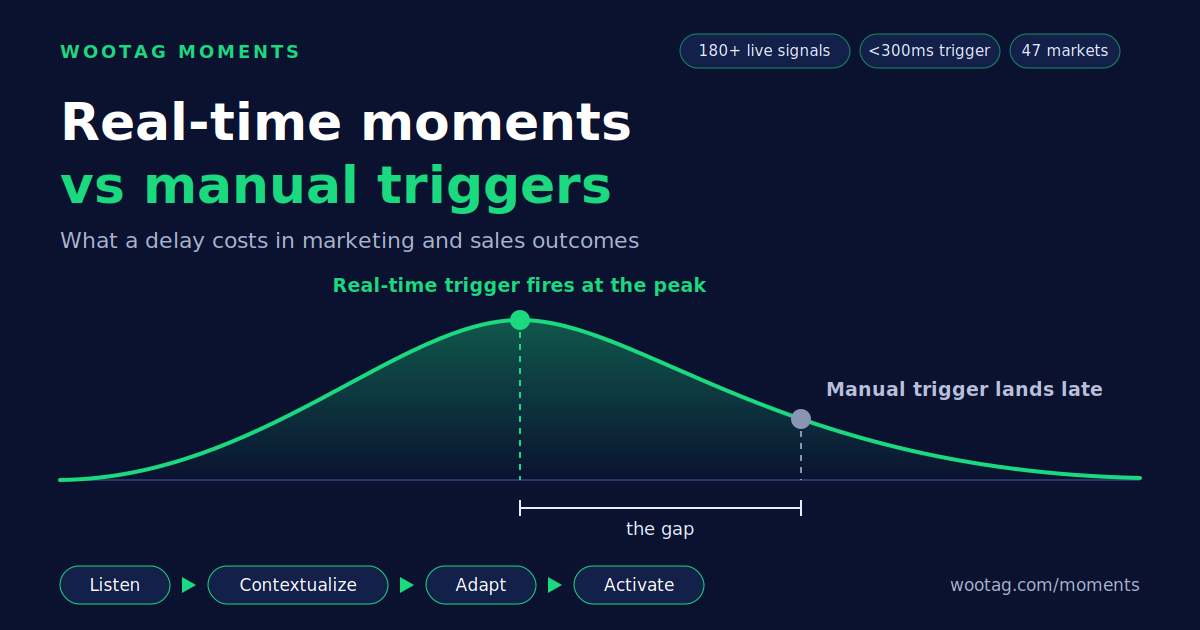

A penalty is awarded in the 78th minute. The stadium goes silent, then loud. Millions of people reach for their phones or turn to the person next to them. For the next 40 seconds, attention is at its peak.
Now picture two brands. The first has a moment ready to fire the second the referee points to the spot. The second has a smart social manager who spots the penalty, drafts a post, waits for approval, and goes live 25 minutes later. By then the match has moved on, the audience has moved on, and the post lands in a feed that has already forgotten why it mattered.
Both brands “did” moment marketing. Only one of them got the moment.
The gap is not effort, it is timing
Most teams that trigger activations manually are doing good work. The creative is sharp and the idea is right. But a moment has a shelf life, and manual workflows spend that shelf life on coordination: someone notices, someone briefs, someone approves, someone schedules.
Each step is reasonable. Together they add a delay, and that delay changes what the audience feels when they see your message. Inside the moment, it feels like the brand is in the room. After the moment, it feels like a brand commenting on yesterday.
That difference shows up in outcomes. In the moment, people engage because the message matches what they are feeling right now. Afterwards, the same creative has to work much harder for much less.
Why the gap persists
Three things keep teams stuck with manual triggers.
Moments are unpredictable in timing. A goal, a heatwave alert, a sharp market move: you know the category will happen, but not the minute. No team can sit awake for every one.
Approval chains were built for planned work. Brand and legal review make sense for a quarterly hero activation. They do not fit a window that closes in under a minute.
The cost of delay is invisible. A late post still gets some engagement, so it looks like it worked. Nobody sees the outcome they would have had if it had landed on time.
Speed decay is well documented in sales, and it is a useful parallel. A Harvard Business Review study of online sales leads found that firms attempting contact within an hour of an inquiry were nearly seven times as likely to qualify the lead as firms that tried an hour later, and more than 60 times as likely as those waiting 24 hours or more. That study is about inbound leads, not live moments, so treat it as a parallel and not a direct measure. But the principle carries over: intent is highest right when it appears, and it fades quickly. The same audit found the average business took 42 hours to respond, so the gap between the moment of interest and the moment of response is where most of the value leaks out.
What real-time changes for marketing outcomes
When a signal fires an activation the moment it happens, three things shift.
Relevance becomes structural. The creative is tied to the live event, not to a guess about the audience. A goal creative runs on a goal. A penalty creative runs on a penalty.
Spend follows attention. Instead of running one creative on loop, budget goes where the moment is. Wootag’s Valvoline activation on Connected TV triggered a matching spot for live match events, with goal, halftime, penalty and team win each getting its own message. The account reported a 99.03% average VCR and 37% cost efficiency, with penalty as the top moment.
Pre and post moments count too. The Budweiser 0.0 activation on display served creative across kick-off, goal, halftime, penalty and win. Its reported result was a 3.2x engagement uplift and 39% cost efficiency, and pre-match came out as the top moment. A manual team tends to plan for the dramatic peaks and miss the quieter windows where response is strong.
What real-time changes for sales outcomes
Marketing metrics matter, but the point of catching a moment is that intent turns into action while it is still warm.
That is where activation format matters. When a moment fires in real time, it can carry a shoppable product, a live offer, or a hyperlocal walk-in prompt, and reach someone who is still in the state of mind that made them care. Fire the same offer an hour later and the person has to rebuild the interest on their own.
Real-time also protects sales from the reverse problem: promoting something the shelf cannot deliver. When signals from stock and deals are connected, a moment can route demand to the store when stock is healthy and to a marketplace or quick-commerce partner when it is not. A manual workflow rarely has that awareness at the speed of the moment.
The advantage does not depend on the channel
None of this is tied to one platform. Whether the activation runs on social, connected TV, display, push notifications or in-app, the logic is the same: a signal is detected, context is applied, the asset adapts, and it activates. The channel is where the moment lands, not what makes it work.
That matters because teams often assume real-time is a social media tactic. It is closer to an operating model. Once the trigger is automatic, the same moment can reach people wherever they happen to be. Wootag’s four stages, Listen, Contextualize, Adapt and Activate, are built around that idea, with 180+ live signal feeds and sub-300ms trigger latency across 47 markets.
Where the gap costs the most: a vertical view
| Vertical | Moment | What a delayed manual post tends to get | What a real-time trigger can do |
|---|---|---|---|
| Beverages and F&B | Goal, halftime, penalty | A celebration post after the crowd has left | Serve the offer while people are reaching for a drink |
| Personal and home care | Heatwave, AQI spike | A weather post after the peak hours | Promote the relevant product while the discomfort is felt |
| Fintech and investing | Index swing or rally | A commentary piece a day later | Match the message to the mood as the market moves |
| Travel and mobility | Flight delay, weather disruption | A generic apology or offer, too late | Offer alternatives while people are still deciding |
| Retail and apparel | Local weather or event shift | A weekly promo that ignores the day | Surface stock that fits the day, and route to another seller when local stock is low |
Sourcing and transparency
Everything about Wootag’s platform specs (180+ live signal feeds, sub-300ms trigger latency, 47 markets) and every performance number attributed to Valvoline and Budweiser comes from Wootag’s own platform pages and case studies at wootag.com/moments and wootag.com/moments/case-studies. These are self-reported results.
Those case studies show what happened when moments were triggered in real time. They do not compare against a manually triggered version with a time gap, so they should not be read as a direct A/B measure of delay. The delay argument in this post is reasoned from how moments work and supported by adjacent research.
The third-party research cited is the Harvard Business Review lead response study (Oldroyd, McElheran and Elkington, 2011), which concerns sales lead response times. It is used here as a parallel for how quickly intent decays, not as proof about live moments.
Your next moment is already happening
The question is not whether your brand has good moments to respond to. It is how much of each one you are still there for when it lands. If your current activations depend on someone noticing, approving and scheduling, you already know the answer.
Wootag will show you a live moment built around your brand. Book a demo at and pick the signal that matters most to your category.
Real-Time Moments vs Manual Triggers: What a Delay Costs You in Marketing and Sales
