
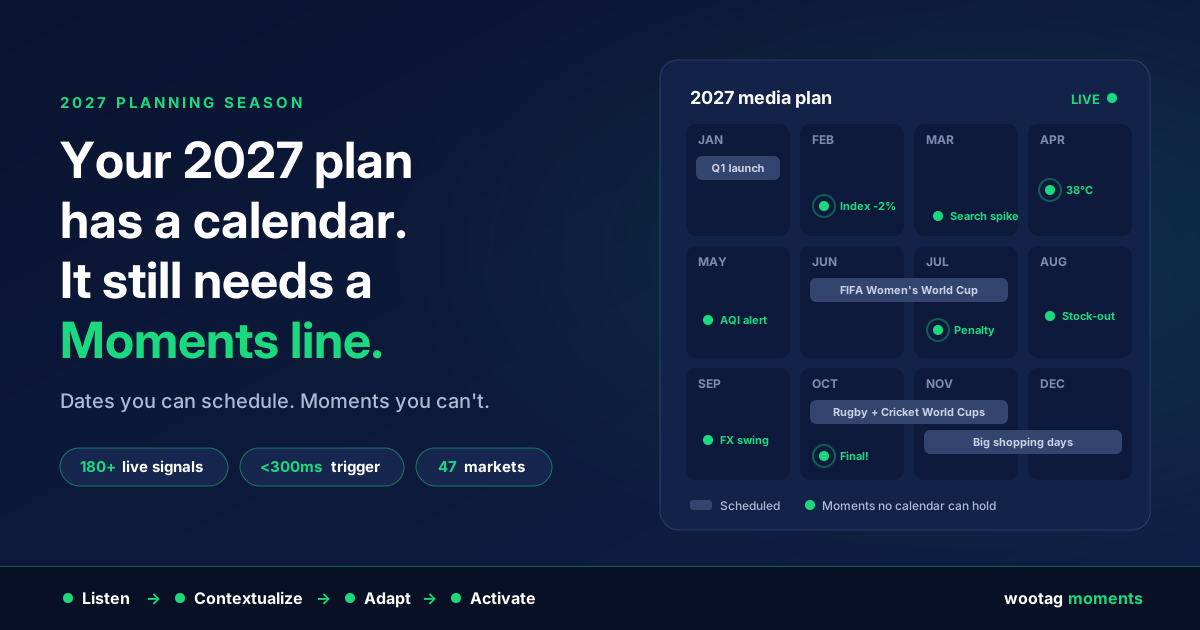

Planning season locks in the dates you can see. The moments that will move your numbers next year mostly haven’t happened yet.
Somewhere this week, a 2027 media plan is being signed off.
It has a Q1 launch. A summer push. A big shopping days block in Q4. If the brand plays in sport, it probably has a line for the FIFA Women’s World Cup in Brazil (24 June to 25 July) and another for the Men’s Rugby World Cup in Australia (1 October to 13 November), with the ICC Men’s Cricket World Cup across South Africa, Zimbabwe and Namibia landing in the same window.
Every date on that plan is known today. That is the problem.
The plan can tell you when the World Cup starts. It cannot tell you which team reaches the final, which city crosses 38°C in the second week of April, the morning the index drops two percent, or the Tuesday a search term in your category quietly triples. Those are the moments your customers actually react to. And almost none of them can be put on a calendar in October.
What the plan can see, and what it can’t
Think of next year in two columns.
What you can schedule: tournament dates, public holidays, shopping festivals, product launches, seasonal flights.
What you can’t: a goal in the 89th minute. A heatwave in one city but not the next. A market swing. A local stock-out. A rival’s price cut. A home team going out in the group stage.
Most annual plans are built entirely from the first column. The second column gets handled the way it always has: someone spots it on social, a Slack thread starts, the creative team scrambles, and by the time the post goes live the moment has moved on.
Our own case studies show how much of the value sits in that second column. When Valvoline ran live FIFA moments on Connected TV, four triggers were set up: Goal, Halftime, Penalty and Team Win. The moment that performed best was the Penalty. Nobody can schedule a penalty. You can only have a rule ready for one.
We saw the same pattern over a week of running Asian Games moments. Engagement during a medal moment ran close to 5x the average, and when a country’s athlete qualified for a final it ran between 2x and 3.5x. Not one of those medals was on anyone’s plan in January. They were in the rules.
Why annual plans keep missing these moments
It isn’t a creativity problem. It’s a structural one.
Plans are built on dates, not conditions. A flight runs from one date to another. A moment starts when something in the real world crosses a threshold. Those are different units, and most planning templates only have room for one of them.
Budget is locked into flights. Moving money mid-quarter usually means approvals, and approvals take longer than a match. Research from Google and Kantar, surveying more than 2,400 marketers, found that 31% of budget agile marketers say it is very easy to get extra budget for tests outside the original plan. Among everyone else, that figure is 9%.
Creative is produced for the flight, not for the condition. If you only have one hero film, you can only say one thing, no matter what just happened.
Nobody owns the “if this, then that” decision. The media team owns placements. The brand team owns the message. The moment falls between them.
None of this gets fixed by “being more agile” in July. It gets fixed in the plan you sign now.
What a Moments line looks like in a 2027 plan
A Moments line isn’t a separate bucket of extra spend. It’s a way of writing part of the plan as rules instead of dates. We’d suggest three layers.
Layer 1: Tentpoles, with rules inside them
Don’t buy the World Cup as one block. Break it into the moments inside it: pre-match, kick-off, goal, halftime, final whistle, team through to the final. Give each one its own message, and give the whole thing a default for when nothing is happening. The tournament is still on the calendar. What changes is that the activation now responds to what happens during it.
Layer 2: Always-on conditions
This is the layer most plans don’t have at all. Weather, air quality, markets, commodities, local stock and search trends move every week, not every four years. Decide which of them change what your customer does, set the threshold, and let the activation fire when the threshold is met. Everyuth did this with live city temperature on Meta, assembling the right creative for each viewer’s city across hundreds of weather-aware moments from a single setup.
Layer 3: Silence, written in on purpose
The most underrated line in a moments plan is the one that says don’t spend. Franklin Templeton’s activation watched the index live: a rise of 0.3% or more served a growth film, a fall of 0.3% or more served a stability film, and anything in between paused automatically. The result was 24% budget saved and zero wasted impressions. Part of a Moments line is spend you deliberately choose not to make.
Six questions to answer before the plan is signed
- Which five real-world signals actually change what our customer does?
- What threshold turns each signal into a moment worth acting on?
- What do we say in each state: up, down, win, loss, hot, cold?
- Where does each moment need to land: feed, CTV, push, retail screen, marketplace?
- What happens when nothing fires? What’s the default, and when do we stay quiet?
- How much of the budget is held to follow the rules, rather than the calendar?
If you can answer those six, you have a Moments line. If you can’t, you have a calendar.
The Moments line doesn’t belong to one channel
A rule written once should be able to fire anywhere your audience already is. The same goal, the same heatwave or the same market move can trigger a Reel, an In-Feed ad, a CTV spot, a programmatic banner, a push notification or a shoppable tile, each adapted to the format it lands in.
That’s why the decision layer sits above your channels, not inside any one of them. Your CDP, CRM, automation tools and media buys stay exactly where they are. What changes is that something is now deciding what gets said, to whom, in what tone, at what moment, and handing that decision to every channel at once.
How the Moments line maps across verticals
| Vertical | The tentpole already on your 2027 plan | The signal you can’t schedule | What the rule decides |
|---|---|---|---|
| FMCG and beverages | FIFA Women’s World Cup | Goals, results, a city heatwave | Celebration, refreshment or recovery message, by match state and local temperature |
| Personal and home care | Summer season | City temperature, humidity, air quality | Which product and which tone, city by city |
| Fintech and financial services | Financial year end | Index or currency move past a threshold | Growth story, stability story, or pause |
| QSR and food delivery | Rugby World Cup match nights | Result, kick-off time, rain | Late night bundle, rainy day delivery offer, winner’s deal |
| Travel | Long weekends and holidays | Forex move, destination weather, event announcements | Which destination, which offer, which market to push |
| Retail and apparel | Big shopping days | Local stock, sudden weather change | Which product to feature, and where to route demand when stock runs low |
| Automotive and lubricants | Racing calendar | Race and driver events, fuel price moves | Performance message tied to what just happened on track |
| Telecom and streaming | Cricket World Cup | Match moments, viewing spikes | Data pack or upgrade offer at peak attention |
Sources and transparency
Wootag platform claims (self-reported): 180+ live signal feeds, 100+ signal categories, sub-300ms trigger latency and 47 live markets are from wootag.com/moments. Case study results for Valvoline, Everyuth and Franklin Templeton are self-reported by Wootag on wootag.com/moments/case-studies. The Asian Games engagement multiples are Wootag’s own observation from one week of live activations and should be read as directional, not as a benchmark.
Third-party research: The 31% vs 9% budget agility figure is from Google and Kantar’s survey of more than 2,400 marketers worldwide (Think with Google, “Budget agile”). Kantar’s separate research with 575 senior marketers across eight countries found that 90% of leading marketers set aside budget for experimentation during planning, compared with 67% of average marketers.
Event dates: 2027 tournament dates are taken from publicly listed sporting calendars and may be subject to final confirmation by the organisers.
Before your plan locks
Your calendar is almost finished. Leave room in it for the moments that haven’t happened yet.
Tell us the signals that matter most in your category, and we’ll show you a live moment built on your brand in 20 minutes, along with what a Moments line could look like inside your 2027 plan.
