

A goal goes in during the 78th minute. A brand’s CTV spot is still playing the same 30 second cut it played in minute one. The ad isn’t wrong. It’s just not there yet, emotionally, with the person watching.
That gap, between what creativity intends to feel like and what it actually lands as, is the subject of a recent Campaign India interview with Arnaud Debia, Ipsos’ global creative development director. His research is blunt about it: unconventional, break the mould advertising delivers a 20 percent uplift over category codes, but only when it’s paired with empathy. Creativity on its own doesn’t reliably move the needle. And AI, for all the speed it brings to producing variations, cannot identify the human tension that makes an idea credible in the first place. It can generate novelty. It cannot generate relevance.
That distinction is worth sitting with, because most brands are currently investing heavily in the half of the equation that AI is good at.
The gap: empathy is treated as a briefing input, not an operating capability
Ask most marketing teams if empathy matters to their creative and every one of them will say yes. It shows up in the brief. It shows up in the persona deck. It shows up in the post-campaign case study language, “we connected with our audience at a human level.”
But ask the same teams what their creative actually knew about the person’s day, hour, or moment when it was served, and the honest answer is usually nothing. The same ad ran whether it was raining or clear, whether the local team had just won or lost, whether the market had just moved 2 percent or stayed flat. Empathy was designed into the concept and then abandoned at delivery, because delivery infrastructure has no way to act on it.
This is the real gap Debia’s research is pointing at. Empathy isn’t a mood a creative team feels while writing a brief. It’s an accurate read of what’s happening in someone’s actual life at the moment a brand shows up in it. That read either exists as a live, structured signal the activation can respond to, or it doesn’t exist at all, no matter how empathetically the storyboard was written.
Why the gap persists
Two forces are widening this gap right now, not closing it.
First, AI-generated creative is genuinely good at producing volume and novelty fast. That’s real and useful. But volume solves a production problem, not a relevance problem. A hundred AI-generated variants of an ad that still doesn’t know what’s happening around the viewer is a hundred versions of the same miss.
Second, the systems most brands use to “personalize” are built on historical and declared data, past purchases, stated preferences, demographic segments. That’s useful for targeting who to reach. It says nothing about what’s true for that person right now. Empathy, the kind Ipsos is describing, is inherently present tense. It requires knowing the temperature outside someone’s window, the score of the match they’re watching, the direction the index just moved, not who they were six months ago.
Most martech stacks were never built to close that gap. They weren’t built to listen.
Empathy has to travel wherever the moment is happening
This is also why empathetic creative can’t be a single channel decision. The moment that creates real human tension, a goal scored, a heatwave breaking, a market swing, doesn’t happen on one platform. It happens in someone’s life, and their attention moves across CTV, Meta, push notifications and TikTok inside the same hour. If the empathetic read of the moment only reaches one of those surfaces, the activation is empathetic in theory and generic everywhere else the person actually is.
That’s the argument for treating context as infrastructure rather than a campaign feature: a layer that listens for the signal, understands what it means for that audience, and pushes the matching creative out wherever attention currently sits, rather than a one-off execution built for a single channel and a single moment.
What “human tension” looks like as a live signal, by vertical
| Vertical | The human tension Debia is describing | The live signal that makes it real |
|---|---|---|
| Automotive & lubricants | The emotional stakes of a live match, tied to performance and endurance | Goal, halftime, penalty and match result events |
| Personal care & FMCG | Physical discomfort from heat, humidity or pollution | Live local temperature and air quality by city |
| Fintech & wealth | Anxiety or opportunity tied to market movement | Real time index and stock price change |
| Travel & mobility | Weather disrupting or enabling plans | Local weather and forecast shifts |
| Retail & QSR | Immediate cravings or needs tied to conditions or events | Weather, local events, footfall and stock signals |
Sourcing transparency
The 20 percent uplift figure and the observation that AI can produce novelty but not identify human tension come from Ipsos’ research, as reported by Arnaud Debia in Campaign India. Separately, Ipsos’ own Cannes 2026 analysis found that creative concurrently strengthening brand resonance, credibility and relatability can deliver up to 32 percent greater effectiveness, a related but distinct finding worth citing on its own terms.
The Valvoline example above reflects a real Wootag Moments activation: live FIFA match events (goal, halftime, penalty, team win) triggering matching CTV creative in real time, delivered through the Moments platform, with a 99.03 percent average VCR and 37 percent cost efficiency gain, self reported by Wootag. These are two separate claims from two separate sources and are presented as such.
The point
Creativity doesn’t fail because writers stop empathizing. It fails because the systems delivering that creativity have no way to know what’s actually happening to the person on the other end of it. Empathy that doesn’t travel with the activation, in real time, across every surface someone’s attention touches, isn’t empathy. It’s a nice sentence in a brief.
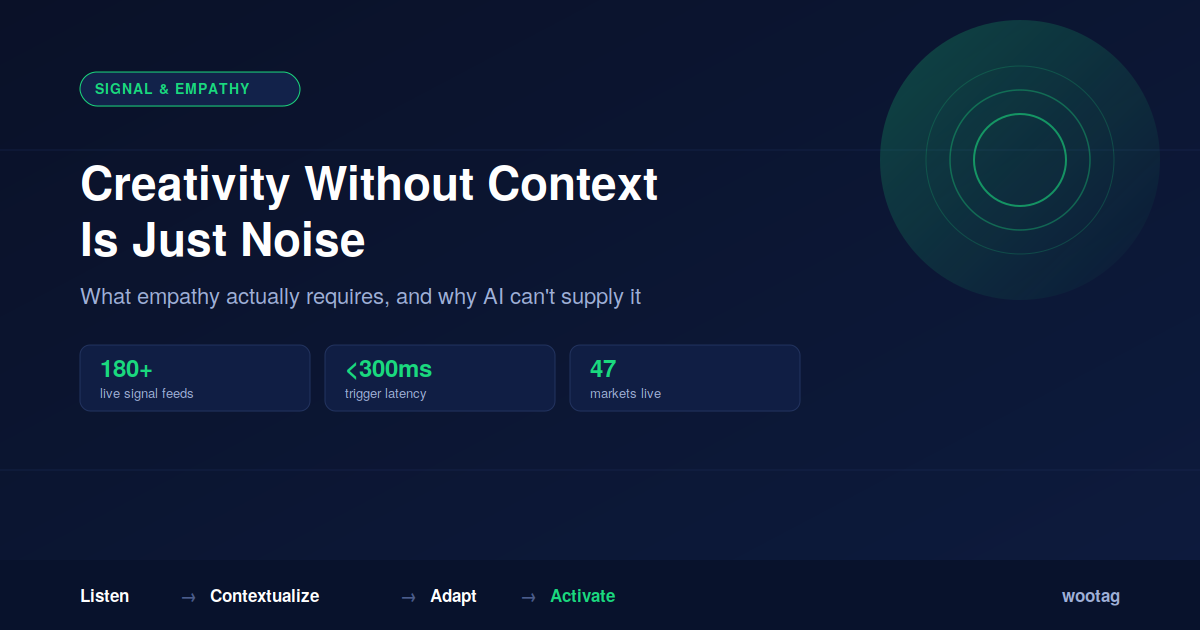
Wootag Moments exists to close exactly that gap, listening for the real world signal, contextualizing what it means, adapting the message, and activating it wherever the moment is unfolding. If your creative is empathetic on paper and generic in market, that’s an infrastructure problem before it’s a creative one.
Book a demo to see how Moments OS turns live signals into activations that actually meet people where they are.
