
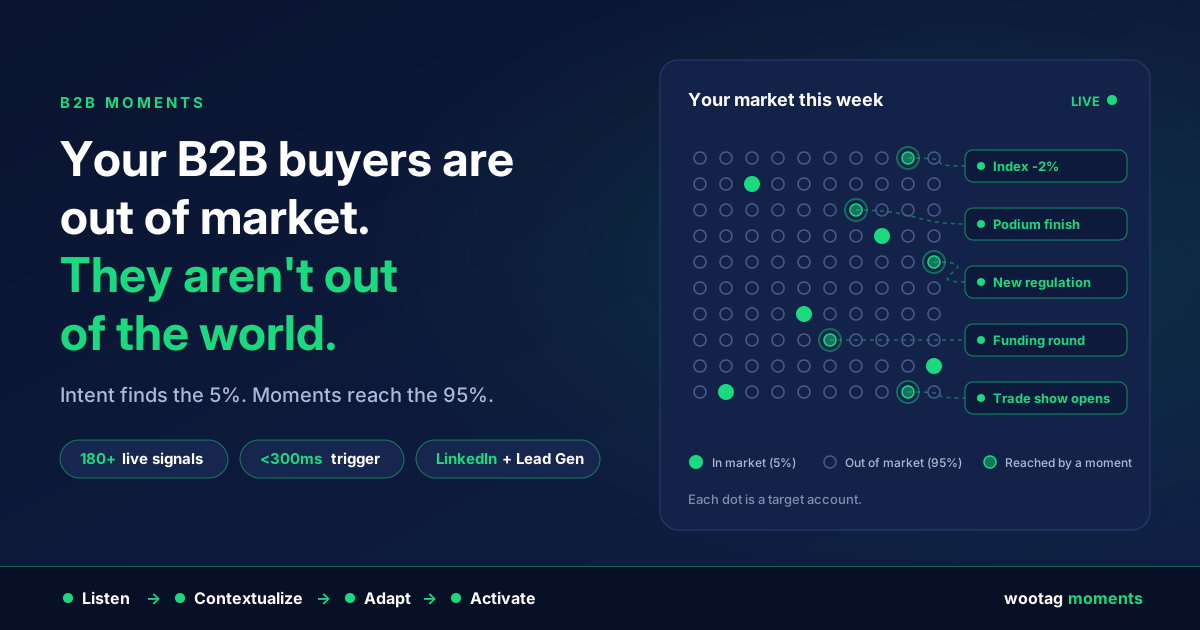

Intent data tells you who is ready to buy this quarter. Real-world moments decide whether you are remembered by everyone else.
It’s Sunday night, and the Asia Pacific CFO you’ve been trying to reach for two years is watching the final round of a golf major your company sponsors. Monday morning the index opens down 2%. On Wednesday her industry’s regulator publishes a new reporting deadline. On Friday her company announces a hiring freeze.
That’s four moments in one week, and she noticed every one of them.
Your brand showed up in none of them. Her account isn’t “in market”, so it isn’t on this quarter’s target list, so nothing fired.
Most B2B marketing works like this. Plenty of teams are good at finding buyers who are ready to buy. Very few are built to stay relevant to the much larger group who aren’t ready yet.
The 95% you’re not talking to
The LinkedIn B2B Institute, working with Professor John Dawes of the Ehrenberg-Bass Institute, put a number on this. At any given time, only about 5% of B2B buyers are in market. The other 95% are not planning to buy in the near future. Their example: if companies switch business banks roughly once every five years, then only about 20% are likely to be in market over the next year, and only around 2% over the next month.
The 95% still matter, though. They are next year’s shortlist.
Research from 6sense shows how early that shortlist forms. In its 2025 B2B Buyer Experience Study, based on nearly 4,000 buyer responses, 94% of buyers had already ranked their shortlisted vendors by preference before contacting any of them. On average, buyers were 61% of the way through their buying process when they first reached out to a seller.
So the deal is mostly decided before anyone fills in a form. What decides it is which brands the buyer kept noticing during the long stretch when they weren’t buying.
Why B2B keeps missing these moments
The stack is built for the 5%. Intent platforms, lead scoring and ABM tools are very good at answering one question: which accounts are showing buying behaviour right now? That is valuable. But it means the rest of the market gets the same generic always-on ad on repeat.
The B2B calendar is planned around your own dates. Product launches, events, webinars and quarter-end pushes are all things you control. Your buyer’s week is shaped by things you don’t control: markets, news, regulation, sport, hiring, weather affecting operations.
Sponsorships go quiet between hero moments. Plenty of B2B brands spend serious money on F1, golf, tennis, sailing or rugby. Most of that value gets used on hospitality and a handful of planned posts. The live moments during each event (a lead change on the final day, a podium, a team win) come and go without the brand saying anything.
Speed breaks the approval chain. In B2B, anything that goes out usually passes through brand, legal and regional teams. That process can’t keep up with an index move or a final-round leaderboard. So teams don’t try.
Two kinds of signals, two different jobs
“Signal orchestration” has come to mean B2B intent signals, and that is a legitimate category. We’d argue there are two kinds of signal, and they do different jobs.
| Intent signals | Real-world moments | |
|---|---|---|
| The question it answers | Who is likely to buy now? | When is my buyer paying attention, and what should I say? |
| Audience | The roughly 5% in market | Everyone you want on next year’s shortlist |
| Typical signals | Website visits, content consumption, review site activity, technographics | Markets, industry news, regulation, events, sport, firmographic changes like funding or headcount |
| What it drives | Prioritised outreach, account scoring, sales plays | Relevant communication at the moments buyers are already paying attention to |
| Lives in | CRM, ABM and sales tools | Above your channels, deciding the message each one gets |
You don’t have to pick one. Intent data decides which accounts deserve attention. Real-world moments decide what you say to them, and to the wider market, so that when an account does come into market your brand is already one it knows.
What a B2B moment actually looks like
A B2B moment is a rule. Something changes in the world, it crosses a threshold you’ve set, and the communication changes to match. Some examples:
Market moments. An index moves sharply, a currency swings or a commodity spikes. A treasury platform, a payments provider or a wealth manager shifts from a growth story to a resilience story. If the move is too small to matter, nothing fires.
Sponsorship moments. Your sponsored driver finishes on the podium, your golfer leads after round three, your sailing team wins a race. The LinkedIn ad, the Company Page post and the client hospitality invite all update while people are still talking about it.
Industry and regulatory moments. A compliance deadline is announced, a standard is updated or an industry report lands. Your messaging moves to the problem your buyer just started worrying about.
Firmographic moments. A target account raises a round, opens a new market or grows its headcount. That’s a reason to show them how others managed the same stage.
Event moments. Your category’s biggest trade show opens, or a keynote makes the news. You turn up in the feeds of people following it, not only the ones walking the floor.
Workforce moments. For HR, collaboration and productivity software, employee trends and big sporting weeks are when people talk about how work gets done. One of the first B2B accounts we work with, an enterprise software brand, runs sports and workforce-trend moments across several Asia Pacific markets.
All of them follow Listen → Contextualize → Adapt → Activate. Wootag listens to the signal, works out what it means for this audience, adapts the creative to each format, and activates across channels in under 300 milliseconds from the trigger.
The outcomes are different, and that’s fine
Consumer moments usually end at a cart. B2B moments don’t, and they shouldn’t pretend to.
In B2B, the moment drives awareness among the 95%, visits to your site, Lead Gen form completions, demo bookings, event and hospitality RSVPs, and more meetings booked by sales after the moment. On LinkedIn, sponsorship hospitality and VIP offers triggered by a moment can be routed straight into your CRM, so marketing and sales are looking at the same pipeline.
For sponsorships, it also gives you a clearer way to measure return. Our LinkedIn integration uses a simple model: influenced pipeline × win rate × gross margin, divided by rights fee plus activation plus media. That turns sponsorship from a brand-line cost into something you can report against pipeline.
Channel-independent by design
A moment shouldn’t belong to one platform. The same trigger can update a LinkedIn Single Image, Video, Lead Gen or Dynamic ad, a Company Page post, a programmatic banner, a CTV spot, an email or push sent through your customer engagement platform, and the talking points your sales team uses that week.
Your CRM, marketing automation, ABM platform and media buying stay exactly where they are. The orchestration layer sits above them and decides what is said, to whom, in what tone, and at what moment, then passes that decision to every channel at once. Approved variants are built in advance, so speed no longer means skipping governance.
Where B2B moments fit by segment
| Segment | Signal that matters | The moment | Where it runs | B2B outcome |
|---|---|---|---|---|
| Enterprise SaaS | Sponsored event results, industry news | Podium or final-round message tied to your sponsorship | LinkedIn ads, Company Page, client hospitality | Awareness, event RSVPs, meetings |
| Banking, treasury and payments | Index, currency and rate moves | Resilience or opportunity story by direction of move | LinkedIn, programmatic, email | Site visits, advisor or demo bookings |
| Cybersecurity | Major breach news, regulatory deadlines | Readiness message as the news breaks | LinkedIn Lead Gen, search, programmatic | Assessment requests, demo bookings |
| HR and workplace tech | Workforce trends, big sporting weeks | Productivity, wellbeing or team culture message | LinkedIn, CEP, email | Content downloads, trials |
| Logistics and supply chain | Port disruption, fuel prices, severe weather | Continuity and reliability message by region | LinkedIn, programmatic, account emails | Quote requests, sales meetings |
| Professional services | Earnings season, policy changes, funding rounds | Point of view tied to the change | LinkedIn thought leadership, email | Briefing registrations, partner meetings |
| Cloud and infrastructure | Major tech events, outage news, launches | Reliability and scale message in context | LinkedIn, programmatic, CTV | Site visits, architecture consultations |
Sources and transparency
Wootag platform claims (self-reported): Sub-300ms trigger latency, 180+ live signal feeds and 47 live markets are from wootag.com/moments. LinkedIn ad formats, B2B signal types, CRM routing of hospitality offers and the sponsorship ROI model are described on wootag.com/moments/linkedin. That page also reports a 2.9x engagement uplift, 3.4x lead quality and 34% lower cost per qualified lead. These are Wootag’s own figures and the page does not publish the methodology or baseline behind them. The enterprise software account mentioned above is a live Wootag customer and is not named here.
Third-party research: The 95:5 rule comes from the LinkedIn B2B Institute’s work with Professor John Dawes of the Ehrenberg-Bass Institute, as reported in Marketing Week. The 94% preference ranking and 61% figures are from 6sense’s 2025 B2B Buyer Experience Study, based on nearly 4,000 buyer responses.
Stay on the shortlist
The buyers who will sign next year are watching markets, sport, news and their own industries this week. Intent data will tell you when they’re ready to buy. Moments make sure your brand is already on the shortlist when they are.
Tell us the signals your buyers care about, and we’ll show you a live B2B moment built on your brand in 20 minutes.
Your B2B Buyers Are Out of Market. They Aren't Out of the World.
