

The ad did its job. The shelf didn’t.
A shopper sees a sharp ad for a new pack size, likes it, and walks to the store down the road. The pack isn’t there. The shopkeeper shrugs and points at a rival brand that is.
On paper, that activation worked. It reached the right person, it got attention, it probably even drove the visit. In reality, it just paid to send a customer to a competitor.
This is the quiet leak in most retail and FMCG marketing. Media is planned around audiences. Sales happen around shelves. And the two rarely talk to each other in real time.
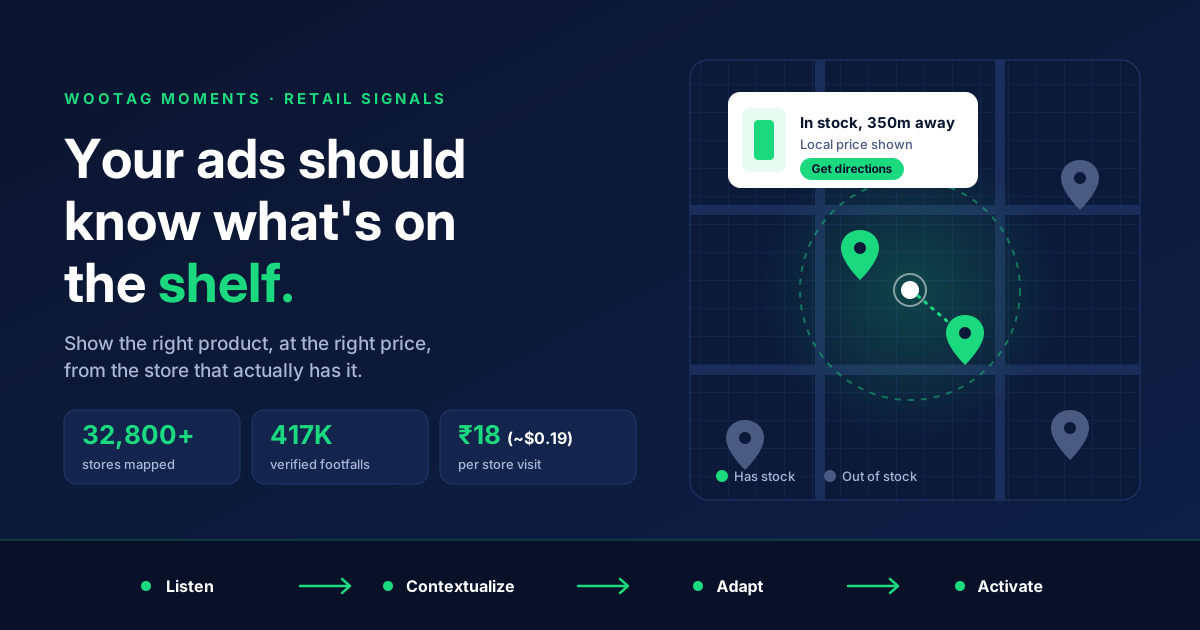
Retail Signals on Wootag Moments is built to close that leak. It connects what is actually sitting in a specific store, at a specific price, right now, to what a shopper near that store gets shown.
Media knows the audience. It doesn’t know the shelf.
Most activation stacks are very good at one question: who should see this? Age, interests, past purchases, lookalikes, geography. They are close to blind on a second question that matters just as much for anyone selling through stores: can this person actually buy it nearby, today, at the price we’re showing?
That blind spot is expensive. A 2026 study of 3,000 consumers by TELUS Consumer Goods found that 45% will switch to a different brand when the product they want is out of stock. A separate US survey by DOSS found that 62% of shoppers have already switched brands because of a stockout.
Read those numbers from the brand side. Every activation that pushes a shopper toward a store without the product is not neutral spend. It is spend that can hand the sale, and sometimes the habit, to whoever is sitting next to you on the shelf.
The same problem shows up in quieter ways too:
- A promo price shown in an ad that the local store isn’t running.
- A hero SKU pushed nationally while half the neighborhood stores are carrying last season’s pack.
- A store locator that sends people to the nearest outlet, not the nearest outlet that has stock.
- Creative in one language for a country where people shop in a dozen.
Why this gap has stuck around
Nobody in marketing thinks stock and pricing don’t matter. The gap persists because the data lives in the wrong place.
Store data sits with sales and supply chain. Inventory, pricing and store lists live in ERP systems, distributor feeds and retail partner portals. Marketing usually sees a weekly spreadsheet, if that.
Ad platforms were never built to read it. Meta, TikTok, programmatic and push all understand audiences and locations. None of them natively know that store number 4,112 ran out of the 500g pack yesterday afternoon.
Measurement rewards the wrong thing. Clicks, views and reach all look healthy even when the shopper ends up at an empty shelf. The leak never shows up in the dashboard, so it never gets fixed.
Hyperlocal at scale feels like a manual job. Mapping thousands of outlets, each with its own stock, price and language, sounds like an army of trade marketers with spreadsheets. So most brands default to national creative and hope the shelves keep up.
None of these are creative problems. They are plumbing problems. And plumbing is exactly what a signal layer is for.
What Retail Signals does
Retail Signals turns your own store network into a live signal source, the same way Wootag Moments already listens to weather, sports and markets. Stores, locations, stock levels and prices flow into the platform. Every activation then checks that data before it decides what to show, and to whom.
In practice, a shopper near a store sees the product that store actually has, at the price that store is actually charging, with directions to that counter. If the hero SKU is out, the activation can switch to a sister product that is in stock, or quietly stop spending in that catchment until the shelf is refilled.
It plugs straight into the Listen, Contextualize, Adapt, Activate flow:
- Listen: read store, product, stock and price data from your systems.
- Contextualize: match each shopper’s location to the nearest stores that can serve them.
- Adapt: pick the right product, price, offer and language for that store and that person.
- Activate: deliver it across social, programmatic, push and the rest of your channels.
How setup works
The setup lives in five steps inside the platform. Most teams get through the first two in a working session.
- Integrate with your retail store. Choose how Moments reads your catalogue. There are three options, and you can run more than one at the same time:
- API: a realtime pull from your commerce endpoint, syncing every 5 minutes with OAuth or bearer token auth.
- Database: a direct read replica connection using read only credentials for Postgres, MySQL, Snowflake or BigQuery.
- CSV: a scheduled flat file drop, uploaded manually or picked up from an SFTP or S3 bucket.
- Map your locations. Import the pincodes your stores serve by typing, pasting or uploading a file. The platform validates them before anything goes live, so a typo doesn’t quietly switch off a neighborhood.
- Configure a signal. Set the rules that matter to you. For example, only promote a SKU where stock is above a threshold, show the local price, or swap to an alternate product when inventory runs low.
- Review active configurations. See every live rule in one place, so trade marketing, brand and media teams are all looking at the same logic.
- Activate on location hotspots and programmatic. Point spend at the catchments where stock, price and demand line up, and let programmatic activations follow those hotspots as they shift.
The point of this design is that nobody has to rebuild their stack. Retail Signals reads from systems you already run and feeds the channels you already buy.
In the field: Tata Consumer Products
Tata Consumer Products used Retail Signals to drive 417K verified store footfalls at ₹18 (about $0.19) per visit.
The brief was simple to say and hard to do: get people into neighborhood stores, not just onto a landing page. India’s everyday purchases still run through small local outlets, and each of those outlets has its own stock, its own catchment and often its own language.
Here’s how the deployment was set up:
| What they did | Why it mattered |
|---|---|
| Mapped 32,800+ neighborhood stores into Retail Signals | Every shopper could be matched to a real nearby counter, not a generic city target |
| Delivered creative in each area’s local dialect | The message sounded like it came from the neighborhood, not head office |
| Guided shoppers right to the counter | The activation ended at a store that could serve them, not a store locator |
| Tracked verified store visits, not clicks or views | Success was measured where the sale actually happens |
| Reallocated spend every two weeks based on what worked | Budget kept moving toward the catchments and stores that were converting |
The two week reallocation is the part worth copying. Most brands set a hyperlocal plan at launch and leave it running. Tata treated store visits as a live signal of their own, and kept moving money toward the places that were proving it.
The result: 417K verified footfalls at ₹18 (about $0.19) a visit. No vanity metrics in that number. Every one of those is a person who walked into a store.
It isn’t tied to one channel
Stock and price are facts about a store. They don’t belong to any single media platform, so the logic that reads them shouldn’t either.
That’s why the decision sits in a layer underneath your channels. The same rule, say “only promote the 1kg pack where at least 20 units are on hand”, can steer a social ad, a programmatic display unit, a push notification and a CTV spot at once. Change the rule once and every channel follows.
It also means your stack stays your stack. Your CDP, CRM, automation tools and media buying setup keep doing what they do. Retail Signals simply gives them one more thing they never had: a live view of what each store can actually sell.
And because Retail Signals is one module, not a prerequisite, brands can use it on its own or combine it with public signals. A heatwave plus a well stocked cooler at the corner store is a far better moment than either one alone.
Where Retail Signals fits by vertical
The pattern travels well beyond packaged foods. Anywhere a sale depends on what one specific store has on hand, the same logic applies.
| Vertical | Retail signal to read | What the activation does |
|---|---|---|
| FMCG and packaged foods | SKU stock by neighborhood outlet | Promotes only the packs each kirana or convenience store carries, in the local language |
| Home and personal care | Stock plus local promo pricing | Shows the store’s actual offer price and swaps to an in stock variant when needed |
| Beverages | Chiller stock by store | Pairs a hot day with the nearest outlet that has cold stock |
| Apparel and footwear | Size and colour availability by store | Pushes the styles each store can actually fit, and routes to online when sizes run out |
| Consumer electronics | Model stock and demo availability | Sends shoppers to stores with the model in stock and on display |
| QSR and food service | Outlet hours, menu availability | Promotes items each outlet is serving right now, and pauses closed outlets |
| Pharmacy and wellness | Product availability by outlet | Points people to the nearest outlet that has the product, without wasted trips |
A note on sources
We keep our own numbers and independent research separate, so you can judge each on its own.
Wootag platform and customer data. Retail Signals setup options (API sync every 5 minutes, read replica database connections, CSV via SFTP or S3, pincode import) describe the product as it ships today. The Tata Consumer Products results (32,800+ stores mapped, 417K verified footfalls, ₹18 or about $0.19 per visit, two weekly spend reallocation) are from that customer deployment and are self reported. The USD figure uses a rate of roughly ₹96.5 to the dollar (mid 2026) and is approximate. Platform figures such as 180+ live signals and sub 300ms trigger latency are from wootag.com/moments.
Independent research. The 45% brand switching figure comes from the TELUS Consumer Goods 2026 Food and Beverage Study of 3,000 global consumers, published as a partner feature in The Grocer. The 62% figure comes from a DOSS survey of 1,000 US consumers, reported by Chain Store Age. Both are vendor led surveys, so treat them as directional rather than definitive.
See it on your own store network
If you sell through stores, every activation you run is already making a promise about what’s on the shelf. Retail Signals makes sure that promise holds.
Bring us your store list, or even a single region’s pincodes. We’ll show you what a stock aware, price aware activation looks like on your catalogue, and where your current spend is sending people to empty shelves.
Retail Signals: Your Ads Should Know What's on the Shelf
