
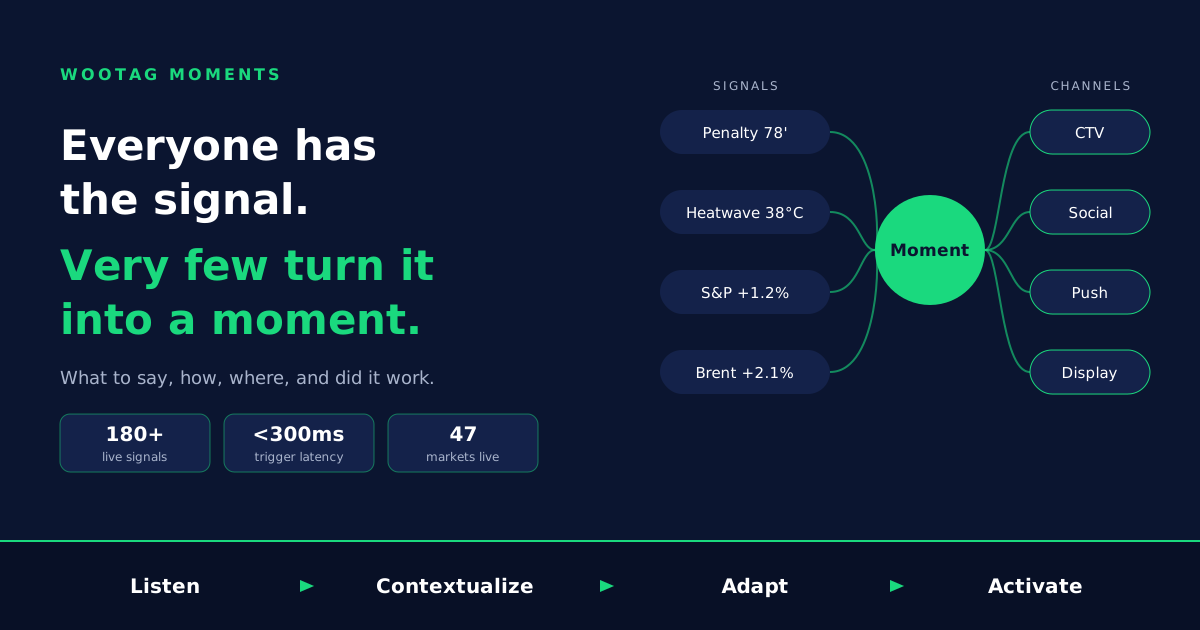

Signal providers tell you something happened. Orchestration decides what your brand does about it, and whether it worked.
In short
- Live signals on sports, weather, markets and commodities are available from many providers, but they are scattered across separate contracts, APIs and formats. Available is not the same as usable.
- Wootag’s Moments Marketplace brings those signals into one catalogue, so brands get the source and the orchestration in one place instead of stitching providers together.
- The value then sits in six decisions that come after the signal: what to do, how fast, what to say, in what format, on which channel, and whether it moved a business outcome.
It is the 78th minute. A penalty is awarded.
Within seconds that event is sitting on a dozen data feeds. Sports data companies have it. Broadcasters have it. Betting apps have it. Your social listening tool probably flagged it before the player even placed the ball on the spot.
So here is the harder question. What did your brand do in that moment?
For most brands the honest answer is nothing. Not because they missed the signal. They had it. Nothing in their stack was set up to act on it.
The signal is not the scarce part anymore
A few years ago, getting a reliable live feed was real work. Today it is a procurement decision. Weather APIs, live match data, index tickers, crude and gold prices, fuel rates, air quality readings. Every category has several providers, competitive pricing and decent uptime.
The research backs this up from the other side. In a December 2025 survey of 366 marketing leaders by eClerx, only a quarter said their marketing investments are driven by unified, real-time data. Nearly half said they do use data, but it is fragmented across systems and teams. Gartner has found that recommendations from marketing analytics get rejected 76% of the time.
Read those numbers together and a pattern shows up. Marketers are not short of data. They are short of a way to turn it into action while it still matters.
A signal on its own is a fact. “It is 38°C in the city.” “The S&P is up 1.2% today.” “Penalty awarded.” None of these facts sell anything, build any preference or bring anyone closer to a brand. They only become useful once somebody, or something, decides what to do with them.
Available is not the same as usable
There is a catch in “every category has several providers.” It means every category has a different provider.
Your match data comes from one company. Weather from another. Index and commodity prices from a third. Air quality, fuel rates, festival calendars and search trends each sit somewhere else. Every one of them comes with its own contract, its own API, its own data format, its own update frequency and its own definition of what counts as an event.
So a brand that wants to react to a goal, a heatwave and a market dip in the same quarter is not really buying three signals. It is signing three vendor agreements, building three integrations, cleaning three data formats and maintaining three pipelines. Then it has to work out how to combine them, because the most useful moments rarely come from one signal alone. A hot afternoon on a match day. A rainy weekend when a product is in stock at the nearest store. A falling index on the morning a fund launches.
This is where most real-time ambitions quietly stall. The data team gets one feed live, the use case works, and then the second and third signals sit in a backlog because each one is a fresh engineering project.
Wootag approaches this from the source side as well as the orchestration side. The Moments Marketplace is a single catalogue of ready-to-use signals across 27 signal families: sports and live play, weather and environment, markets and money, places and movement, culture and calendar, commerce and conversation, social and search trends, retail and stock, with more being added. Brands pick the signals that matter to their category instead of procuring them provider by provider.
And when the signal a brand needs is its own, such as store stock, pricing or a proprietary data feed, it can be connected as a custom signal with brand-specific triggers and thresholds, and sit right alongside the public ones.
That changes the starting point. A signal from the Marketplace does not arrive as raw data waiting for someone to wire it up. It arrives already connected to the rules, assets and channels that turn it into a moment. Combining a weather reading with a match event and a stock level becomes a rule you set, not an integration you build.
So the advantage is not just better orchestration. It is having the signals and the orchestration in the same place, which is what makes acting on more than one signal realistic in the first place.
Six questions a signal cannot answer for you
Every signal arrives with the same six questions attached. The provider answers none of them. This is where the real work, and the real value, lives.
1. What do you want to do with it?
Not every signal deserves a response. Some deserve a celebration, some a reassurance, some an offer, and some deserve silence.
Franklin Templeton’s activation on Wootag Moments is a good example of this. A rise of 0.3% or more in the Sensex triggered a growth-led film. A fall of 0.3% or more triggered a stability-led film. Anything in between and the activation paused on its own. No ad served, no budget spent on a day when the market had nothing to say. Deciding not to act was as deliberate as deciding to act, and it saved 24% of the budget.
2. How quickly do you need to react?
Every moment has a shelf life. A goal is hot for a few minutes. A heatwave lasts days. A market dip might matter for an afternoon. Your reaction speed has to match the half-life of the moment.
If your brand responds to a goal the next morning with a post that went through three rounds of approval, you have not joined the conversation. You have commented on it after everyone left. This is why trigger speed is measured in milliseconds on Wootag Moments, with signals turning into live brand experiences in under 300ms.
3. What do you want to say?
This is the question most teams skip, and it is the one that matters most. A signal changes the context. The context should change the communication, not just the creative.
The same goal means joy to one set of fans and heartbreak to another. The same rainy morning can be a reason to order in, a reason to buy a raincoat or a reason to check your car’s engine oil. What you say, to whom, and in what tone should follow from the signal and the audience together. Creative is one output of that decision. It is not the decision itself.
4. In what form should it reach people?
Text, image, audio or video. Each has a job.
A push notification is text and it works when someone has a few seconds. A connected TV break is video and it works when someone is leaning back on the couch. A vertical story is short video built for a thumb. An audio spot on a streaming app reaches people who are not looking at a screen at all. And within video alone, the same message has to live in 9:16, 1:1 and 16:9.
Building every variation by hand for every signal is impossible. Adapting assets automatically to the right format, message and size is what makes moments practical at scale.
5. Where should it land?
A signal is not a moment until it reaches a person in the right state of mind. That means picking channels by where the moment psychologically lands, not by where the media plan happens to have budget.
Social feeds on Meta and TikTok. Professional audiences on LinkedIn. Owned audiences through push and customer engagement platforms. The big screen through CTV and OTT. Open web through programmatic display and video. Retail screens and shoppable placements when the goal is a transaction. One signal can and often should fire across several of these at once, each with a version built for that space.
6. Did it actually help your business?
This is the question that separates a clever stunt from infrastructure. If you cannot tell which moment worked, you cannot do more of it.
Valvoline ran live FIFA moments on CTV: Goal, Halftime, Penalty and Team Win, each with its own spot. The activation averaged a 99.03% video completion rate with 37% cost efficiency, and Penalty came through as the top performing moment. Budweiser ran the same idea for Budweiser 0.0 on programmatic display with live scorelines, and saw a 3.2x engagement uplift with 39% cost efficiency. Their top moment was Pre-Match.
Notice what those results tell you beyond the headline numbers. Valvoline’s best moment and Budweiser’s best moment were different. That is not a coincidence. It is learning you can only get when every moment is measured on its own, and it tells you exactly where to put more weight next time.
Outcomes also depend on who you are selling to. For a consumer brand, success might be engagement, store visits or sales. For a B2B brand, it is more likely to be site visits, leads and demo bookings. The point is to define the outcome before the signal fires, then measure against it.
Why most brands stop at the signal
If the value is so clear, why do so few brands get past the data feed?
Signals are scattered. Each new signal is a new vendor and a new integration, so most brands never get past their first one or two.
Stacks are built for planned activations. Most marketing systems assume you know weeks in advance what you will say and when. Live moments do not wait for a calendar.
The decision is spread across teams. The data team owns the feed. The creative team owns the assets. The media team owns the channels. Analytics owns the report. Each part works. Nobody owns the moment from end to end.
Creative is built once. One hero asset, approved weeks ago, playing on loop no matter what is happening outside.
Measurement happens at the wrong level. Results get reported for the whole activation, so a brilliant penalty moment and a flat halftime moment get averaged into the same number.
The first is a sourcing problem. The rest are orchestration problems. Solving only one of them still leaves you stuck.
What orchestration actually means
A signal provider sells you the event. An orchestration platform takes that event and carries it all the way to a person, and then back to a result.
On Wootag Moments, that happens in four steps.
Listen. Pick signals from the Moments Marketplace, or connect your own, and detect the moments that matter to your category across 180+ live feeds.
Contextualize. Apply your rules. Which signal, which threshold, which audience, which market, and which message fits. This is also where compute comes in: looking at growth over different time windows or how volatile an index has been, which creates moments a single signal reading simply cannot.
Adapt. Reshape assets automatically for the right format, message and channel, across text, image, video and audio.
Activate. Fire across social, CTV, programmatic, push and commerce placements, and measure every moment on its own.
Importantly, this layer sits beneath the tools you already use. Your CDP, CRM and engagement platform stay in place. Orchestration feeds them better reasons to talk to people, at better times, with better words.
So what is a moment, really? It is a signal, plus a decision, plus a message delivered to a person when they are most likely to care. Remove any one of those three and you are back to a data point.
The channel will change. The decision layer should not.
Channels come and go. Algorithms shift, ad formats get retired, new platforms pull attention away from old ones, and audience behavior moves faster than any annual plan.
If the logic of when and what to communicate is built inside one channel’s tools, you rebuild it every time that channel changes or a new one appears. If that logic lives in an independent decision layer, every channel simply becomes an output. Adding a new one means plugging it in, not starting over.
That is the difference between a feature and infrastructure. Features belong to a channel. Infrastructure outlives them.
How this maps across categories
| Category | Signal | Decision | Format | Where it lands | Outcome to measure |
|---|---|---|---|---|---|
| Beverages | Live football match events | Event-specific message with live scoreline | Display, short video | Programmatic display, social | Engagement, cost efficiency |
| Automotive and lubricants | Goal, Penalty, Halftime, Team Win | A different CTV spot for each event | Video | CTV, OTT | Completion rate, cost efficiency |
| Financial services | Index up, down or flat | Growth story, stability story, or pause | Video | Programmatic video, display | CTR, budget saved |
| Personal and home care | City temperature, air quality | Product and message by local condition | Image, video | Meta, TikTok | Engagement, sales |
| QSR and food delivery | Rain, heat, match days | Time and tailor the offer | Push text, image | Push, Meta | Orders, store visits |
| Retail and apparel | Weather plus store stock | Show the in-stock product per store | Image, carousel | Meta, TikTok | Store visits, sales |
| B2B and fintech services | Market volatility | Timely, reassuring point of view | Text, video | Site visits, leads, demo bookings |
A note on sources
We keep platform claims and independent research separate so you can judge each on its own.
Wootag platform and case study figures (self-reported). Platform specifications (180+ live signal feeds, trigger latency under 300ms, 47 markets live) are from wootag.com/moments. Marketplace details (27 signal families and custom signals via integration) are from wootag.com/moments/marketplace. Valvoline, Budweiser and Franklin Templeton results are from wootag.com/moments/case-studies.
Independent research. The share of marketing leaders driven by unified, real-time data comes from an eClerx survey of 366 marketing leaders conducted in December 2025, reported by MarketingProfs. The 76% rejection rate for marketing analytics recommendations comes from Gartner research published in March 2024.
Your next moment is already happening
Signals will keep getting cheaper and more plentiful, and more scattered across providers. That is good news, as long as you have one place to source them and something that knows what to do with them.
Tell us the signal that matters to your category. We will show you how it becomes a moment, built on your brand, with the message, format, channel and outcome mapped out.
Everyone Has the Signal. Very Few Turn It Into a Moment.
