
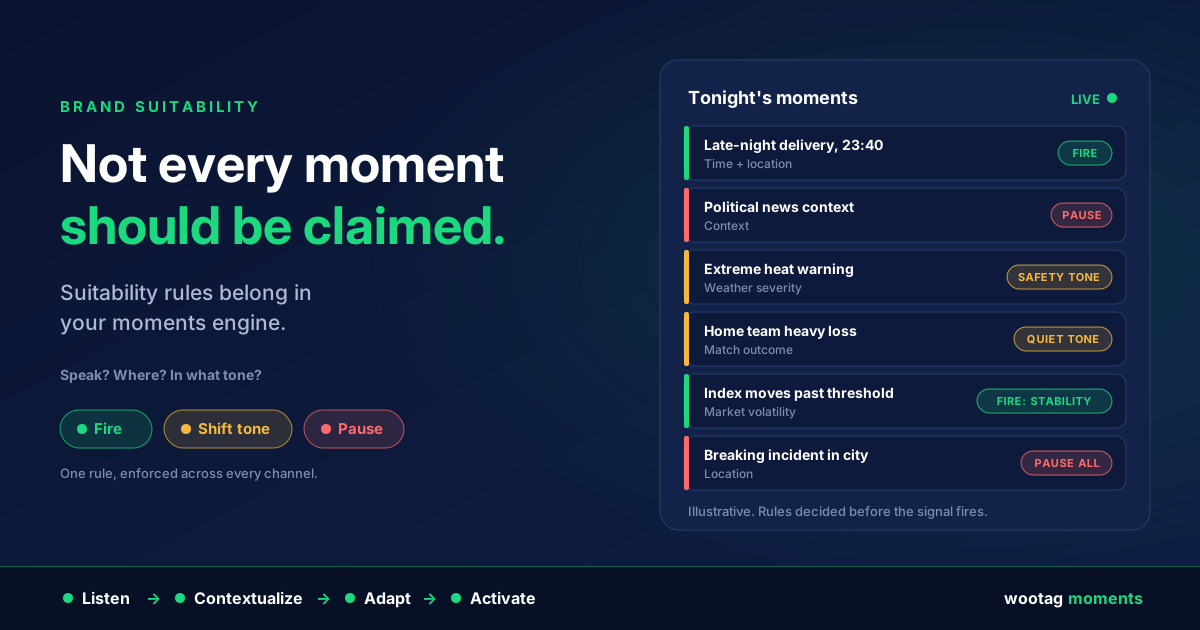

The fastest way to lose trust with a moment is to show up in the wrong one. Deciding when not to speak is part of the job.
In short
- Switching everything off during sensitive moments protects your brand, but it also gives up attention you didn’t need to lose. Suitability should be written into the rules that decide whether a moment fires.
- Every rule answers three questions: should we speak, where, and in what tone. The outcome is to fire, shift tone, or pause.
- Decide your quiet moments before the signal fires, not after.
Tonight is election night in the United States. Tens of millions of people will be on their phones, watching streaming coverage, checking news apps every few minutes and, as it gets late, ordering food.
For most brands, that’s a lot of attention. Most marketing teams will respond to it the same way: switch everything off and wait for it to pass.
It’s an understandable call, and sometimes the right one. But it’s a blunt one. It treats a whole night as off limits because part of it is risky. And it only works for events you can see coming. A storm that turns deadly, a tragedy at a stadium or a market crash at 2pm don’t come with a calendar invite.
That’s why suitability shouldn’t be a switch someone remembers to flip. It belongs inside the rules that decide whether a moment fires at all.
Getting it wrong costs more than a bad CTR
Placement still matters to the people seeing your ads. Research from Integral Ad Science found that 75% of US consumers feel less favourable toward brands that advertise on sites spreading misinformation, and 51% said they were likely to stop using a brand whose ad appeared near inappropriate content.
But blocking everything has a cost too. Research by Stagwell’s HarrisX in the UK pointed to outdated keyword blocklists stopping ads from running on perfectly safe content: football stories were blocked for using the word “attack”, and articles were blocked for mentioning “Paris” because of lists dating back to 2015. The same research found purchase intent next to high-quality hard news stories was close to the levels seen next to lighter content.
So there are two ways to fail. You can appear somewhere you shouldn’t, or you can disappear from places where your audience is paying attention and would have welcomed you. Most brands only manage the first risk, and they do it by accepting the second.
Why suitability usually sits in the wrong place
It lives in the media layer, not the message layer. Verification tools decide which pages or videos an ad can appear on. They don’t decide what the ad should say given what’s happening in the world.
Keyword lists are blunt. They can’t tell a football “attack” from a real one, or a story about a city from a story about an incident in it.
Moments move faster than people. When a rule fires in under a second, there’s no time for someone to check the news first. The judgement has to be written into the rule beforehand.
The bigger risk is often tone, not placement. A cheerful offer in a safe placement can still land badly. A “beat the heat” discount during a heatwave that is causing real harm is a perfect placement with the wrong message.
Three questions every suitability rule answers
A good moments engine doesn’t just ask “did the signal fire?” Before anything goes live, it should also answer:
- Should we speak at all? Some moments are better left alone, and the right outcome is a pause.
- Where? The moment might suit some contexts and some cities, but not others.
- In what tone? The same signal can call for celebration, empathy, reassurance or just useful information.
Answer those three in advance and speed stops being a risk.
What suitability rules look like in practice
Context exclusions. Pause the activation next to political content, contested news and coverage of tragedies, while leaving it running in sport, entertainment and everyday contexts. This is a rule set once, not a decision someone has to make every night.
Severity thresholds. Weather and air quality signals have levels. A warm day can carry a playful message. An official extreme heat warning should move to safety and practical help, or pause offers entirely. In our post on haze and AQI across Southeast Asia, the same logic applied: empathy and safety first, product second.
Tone shifts by outcome. A home team’s win calls for celebration. A heavy loss, or a match marred by an injury or an incident, calls for a quieter message or none. The rule decides which, not whoever happens to be online.
Kill switches for breaking events. If something serious happens in a city, every active moment there should be able to pause in one step, across every channel, until a person decides otherwise.
Silence as a designed outcome. Franklin Templeton’s index-based activation paused automatically when the market move was too small to matter, saving 24% of budget with no wasted impressions. Suitability rules use the same mechanism to protect reputation instead of budget.
Pre-approved variants. Brand and legal teams sign off the celebration, empathy, neutral and safety versions before anything goes live. Speed comes from preparation, not from skipping approval.
Election night, done carefully
So what can a brand actually do tonight without getting near politics? Quite a lot, as long as the creative never references the election, candidates, parties or results.
- Late-night food delivery. Results nights run late. A rule tied to time, location and delivery capacity can push late-night bundles without mentioning why people are still awake.
- Streaming and news apps. Viewing and app opens spike. Brands can show up in sport, entertainment and lifestyle content on those platforms, with political and news contexts excluded.
- The morning after. Markets can move after any major event. A financial brand can use a volatility rule to serve a calm, stay-the-course message if the index moves past a threshold, and say nothing if it doesn’t. The trigger is the market move, never the election.
- Everything else carries on. Weather, commute and local stock moments don’t need to stop just because the news is busy. They just need to stay out of political contexts.
We’d suggest one simple test for any election night activation: if the creative would make sense on any other Tuesday night, it’s probably fine. If it only makes sense because of the election, it doesn’t belong in a brand’s feed.
Rules once, enforced everywhere
Suitability can’t depend on each channel team remembering the same instruction. A rule written once in the moments engine should apply to Meta, TikTok, CTV, programmatic, push and retail screens at the same time.
Your verification tools, brand safety partners and platform controls stay exactly where they are. The moments layer adds the part they don’t cover: deciding whether to speak, where, and in what tone, given what just happened in the world.
Where suitability rules matter most
| Moment | The risk | The rule | What fires instead |
|---|---|---|---|
| Election night | Appearing partisan or next to political content | Exclude political and news contexts; no election references in creative | Late-night delivery, entertainment and lifestyle moments |
| Extreme heat or storm warnings | A promotional tone during real harm | Severity threshold switches from offer to safety | Practical help, stock availability, or pause |
| Poor air quality or haze | Selling into a health concern | Empathy and safety first at high AQI levels | Health and safety tips, relevant products without discounts |
| Home team heavy loss | Celebratory creative at the wrong time | Outcome-based tone switch | Support message, or no message |
| Incident at a sporting event | Any branded message at all | Kill switch for the event and city | Pause across every channel |
| Market crash | Growth messaging into fear | Volatility rule moves to stability tone | Reassurance message, or pause |
| Breaking tragedy in a city | Appearing tone-deaf locally | Location-based pause on all moments | Pause until a person reviews it |
Sources and transparency
Wootag platform claims (self-reported): The Franklin Templeton results (24% budget saved, zero wasted impressions) are self-reported on wootag.com/moments/case-studies. Election results are listed among the signal categories on wootag.com/moments. The suitability rules described above are recommended practice for configuring moments, and the election night examples are illustrative.
Third-party research: The 75% and 51% figures are from Integral Ad Science’s consumer research on brand safety, published in 2024. The keyword blocklist examples and hard news purchase intent findings are from Stagwell’s HarrisX research in the UK, as reported by Marketing Beat in September 2024.
This post doesn’t take a position on any election, candidate or party.
Decide your quiet moments before you need them
The moments you choose not to claim say as much about your brand as the ones you do. The time to decide is before the signal fires, not after.
Tell us the moments you’re planning and the ones that worry you, and we’ll show you a live moment built on your brand in 20 minutes, with suitability rules included.
Not Every Moment Should Be Claimed: Why Suitability Rules Belong in Your Moments Engine
