

Tennis fans are more valuable than ever this year, and fewer than 35 brands hold the exclusive right to reach them on site
The 2026 US Open is the longest in the tournament’s history: a 22 day draw running from August 23 to September 13, with more competition days than any edition in the event’s nearly 150 year run. It is also, by most measures, the most commercially valuable. New York has been confirmed as the strongest tennis fandom market in the country, with viewership, betting, attendance and social engagement all peaking in the same three week window, and the USTA has nearly doubled its content creator credential program for 2026 to meet a fan base that over indexes heavily on celebrity interest and influencer receptiveness.
None of that opportunity is evenly distributed. The US Open’s on site partner roster sits in the low thirties, a mix of category exclusive deals across finance, spirits, airlines, timepieces and personal care that have in some cases run for decades. If your organization is not one of them, the tournament can look like a closed door. If your organization is one of them, the fee only buys you a seat at the table, not a guarantee that anyone notices you sitting there.
This piece looks at what the 2026 trends actually show, and how both groups, the official partners and the brands operating outside the sponsorship perimeter, can use the same underlying idea to reach tennis followers: treat the tournament as a stream of real time signals, not a single two week media buy.
What the 2026 US Open trends are actually telling marketers
A few patterns are showing up clearly this year, and they point in the same direction.
Sponsors are trading logo visibility for participation. Coverage of this year’s activations has been consistent on one point: brands at Flushing Meadows are moving away from static signage and toward experiences fans can step into, film and share. Grey Goose’s off site pop up at Grand Central, IHG’s late night coach service for fans leaving marquee night matches, and Wilson’s retail linked tribute space are all built around the same insight, that a sponsorship fee only pays off if the fan does something with it in the moment.
Non-sponsors are finding their way into the tournament’s culture without paying for a stadium credential. Lacoste is a useful example. The brand is closely tied to tennis in the public imagination but does not hold an official US Open partnership. Its answer this year was a season long collaboration with a Manhattan hotel, built entirely around the tournament’s dates and the city’s tennis mood rather than anything happening on court. That is a brand capturing tennis attention on its own terms, adjacent to the event rather than inside it.
The audience watching is not the audience on site. Attendance set a new record last year at over 1.1 million fans through the gates, but the far larger audience is scattered across broadcast, streaming apps, social platforms and second screens during every match. A brand’s on site activation, however well built, only reaches the people standing in front of it.
Fashion and culture are pulling in tennis viewers who never watch a full match. The current “tenniscore” moment in apparel, visible in this year’s heritage inspired collections from official outfitters and in tennis adjacent collaborations from brands with no tournament rights at all, shows that tennis relevance now extends well past the scoreboard.
Put together, these trends describe a widening gap between two things: the fixed cost of being associated with the US Open, and the moving target of actually being relevant to the people following it. Closing that gap is not a sponsorship budget question. It is a signal problem.
The channel independent layer underneath both strategies
Whether an organization holds a partner slot or not, the same structural issue applies. A brand’s audience during the tournament is not sitting in one place. Some are watching the night session live on a streaming app. Some are getting score alerts pushed to a phone during the workday. Some are scrolling a highlights clip on social an hour after the match ended. Some are walking past a retail screen with no idea a match point was just saved three miles away.
A response built for only one of those channels will always miss the others. That is why the layer that listens for a meaningful moment and decides how to respond to it needs to sit underneath every channel a brand uses, rather than living inside just one of them. This is the idea behind Wootag Moments’ four stage framework:
- Listen: continuously track live signals, whether that is a match state, a weather shift over the tournament grounds, or a cultural trend spiking in search and social.
- Contextualize: map each signal to the right message, offer or creative variant, so a match point celebration and a rain delay never get treated the same way.
- Adapt: reshape a single creative source automatically for whichever channel it is about to appear in, from a CTV spot to a shoppable social overlay.
- Activate: push the response live across every channel simultaneously, in well under a second, so no channel is still showing yesterday’s message during today’s moment.
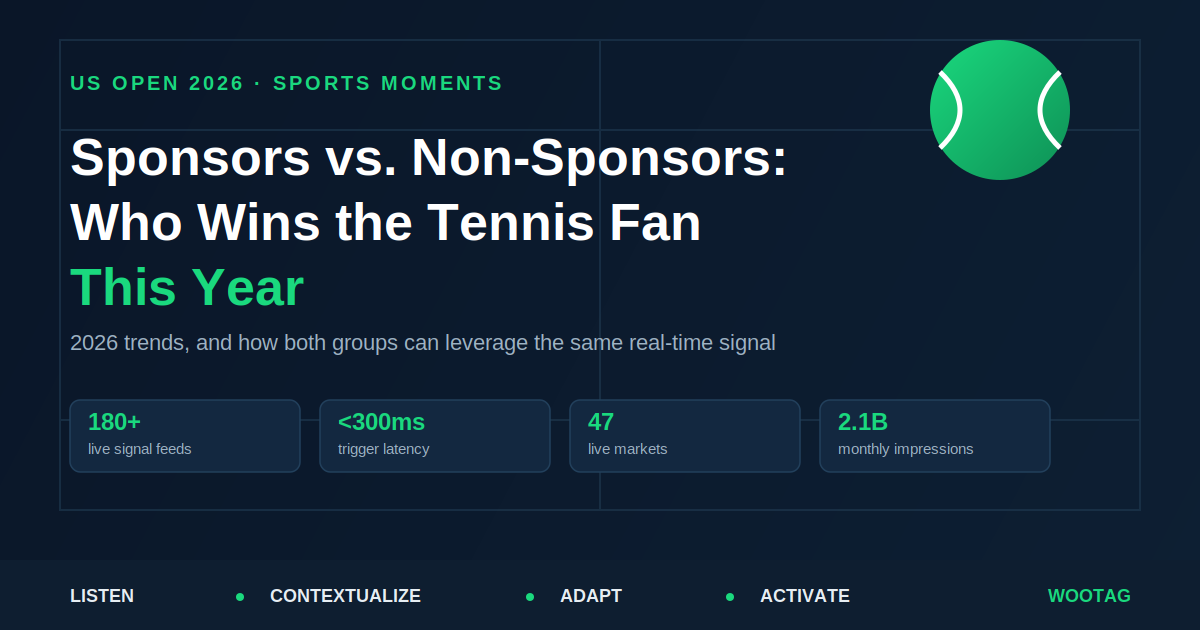
Wootag Moments runs this framework on top of 180-plus live signal feeds across 47 markets, with trigger to activation latency under 300 milliseconds. It sits beneath a brand’s existing CDP, CRM or automation stack rather than replacing it, which matters here specifically because sponsors and non-sponsors are not choosing between two different tools. They are choosing how to point the same infrastructure at two different starting positions.
How official sponsors can get more out of a fee they’ve already paid
For a brand that already holds a partner slot, the leverage point is turning a fixed, tournament length commitment into something that compounds every day of the draw instead of staying flat for three weeks.
| What the sponsorship already buys | What a signal-responsive layer adds on top |
|---|---|
| Category exclusivity and on site presence | Real time creative tied to specific match, weather or crowd moments, not just tournament length |
| A single locked media plan and creative set | Adaptive messaging that changes with the draw, without re-briefing a media team mid tournament |
| On site experiential for the fans physically present | An equivalent live experience for the much larger remote audience, on the channel they’re actually using |
| A fixed cost regardless of how the tournament unfolds | Measurement tied to individual moments, so spend can be weighted toward what is actually driving attention |
In practice this can look like a personal care sponsor’s messaging adapting automatically on a heat advisory day, a financial sponsor’s creative shifting tone around a marquee upset versus a routine early round win, or a hospitality sponsor triggering a location based offer the moment a late match runs long and fans are figuring out how to get home. None of this requires a new sponsorship line item. It requires the existing investment to respond to what is actually happening, rather than running the same asset on a loop regardless of the scoreline.
How non-sponsor brands can reach the same audience without a partner slot
For organizations outside the roster of official partners, the opportunity is different but built on the identical idea. A non-sponsor cannot put a name on center court, but it can still be relevant in the exact moments a tennis following audience is paying attention, on channels that have nothing to do with stadium signage.
- Weather and location signals. New York in late August and early September regularly produces heat advisory days. A brand with no tournament rights at all, in beverage, personal care or retail, can trigger hyperlocal, weather aware messaging that has nothing to do with the match itself and everything to do with the conditions fans are actually experiencing.
- Cultural and search trend signals. The current surge in tennis inspired fashion is being driven as much by adjacent, non sponsor collaborations as by official outfitters. A brand that tracks that trend signal in real time can move on it while it is peaking, rather than briefing a campaign after the moment has already cooled.
- Second screen and social attention windows. The audience checking scores on a phone during a workday, or watching a highlights clip an hour after the match, is enormous and channel agnostic. A brand can meet that audience with programmatic and social creative timed to genuine spikes in attention, without ever needing a credential.
- Adjacent, non-competing local partnerships. Lacoste’s hotel collaboration shows the model: pair with a venue, event or cultural moment that already has tennis relevance, and let the signal, not a sponsorship contract, do the targeting.
The common thread is that none of these plays require exclusivity. They require the same listen, contextualize, adapt, activate loop, pointed at signals that sit outside the tournament’s official inventory entirely.
A proof point from outside tennis, used honestly
Wootag has not yet run a published tennis case study, so rather than invent one, it is worth pointing to what the same signal triggered architecture has already done in a different sport. In Wootag’s own published case studies, Valvoline used live FIFA match events, goals, halftime, penalties and team wins, to trigger a different Connected TV creative for each moment type, and Budweiser’s non-alcoholic beer brand did the same across programmatic display during the FIFA World Cup. Both are self-reported results from Wootag’s case study page rather than independently audited figures, and both are football examples rather than tennis ones. What they demonstrate is the underlying mechanism, live match signals triggering channel specific creative in real time, which is exactly the mechanism this piece is describing for a tennis audience, whether the brand pointing it at that audience holds a US Open partnership or not.
Sourcing note
Tournament dates, attendance figures, sponsorship trends and named brand activations referenced above (Grey Goose, IHG, Wilson, Lacoste, Ralph Lauren and related 2026 US Open coverage) come from public reporting via Nielsen, ESPN, Forbes, EventMarketer and Avenue Z, as cited inline. Wootag platform specifications, 180-plus signal feeds, 47 live markets and sub-300ms trigger latency, are Wootag’s own published product figures from wootag.com/moments and wootag.com/sports, presented as company specifications rather than independently verified benchmarks. The Valvoline and Budweiser figures cited above come from Wootag’s own published case studies at wootag.com/moments/case-studies and are self-reported campaign results, not independently audited, and both are football activations referenced here only as evidence of the underlying signal-triggered architecture, not as tennis specific results.
Turn tennis attention into a brand moment, sponsor slot or not
The 2026 US Open is producing more competition days, more attention and more culture than any edition before it. A partner slot buys the right to be associated with that. It does not, by itself, buy relevance in any single moment of it. And for the brands without a slot at all, the same tournament is still fully reachable, through the weather, the culture and the attention it generates well beyond the stadium gates.
Book a demo to see how Wootag Moments can turn tennis season, or any live signal your audience is following, into a real time activation your brand doesn’t need a stadium credential to run.
